“To Avoid Undue Public Anxiety”
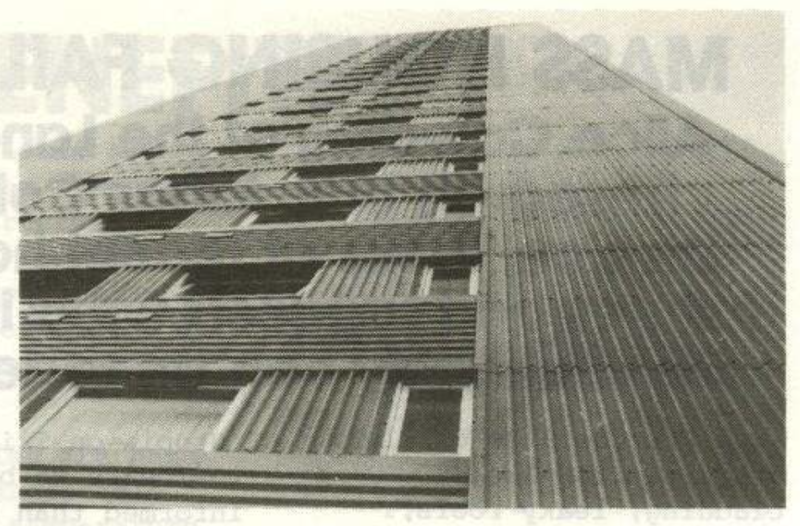
In January 1968, Hurricane Low Q tracked south through Scotland's central belt. Six floors of concrete wall panels were sucked off a tower block in Glasgow.
The tower was a large panel system block – the same type of construction as Ronan Point. Hugh Griffiths QC, chairman of the Ronan Point inquiry, knew about the risk posed by high winds.1 But, as he privately noted, “we have deliberately not referred to it in the [inquiry] report to avoid undue public anxiety”. 2
In January 1969, the engineering firm W.A. Fairhurst & Partners prepared a confidential report for Glasgow Corporation assessing the capacity of four large panel system estates to withstand high winds.
The findings were shocking. One block, Maryhill B, was found to be exceeding normal permissible limits on wind loading by 49%.The status of Royston B, at 25 storeys, was even more critical. Wind loading aside, the block was 67% above permissible stresses for dead load, meaning the building’s ability to bear its own permanent, structural weight, and live load, meaning the weights of the residents who lived there and all their belongings.
The report concluded: “A storm of abnormal severity could cause cracking of structural walls and might alarm the occupants.” 3
Might alarm them.
The engineers could not recommend any method of strengthening. The blocks, the report concluded, could not be made safe against the kind of winds they would face in their lifetime.4
The report was shelved, unpublished, in the 1960s.
In the 1980s, the Roystonhill Tenants Association went digging for answers. Tenant Eileen McCloy worked from a room in the local Social Services office. The Association organised a national conference for concerned tenants living in large panel system blocks, and met with the Building Research Establishment to discuss defects.
Too often, however, the activities of tenants associations and the National Tower Blocks Network were happening in parallel with the official world of architects, construction firms and policymakers. When Eileen McCloy attended the International Housing Conference, senior Glasgow housing officers physically removed her from a workshop, leaving other delegates shocked and mystified.5 Tenants who asked too many questions were not welcome.
By 1986, the Roystonhill blocks had been overclad with pressed metal panels backed with polyurethane foam. An architect who visited was horrified. The humidity inside the overclad flats was the worst he had ever encountered. Children growing up in the blocks suffered more respiratory illnesses than their peers. And, he wrote, there would be no way that the fire brigade could fight a fire in an unstopped void between cladding and walls that spanned 25 storeys.
Two 13-storey blocks in the city still had piped gas connected, against regulations.7 Glasgow was not alone: in Sheffield, three Reema large panel system blocks had never had their gas removed – it was still being used for cooking and heating until the council finally cut it off in 1986, handing tenants fan heaters and Baby Belling cookers while they worked out what to do.7
The blocks stayed up – for decades more.
- Eileen McCloy, ‘Fears over Safety in Glasgow Reema Blocks’, undated (WESA_8_1_02/03): REEMA large-panel blocks; Glasgow District Council confirming they fail the 2.5 psi minimum; Hugh Griffiths.
- Hugh Griffiths, Letter to Minister for Housing, 14 October 1968: National Archives, AT 54/54.
- Sam Webb Letter to Baillie McClaw, 4 November 1986 (WESA_8_1_04): Fairhurst & Partners investigation; Maryhill B 49%, Royston B 67%, Springburn A&B cracking; verbatim quotation.
- McCloy, ‘Fears over Safety in Glasgow Reema Blocks’, undated (WESA_8_1_02): Fairhurst recommendations
- McCloy, ‘Fears over Safety in Glasgow Reema Blocks’, undated (WESA_8_1_02/03): Eileen McCloy and the Roystonhill Tenants Association; National Tower Blocks Directory 1987 (TBUK2_009, pp.21, 58): Roystonhill Tenants Association entry; Eileen McCloy removed from the International Housing Conference workshop.
- Webb, Letter to Baillie McClaw, 4 November 1986 (WESA_8_1_05/06): the polyurethane overcladding fire risk; two Cambuslang blocks still piped for gas.
- ‘‘The Building Research Establishment Reports on Ronan Point’, The View, Summer 1985 (TBUK12_10): three Reema blocks in Sheffield had not had gas removed after 1968; gas finally disconnected 1986; tenants given fan heaters and Baby Belling cookers; the Tenants Association pressing the council over higher bills.
Related Archive Documents
Action Packs
Want to start a community campaign? Here’s a guide to forming or joining a residents’ association.
Successful campaigns need a strategy. Here's a toolkit.
Drumming up support in your community? Here’s a pack of editable resources, including flyer and poster templates.
Need more information about tower block safety in Scotland? Here’s an accessible explainer of the relevant laws in Scotland.