“Strength in Numbers”
Northam Estate was a post-war project built on the bombed dockside slums of Southampton. The mixed population had a tree-shadowed view of the wharfs and could hear the sounds of the port.
Eight hundred homes. Residents were Caribbean, Asian, white European, Vietnamese, Maltese and British.¹
In the heart of the estate was a community centre run by volunteers. It ran a range of activities and almost all of them were attended exclusively by white people. Racist remarks were being made by people using the centre. At the same time the tenants’ association began receiving complaints about the racist activity of a family in the tower block.²
Tenants kept logbooks to record incidents of racism and petitioned about known racists. It was felt that a lot more positive work needed to be done.³
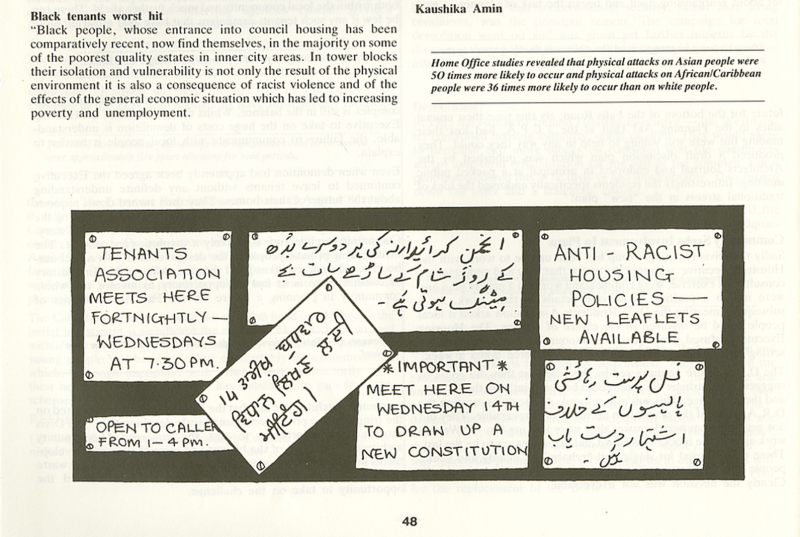
Northam was not unusual. Kaushika Amin of the Runnymede Trust had set the problem out for the Network: black tenants in tower blocks faced the same dampness, heating costs, condensation and broken lifts as their white neighbours, but their isolation was not only the physical structure of the building. It was also a consequence of racial violence. And many tenants’ associations, she wrote, “have become the bastions of ‘white’ interests by actively ignoring issues important to black tenants and, in certain cases, protecting those involved in perpetrating racial violence.”⁴ A tenant from Stepney put it more plainly: “Four of us got elected to the Tenants Association but we gradually gave up . . . because every month as soon as we go in all the tenants reps immediately start abusing us. I mean they see us as the problem, not as fellow tenants.”⁵ On the Cherry Orchard estate in Charlton, women who had organised against attacks on their families wanted lighting and working lifts — not only to get the shopping and the pram upstairs, but to be safe on the way.⁶
So Northam Tenants and Residents Association, the local benefits advice team, the community group and the council’s tenants’ participation officer formed a group to look at the situation. They asked themselves: what can we do? Are we portraying the right image? Do we encourage everyone? Can we achieve anything?⁷
At the second meeting they went looking for training courses and support from other agencies. Three months later a ten-week training programme was running, put on by the local community work training group and attended by a range of people from the estate. The Tenants’ Participation Advisory Service drew up a training plan for the group to assess. The Southampton tenants’ federation began developing a comprehensive training package for every tenant in the city.⁸
The Network thought what Northam had done could be developed on tower-block estates anywhere, and sold the means to do it out of its Sheffield office: a pack called Anti-Racist Tenants Rule OK, whose every page signed off, “Remember a good T.A. is Anti racist: show them this pack.”⁹
- ‘Challenging Racism’, National Tower Blocks Directory, 1992 (TBUK226, p.142): 800 homes; residents “Caribbean, Asian, white European, Vietnamese, Maltese and British”.
- ‘Challenging Racism’, 1992 (TBUK2226, p.142): the volunteer-run centre; activities “almost all … attended exclusively by white people”; racist remarks by people using it; complaints about “the racist activity of a family in the tower block”.
- ‘Challenging Racism’, 1992 (TBUK2226, p.142): logbooks and petitions; “a lot more positive work needed to be done”.
- Kaushika Amin, ‘Tackling Racism’, National Tower Blocks Directory, 1987 (TBUK2070, pp.48-51): quoted verbatim.
- Amin, ‘Tackling Racism’ (TBUK2070, pp.48-51): tenant speaking at the Limehouse Fields Tenants Association anti-racist workshops, Stepney, 1986; quoted verbatim.
- 6 Amin, ‘Tackling Racism’ (TBUK2070, pp.48-51): Cherry Orchard Black Tenants Action Group, Charlton, Greenwich, formed by women on the estate; lighting and lifts “not only to get the shopping and the pram upstairs but also to promote their safety in the face of racist violence”.
- ‘Challenging Racism’, 1992 (TBUK2226, p.142): the joint group; the four questions verbatim.
- ‘Challenging Racism’, 1992 (TBUK2226, p.142): the ten-week programme; TPAS training plan; the federation’s citywide package.
- ‘Challenging Racism’, 1992 (TBUK2226, p.142): “could be similarly developed on tower-block estates elsewhere”; the pack sold from the Network’s Sheffield office. Originally produced by the Housing and Race Action Group, Newham, as ‘Anti Racist Tenants Association Rule O.K!’: ‘Tackling Racism’, 1987 (TBUK2070, pp.48-51).
Related Archive Documents
Action Packs
Want to check if gas is safe in your block? Here’s a digest of the relevant laws and actions you can take.
Are you a tenant facing an emergency move from your block because of building safety issues? Here’s a guide to help you secure clarity about the future.