“Groundhog Day”
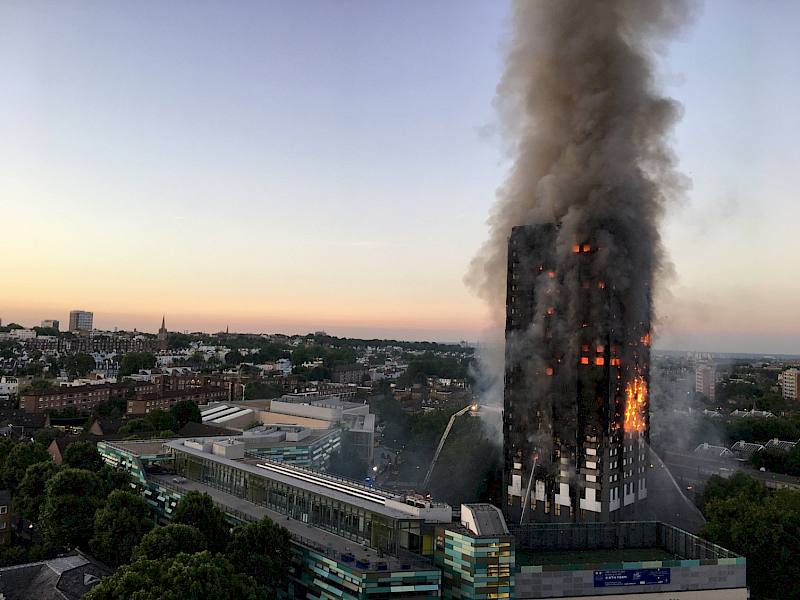
“The phone call you've expected for most of your life can still take you by surprise. Especially at half past four in the morning.” Sam Webb was woken by Ronnie King, a retired Chief Fire Officer. “Get up, switch on the TV. There's a tower block on fire in west London. The entire building — every floor.” 1
Content Warning
This story details a fatal building disaster and includes potentially distressing material.Webb and King had worked together as expert witnesses for families affected by the Lakanal House fire in 2009, when six people died in a tower block in Southwark. They had predicted a fire like Grenfell then. It still shocked them.
Webb turned on the television. News channels were showing live, unedited footage from the scene. He could see people standing at the windows, silhouetted against the fire. He could hear them screaming and the voices calling up to them from the street. And he knew, watching, that they were not going to get out of the building.²
“Sitting on my mother’s lap aged three, in front of an open window in September 1940 is among my earliest memories,” Webb later wrote, “we watched a sight not seen since London burned in the Great Fire, as the Luftwaffe bombed London and the sky glowed red.”³ Grenfell reminded him of those nights. But this was an entirely preventable, entirely predictable fire. It changed everything.
Immediately after the Lakanal House fire, Webb said the building’s failure was either a breach of the regulations or proof that the regulations themselves were rotten. He had been right, and nothing had changed since. Eight years on, the same failure was there, burning in front of him. Warning after warning had gone unheeded. Webb had sat in meetings where ministers admitted they did not understand the fire safety regulations and leaned on their advisors; he had watched one storm out and resign from the group rather than hear that sprinklers were needed.⁴
The cladding warning was older still. In 1991, a fire had raced up the outside of Knowsley Heights in Merseyside, the empty void behind its new cladding drawing the flames like a chimney. Nobody died, but the fire brigade called it a national scandal. Then the warning was filed away and forgotten – twenty-six years before the same chimney effect consumed Grenfell.⁵
There was a reason the advice kept failing. The body that tested whether cladding was safe, the Building Research Establishment, had once been a government laboratory. In 1997, however, it had been privatised. From then on, it earned its money from the very manufacturers whose products it tested.⁶ “We are a private sector organisation; we are not part of government,” one of its officials explained. There were now “commercial pressures that require clients to place formal contracts with us before we can undertake work”.⁷
The Grenfell Inquiry would later find the BRE’s testing “marred by unprofessional conduct” and open to manipulation by manufacturers. In 2001, it had tested the very type of panel later used on Grenfell and watched it fail.⁸ For Webb, the rot ran all the way to the rulebook itself: Approved Document B, the government’s official guidance on fire safety in buildings. “Do we really need any greater proof that Approved Document B is totally unfit for purpose,” he asked, “than the sight of Grenfell Tower on fire from top to bottom on world television screens?” Webb called for what Matthew Hale and Christopher Wren had done after the Great Fire of London: a complete root and branch overhaul of building regulations. “It doesn’t have to be like this.”⁹
- Sam Webb, ‘The Atrocity of Grenfell Tower’, 1 July 2017 (WESA_9_4_02).
- Sam Webb, Audio Interview with Hannan Majid (2019).
- Webb, ‘The Atrocity of Grenfell Tower’ (WESA_9_4_02).
- Webb, ‘The Atrocity of Grenfell Tower’ (WESA_9_4_02): the All-Party Parliamentary Fire and Rescue Group meetings; ministers’ reliance on advisors; warnings over sprinklers.
- ‘Showpiece Tower Block in Flames’, The View, Spring 1991 (TBUK2_002): the unstopped cavity behind the new overcladding acting as a chimney; over 100 tenants evacuated, three treated for smoke inhalation, no deaths. Phil McCann, ‘Fire that was an omen of Grenfell 26 years before’, BBC News, 5 September 2024: Les Skarratts of the Fire Brigades Union on taking the warning to the House of Commons and to select committees — “we’ve told everybody that’ll listen to us that this is a national scandal”; the Grenfell Tower Inquiry’s finding that the Knowsley Heights fire “laid the ground for the 2017 tragedy”.
- Grenfell Tower Inquiry, Phase 2 Report, 2024, Volume 2, Part 3, Chapter 29 ‘Failures in the system’, para 29.25, p.217: BRE, “having begun life as a government agency it was privatised in 1997”, thereafter engaged to advise the department under contracts for research, investigations, reports and experimental work.
- Select Committee on Environment, Transport and Regional Affairs, First Report, Potential Risk of Fire Spread in Buildings via External Cladding Systems, HC 109, Session 1999–2000, Minutes of Evidence, 20 July 1999: evidence of the Building Research Establishment Fire Research Station, quoted verbatim.
- Grenfell Tower Inquiry, Phase 2 Report, 2024, Volume 2, Part 3, Chapter 29 ‘Failures in the system’, para 29.27, p.217: “much of the work carried out by BRE was marred by unprofessional conduct, inadequate practices, a lack of effective oversight, poor reporting and a lack of scientific rigour”; para 29.37, p.220: BRE’s large-scale test of a system incorporating aluminium composite panels with polyethylene cores in 2001 under contract cc1924, after which it “failed to draw the department’s attention in clear terms, either in its report or informally, to the way in which the material had behaved and the dangers it presented, particularly if used on high-rise buildings”.
- Webb, ‘The Atrocity of Grenfell Tower’, 1 July 2017 (WESA_9_4_02).
Related Archive Documents
Action Packs
Worried about fire safety in your tower block? Ask your landlord about whether steps are being taken to deal with unsafe cladding using this letter template.
Check up on the progress of your block’s fire risk assessment.
Confused about ACM (aluminium composite) cladding? Here's an explainer.
Notify the Fire and Rescue service about any fire safety breaches you find.
Find out about some practical actions you can carry out to minimise risk.