“I Knew I Was Right”
Barry and Elaine Meekings were worried. Their flat at 26 Ronan Point had cracks up the walls. There were cockroaches, draughts, leaks, and disrepair in every room.
Barry and Elaine Meekings were worried. Their flat at 26 Ronan Point had cracks up the walls. There were cockroaches, draughts, leaks, and disrepair in every room.1
In 1983, they asked Sam Webb for help. Webb applied to the RIBA for a research grant to carry out a thorough investigation at Ronan Point. It was rejected. The RIBA said it was ‘not rigerous [sic] enough’.2 Regardless, he was determined to go. He decided to take a term off from his job teaching architecture at the Canterbury School of Art.
In 1984, he came to Newham to conduct a survey of the building, bringing along a team of his students to assist. They were joined by community worker Frances Clarke, a former tower block tenant and co-founder of the Newham Tower Block Tenants Campaign. A cadre of sympathetic councillors from Newham’s Housing Committee – Fred Jones, Jean Reeves, and Dick Shepherd – came along to observe.
They inspected fifty flats. Going from door to door, Webb’s team met with anxious residents. They wanted to ask questions, to really listen to the replies.3 Tenants reported alarming observation, subtle things only noticeable to people living in the flats day and night. When somebody cooked a meal in a neighbouring flat, they could smell the food. If there was a strong wind, the edges of their carpets lifted up. Their fish-tanks’ waterlines were lopsided.4
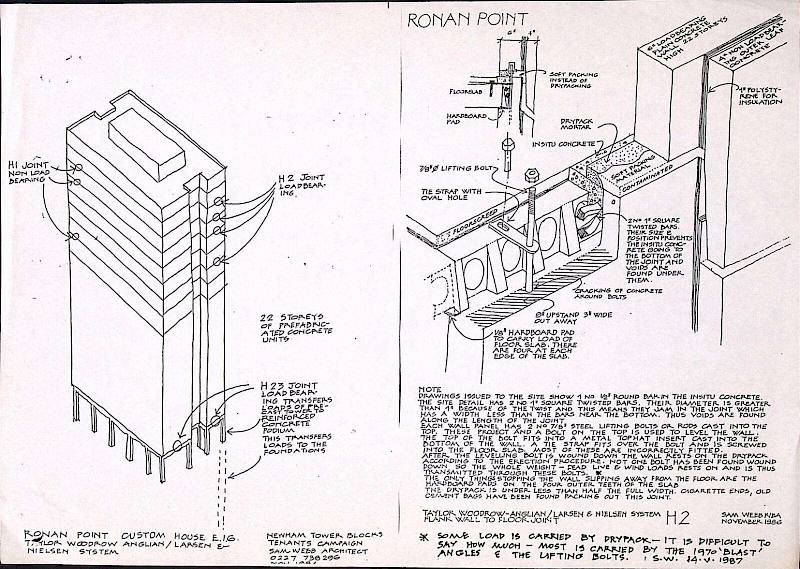
Looking closely at the corners and crevices of people’s living rooms, Webb and his team found structural gaps where panels were snapping and bowing. It looked like many of the panels had been poorly joined. All the evidence indicated a liability to wind damage and a lack of fire compartmentation. The tower was cracking up. Its constituent parts were shifting. As they fell asleep, tenants reported hearing “groaning and grinding and sharp cracking noises as the building moves”.5
Webb presented his damning findings to Newham Council.6 Councillors had observed his investigation with their own eyes. They agreed to evacuate Ronan Point for good. There were cheers from tenants watching in the chamber and crowded outside.7
At last, Webb’s long-held conviction had been vindicated. That evening, he wrote a letter to tell his mum what had happened. “I knew I was right,” he said. “My only sorrow is that Dad can’t see it – but I expect he can really.”8
Sam Webb was known as a “high-rise tenants champion”.9 Over the years, he offered his expertise to tenants’ groups nationwide. He also wanted to develop residents’ own expertise, using architectural education to empower people. He gave workshops training residents to spot building safety faults themselves. He drew out diagrams to clarify the constructional intricacies beneath their wallpaper. Students at Canterbury built him wooden models to demonstrate the faulty operation of joints in large panel system buildings.
Looking back on his time surveying Ronan Point, Webb reflected10:
That term was like a breath of fresh air because I wasn’t surrounded by architects. I had to talk to people and explain quite complex things in a way they could understand – not just tenants, TV interviewers and reporters.
Nevertheless, his efforts to expose the extent of the Ronan Point scandal put his own career on the line. He received rebuffs and personal attacks.
In 1988, four years after they rejected his grant application, Sam Webb was invited to give a lecture at RIBA. The room was packed. Over two hours, he laid out the evidence he had gathered across twenty years. Then Webb called out into the audience. He invited Sue McDowell – a leading member of the Newham Tower Block Tenants Campaign – up to speak. She turned around to the seated professionals and said11:
The one thing that’s different about Sam Webb is that when the tenants turned round and said, ‘Sam, we’re worried, we’ve got a problem, please come and have a look’ – Sam came. And he had a look. And he didn’t think, ‘Silly tenants, you don’t know what you’re talking about.’
Beyond Ronan Point, Webb performed surveys and wrote expert reports for many more tenants’ associations. They saved lives. Years later, they represent a valuable resource bank for us today.
- Barry James Meekings Testimony, 1983 (WESA_1_10_15).
- Letter from RIBA Research Awards Secretary to Sam Webb, 3 May 1984 (WESA:11:3; Barry Russell, ‘Letter: Deserving case in point’, Architects’ Journal, 179:25 (20 June 1984), p.34.
- Questionnaire, 1984 (WESA_3_1_02).
- Holly Smith, Up in the Air (2025), p.130.
- John McGhie, ‘Faulty Towers’, Time Out, 12 July 1984, p.8.
- Sam Webb, Interim Report on Ronan Point, 1984 (WESA_1_6_01).
- Press Release, 22 April 1984 (WESA_1_7_07).
- Sam Webb, Letter to Mother, 19 April 1984 (WESA_11_4).
- Gordon Petrie, ‘Fears over safety in high-rise buildings’, Glasgow Herald, 1 November 1986, p.3.
- Robert Booth, ‘Sam Webb obituary’, Guardian, 10 October 2022, p.6.
- Sam Webb, ‘People in High Places’, Lecture, 24 May 1988: RIBA Library, RIBA Audio Collection, W.
Related Archive Documents
The Lecture
Listen to Sam Webb's lecture to RIBA in 1988. You can also explore a selection of shorter extracts using the playlist below.
Content Note: This lecture includes potentially distressing material, detailing a fatal building disaster, the death of a child, and the suicide of April Merrin.
Credit: RIBA Collections. Sam Webb, ‘People in High Places’, Lecture, 24 May 1988: RIBA Library, RIBA Audio Collection, W.
- Friend’s description of April Merrin’s death.
- Description of Ronan Point collapse of 1968.
- Description of structural faults found during the forensic demolition of 1986.
- Explanation of structural faults in the Ronan Point system. Explanation of bolt placement.
- Injured survivor’s testimony from Ronan Point, summarised by Webb.
- Explanation of internal defects in the structure.
- Ronan Point dismantling party.
- On local authority housing and rent arrears.
- Sue McDowell’s testimony.
The Models
Explore Sam Webb's chipboard models in 3D. They were built by his students at Canterbury School of Architecture to illustrate the faulty operation of joints in large panel system buildings. Watching Webb assemble the wooden parts, high-rise residents could better understand how the panels of their block connected - and how weak these connections were. With a single touch, the models tumbled to pieces.
Action Packs
Think that your block might be built with a large panel system? Here’s a guide with next steps.
Want to carry out your own investigation? Here’s guidance about making a Freedom of Information request.