“The Questionnaire”
Ron Reilly, chairman of the Pellant Road Tenants Association, lived at 51 Hartopp Point, Pellant Road, Fulham.
Hartopp Point, and its sister block Lannoy Point, were large panel system constructions. Concrete panels stacked and bolted, built by Taylor Woodrow-Anglian, the same as Ronan Point.¹ In May 1984, as investigations into Ronan Point were exposing the empty joints and failing structure, Hammersmith and Fulham Council moved to reassure tenants in Hartopp and Lannoy. Remedial work was announced: steel angles bolted to the joints. This was the same fix that had been applied to Ronan Point after the partial collapse in 1968.² Get it done quickly. Draw a line.
Reilly had already put it to his councillors. One of them told him it would take a brave man to say demolish them.³
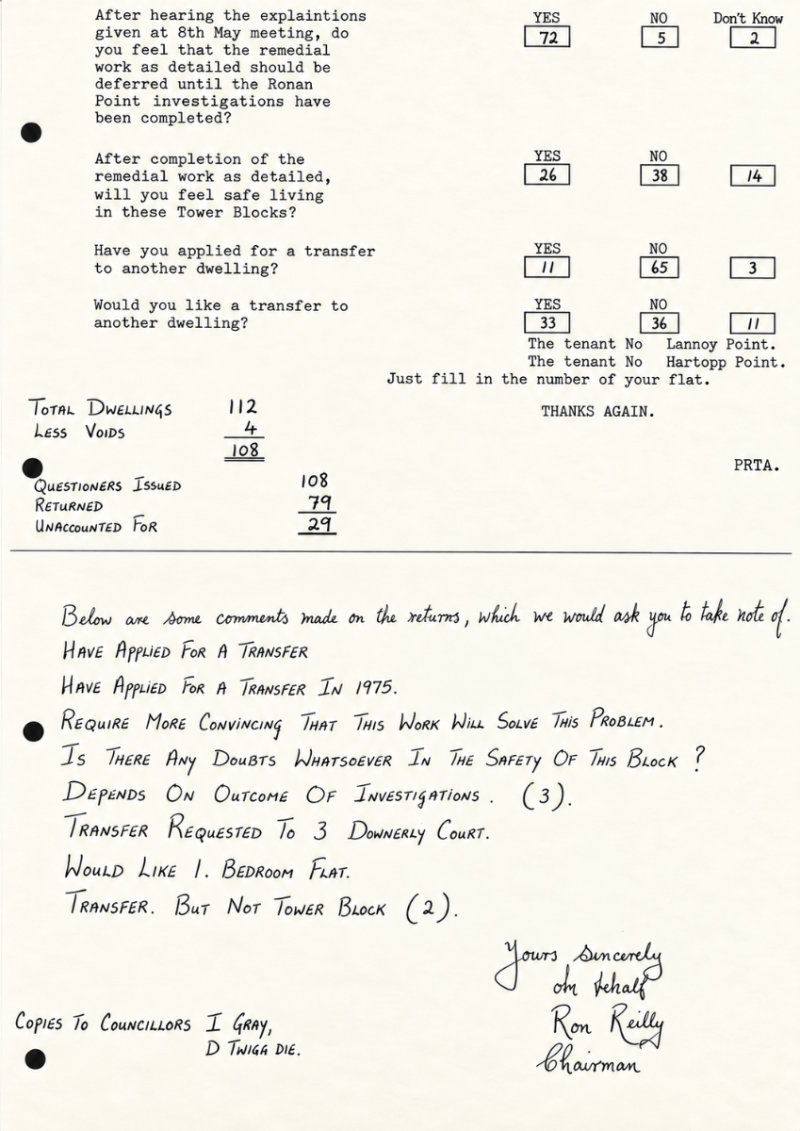
Reilly decided to ask his neighbours what they thought. He wrote a short questionnaire and sent one to every flat. 108 were issued. 79 were returned.
The first question asked tenants whether they thought the remedial work should be deferred until the Ronan Point investigations were complete – until they actually knew what was wrong?
72 respondents said yes; five said no.
These tenants could see the council’s preferred timeline did not make sense; they knew not to trust the fix until there were answers. Before long, the Ronan Point investigation would reveal that those steel angles were cosmetic, applied to buildings defective from the start, buildings reliant on joints packed with cigarette ends and cement bags.
Reilly’s second question asked whether, after the remedial work, they would feel safe?
Again, the overwhelming majority said no.
And then the question that cut the deepest. Would you like a transfer to another dwelling?
More than half didn’t want to leave.⁴ It wasn’t because they felt safe – they had just said they wouldn’t be. It was because this was home. This was old working-class Fulham, before the money came: the market stalls running the length of North End Road, the spit-and-sawdust pubs, the dolls’ hospital on Dawes Road where children took their broken toys, the small shops and yards where a whole life fitted into a few streets. Their children went to school here; their friends were on the same landings and in the next block. What they wanted was for their building to be made safe, not to be dispersed and separated from their friends and neighbours.
Reilly sent the results to housing management and to two councillors. He also sent a copy to the Architects’ Journal, along with a letter to the editor.
“May I, as a lay man living in a Taylor Woodrow Anglian Larsen Nielsen tower block, suggest some of the reasons for the lack of comment in your Profession. Many architects simply do not understand the various types of system buildings and are therefore not in a position to make professional comment; in many cases this is because of the lack, loss, or complete absence of drawings; the only way then to discover the method of construction is to dismantle. Or is it the profession are wary of opening what could be a can of worms?”⁵
1984 saw the Royal Institute of British Architects celebrating its 150th year. Ron Reilly’s letter ended with a warning: “It is doubtful that many of these system-built tower blocks will see your 160th anniversary celebrations.”⁶
Hartopp and Lannoy Points were eventually demolished – in 2021. Arup engineers found bolts missing or loose, and structural movement underway. The towers’ demolition came 53 years after they were built. Ron Reilly’s questionnaire survives in the archive: three sheets of paper, typed in haste, copied to two councillors. A precise record of what tenants knew, what they feared, and what they wanted. To be safe, in their own homes, in their own borough.
- Ron Reilly, Letter to the Architects’ Journal, 22 May 1984 (WESA_4_8_04): Hartopp and Lannoy Points as Taylor Woodrow-Anglian large panel system blocks, the same construction as Ronan Point.
- Ron Reilly, Letter to Miss Hodson, 22 May 1984 (WESA_4_8_03): Hammersmith and Fulham’s announced remedial work.
- Sam Webb, draft letter to Ron Reilly, 16 January 1984 (WESA_4_8_05, marked ‘not sent’): “I think you are quite right and the councillors either do not realise the full seriousness or if they do can’t come to terms with the implications. As one of them said to you ‘It would take a brave man to say demolish them!’” The councillor is unnamed. Webb is quoting back to Reilly a remark a Hammersmith and Fulham councillor had made to him. The letter Webb sent the same day (WESA_4_8_06) omits the passage.
- Pellant Road Tenants’ Association, Questionnaire Results, 1984 (WESA_4_8_02).
- Reilly, Letter to the Architects’ Journal, 22 May 1984 (WESA_4_8_03): quoted verbatim.
- Reilly, Letter to the Architects’ Journal, 22 May 1984 (WESA_4_8_03): the 150th-anniversary warning, verbatim.
Related Archive Documents
Action Packs
Want to start a community campaign? Here’s a guide to forming or joining a residents’ association.
If your landlord is failing to make repairs, here’s what you can do next.
Frustrated with poor repairs? Here’s a letter template for making a complaint.
Are you a tenant facing an emergency move from your block because of building safety issues? Here’s a guide to help you secure clarity about the future.