“Estates: An Intimate History”
“There is a wall inside your head. The wall is about not knowing what is out there or believing that what is out there is either entirely irrelevant to your life, or so complicated that it would go right over your head if you made an attempt to understand it.”
Lynsey Hanley grew up on the edge of Birmingham, in the largest council estate in Europe. In her book Estates: An Intimate History (2007), she wrote about facing the world beyond the Chelmsley Wood estate. The work tackles social housing from its post-war promise to its long withdrawal: the right to housing slowly shattered by the right to buy and dispossession. Her hunch? Class is built into the physical landscape of the country.1
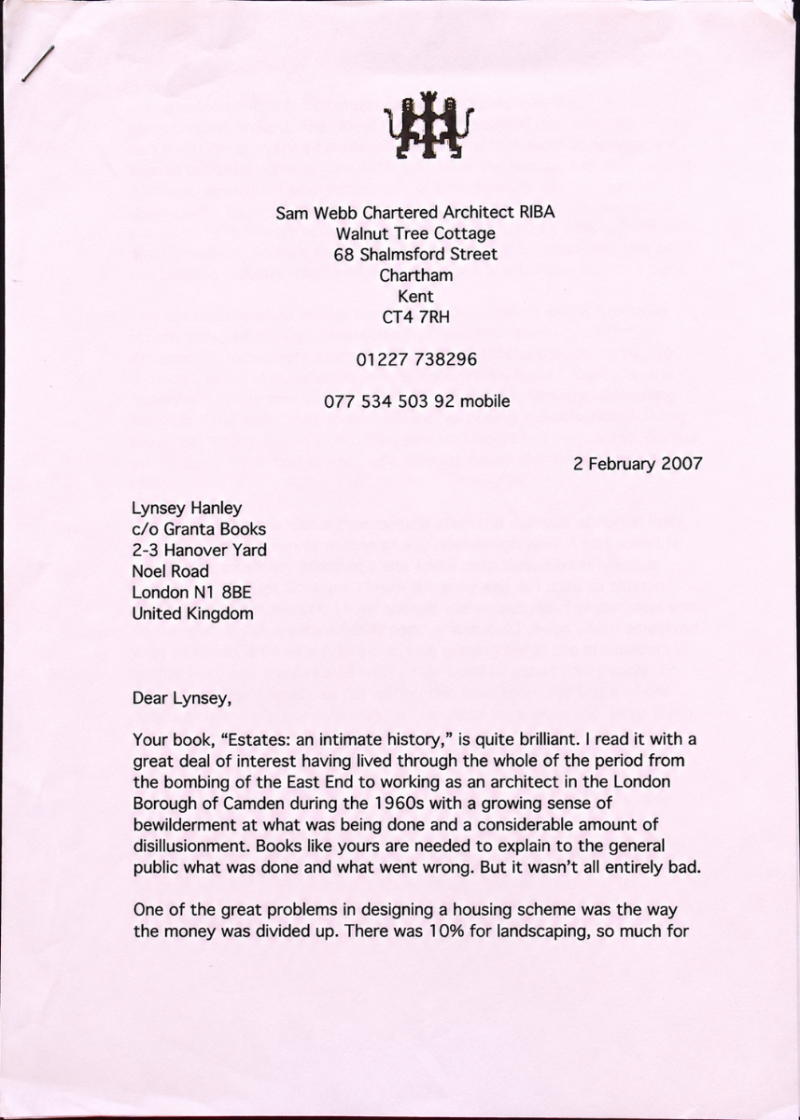
Soon after the book’s publication, a letter arrived from a cottage in Kent. “Your book is quite brilliant.” 2
The letter was from Sam Webb, the chartered architect who had spent four decades investigating the structural safety of system-built tower blocks – the man who had found newspapers and cigarette packets stuffed into the load-bearing joints of Ronan Point, who had commissioned the fire test that had to be stopped after twelve minutes. But what he wanted to tell Hanley was something different: what it had looked like from the drawing board, as a young architect in Camden in the 1960s.
In 1968, during the hiatus after the collapse of Ronan Point, Webb was asked to carry out a feasibility study of a site in Kentish Town – St Silas Street North. It was near Queen's Crescent Market, where he used to shop. The proposal was to demolish a neighbourhood which then housed around 900 people, as well as thirty shops and a thriving boys' club. Some of the shops were mini factories making artificial limbs, false teeth, Greek pastries for West End restaurants. It was a thriving, working neighbourhood – scruffy, but brimming with life. The plan: replace it with new-build housing for 650. Around 250 people, a quarter of the neighbourhood, would have no place in the new scheme.
Webb surveyed the area on the ground. He counted the doorbells and commissioned a huge aerial photo. His conclusion: the terraced houses should be refurbished and converted, extra mews housing built, and the whole area treated to new trees and landscaping. This plan was cheaper. This plan was obvious.
The Borough Architect looked at Webb’s study in exasperation. “This is no use to me. It's just a load of horse sense [common sense].[RG5] Go away and make the neighbourhood demolition feasible.” 3
Sam Webb refused. For months the job was shelved; no one else would touch it. Then Camden advertised the post at a grade above Webb's. An architect from outside, with no knowledge of the site or its history, was brought in to do what Webb would not. The scheme was built, and Webb left Camden soon after. He later read in the Observer that it had become one of the most problematic housing developments in the borough.
“Who was to blame? How do you allocate it? If you were to do today what I did then you would get the sack.” 4
Hanley wrote about the wall inside her head.
The architect spent his career running into one outside.
- Lynsey Hanley, Estates: An Intimate History (2007); Carolyn Steedman, ‘Wall in the Head’, London Review of Books, 38:15, 4 August 2016.
- Sam Webb, Letter to Lynsey Hanley, 2 February 2007 (WESA_11_1_03).
- Webb to Hanley, 2007 (WESA_11_1_03): the Camden ‘horse sense’ anecdote; St Silas Street North; construction economics.
- Webb to Hanley, 2007 (WESA_11_1_03): quoted verbatim.
Related Archive Documents
Action Packs
You can make your own voice heard: writing, photographing, recording, and sharing a story yourself. Here are some pointers for doing citizen journalism.