“The Eyes of the World Are Upon Us”
Two days after Ronan Point collapsed, officials climbed to flat 90 on the eighteenth floor, where Ivy Hodge had been knocked unconscious. They were there on behalf of Home Secretary James Callaghan to calculate the force of the explosion.
Their conclusion? 1.4 pounds per square inch.1 A modest force. The kind any properly-built structure should easily withstand.
Callaghan ordered that the report be kept secret.2
The public inquiry was announced the day after the disaster. It would be established by Sir Elwyn Jones QC, Attorney General and the local constituency MP. No stranger to high profile cases, Jones served as junior British Counsel at the Nuremberg Trials. At the inquiry's opening at Newham Town Hall, he promised the packed gallery a full and searching investigation, saying:3
The eyes of the world are upon us.
Some Canning Town residents were already doubting the official line. Could structural failure have caused the gas explosion, not the other way round? Nobody wanted that question asked. In later evidence, the gas board's own engineer, Bernard Clark, said: 'Even without gas, or any other source of explosion, the building is not safe. It is like Russian Roulette. It is not fit for human beings.' The man called to defend the gas supply condemned the building instead.
Disquiet rumbled in Whitehall about what could be uncovered4 the government's counsel expressed concern that the inquiry should not become 'a witch hunt.' H.J. Yallop, one of the blast effects experts who'd calculated the force of the explosion, was listed as a proposed witness to the inquiry. He was never called.
The two most senior government engineers had both said privately5 that they would not feel safe living in the end or corner rooms of a similarly constructed building, even if the gas were turned off. They were not called and their statements were not circulated, with a note in the Treasury Solicitor's file – headed IMPORTANT - confirming this was deliberate.
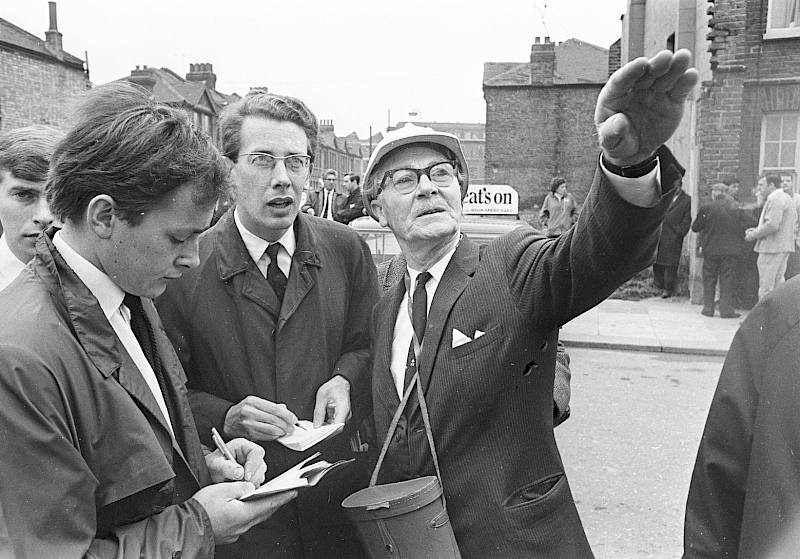
Even before the inquiry opened, the Treasury Solicitor's office summoned George Fairweather and instructed him not to testify. A Fellow of the Royal Institute of British Architects (F.R.I.B.A.), Fairweather was the author of the national fire safety code for tall buildings, and a Member of the Tribunal of Appeal under the London Building Acts — one of the people London turned to when builders and surveyors disputed what safe construction meant.
But Fairweather didn't take heed. He went to the inquiry anyway. When he started to speak, he was asked to stop.
6 I have taken the cudgels here! I have offered evidence to this Tribunal; they have accepted my offer, and I claim the rights to present my case, as anyone would in presenting his case in a court of law!"
The Chairman tried to manage him from the bench, but he was insistent. George Fairweather told the inquiry that Ronan Point was a blind risk – that the nature of the building was such that if any one wall failed, the chain collapse of the whole would follow. That this was not the nature of buildings Britain had built its sense of public safety and public security upon.
When he finished, you could have heard a pin drop.7 Afterwards, a QC phoned to tell him his clients had been instructed not to question him.
The tenants of Ronan Point were not collectively represented during the inquiry. Ivy Hodge was only granted legal representation after her brother complained that during police questioning, she had been subjected to “malicious and unfounded remarks” about her “mental health, moral behaviour, and her reasons for remaining single.”
By 14 October 1968, the Griffiths inquiry report was ready.8 It found that the collapse had been caused by the poor quality of the building rather than a gas explosion of exceptional force. The recommendations were light touch - strengthen Ronan Point and similar blocks and remove the gas. The report was held back until 6 November - The day of Nixon's election. A day when the news cycle would bury it.
- Webb timeline, 17 March 2019 (TBUK5007): officials’ post-collapse measurement at flat 90.
- Webb timeline (TBUK5007): Callaghan instructed the National Building Agency to prepare a secret report putting the force at 1.4 psi.
- Sir Elwyn Jones’s opening words, in Webb, ‘People in High Places’, 21 September 1994 (WESA_9_1_01).
- Webb’s handwritten notes of the pre-inquiry meeting, 10 June 1968 (WESA_12_1): counsel’s ‘witch hunt’ remark; Yallop listed as a proposed witness.
- Creasy and Thomas submissions, 17 July 1968, in Webb, ‘People in High Places’ (WESA_9_1_01); the decision not to call them recorded in the ‘IMPORTANT’ note (WESA_12_1).
- George Fairweather’s evidence, verbatim, in Webb’s interim report (WESA_1_4_01, para 2.09); cross-examination by Keating QC.
- Webb’s interim report (WESA_1_4_01, para 2.09): ‘you could have heard a pin drop’; the QC’s later phone call.
- Webb timeline (TBUK5007): government note of 17 July 1968 that Creasy and Thomas would not be called; Fairweather gave evidence 23 July, not cross-examined.
Related Archive Documents
ACTION PACKS
Think that your block might be built with a large panel system? Here’s a guide with next steps.
Want to carry out your own investigation? Here’s guidance about making a Freedom of Information request.