The View, Summer 1985
THE BUILDING
RESEARCH
ESTABLISHMENT
REPORTS ON
RONAN POINT
The Building Research Establishment
published its report on the structure of
Ronan Point and other Taylor Woodrow
Anglian (TWA) buildings in May. Some of
its conclusions have implications not only
for TWA but for all large panel systems.
Building Regulations enforced after
Ronan's collapse in 1968 state that
buildings above five storeys should
be able to withstand an explosion equal
to 5 pounds per square inch (psi).
Buildings that were already under
construction in 1968 were exempt from
this regulation. They had to be able
to cope with a force of only 2½ psi
on the condition that all gas was
removed.
The BRE Report recognises the danger of
the widespread use of liquid petroleum
gas (LPG). They recommend that where LPG
cannot be banned buildings should be
strengthened to the higher, 5 psi, level.
Some councils may be unwilling to heed the
BRE's advice. The GLC , who built a large
number of TWA blocks, intend to provide
a more economic heating system and not to
strengthen to 5 psi. This will not ensure
that LPG is neither used nor stored in
blocks.
The structural defects in Ronan Point are
being found in many other systems.
Southampton found holes in the floor to
wall joints in their high rise Reema
blocks.
Southampton originally intended to
reinforce only the end flats in their 3
blocks. Their investigations now show
this to be necessary for all flats.
Evidence is mounting that the government
recommendations relating to gas removal and
strengthening, after Ronan's collapse, have
been taken less seriously for the other
systems than they were for Taylor Woodrow-
Anglian.
Three Reema blocks in Sheffield did not
have gas removed after 1968. It was used
for cooking and for warm air heating.
Sheffield council disconnected the gas in
April and have supplied tenants with fan
heaters and Baby Belling cookers until a
permanent solution can be found. The
Tenants Association is asking the council
to contribute to their increased bills.
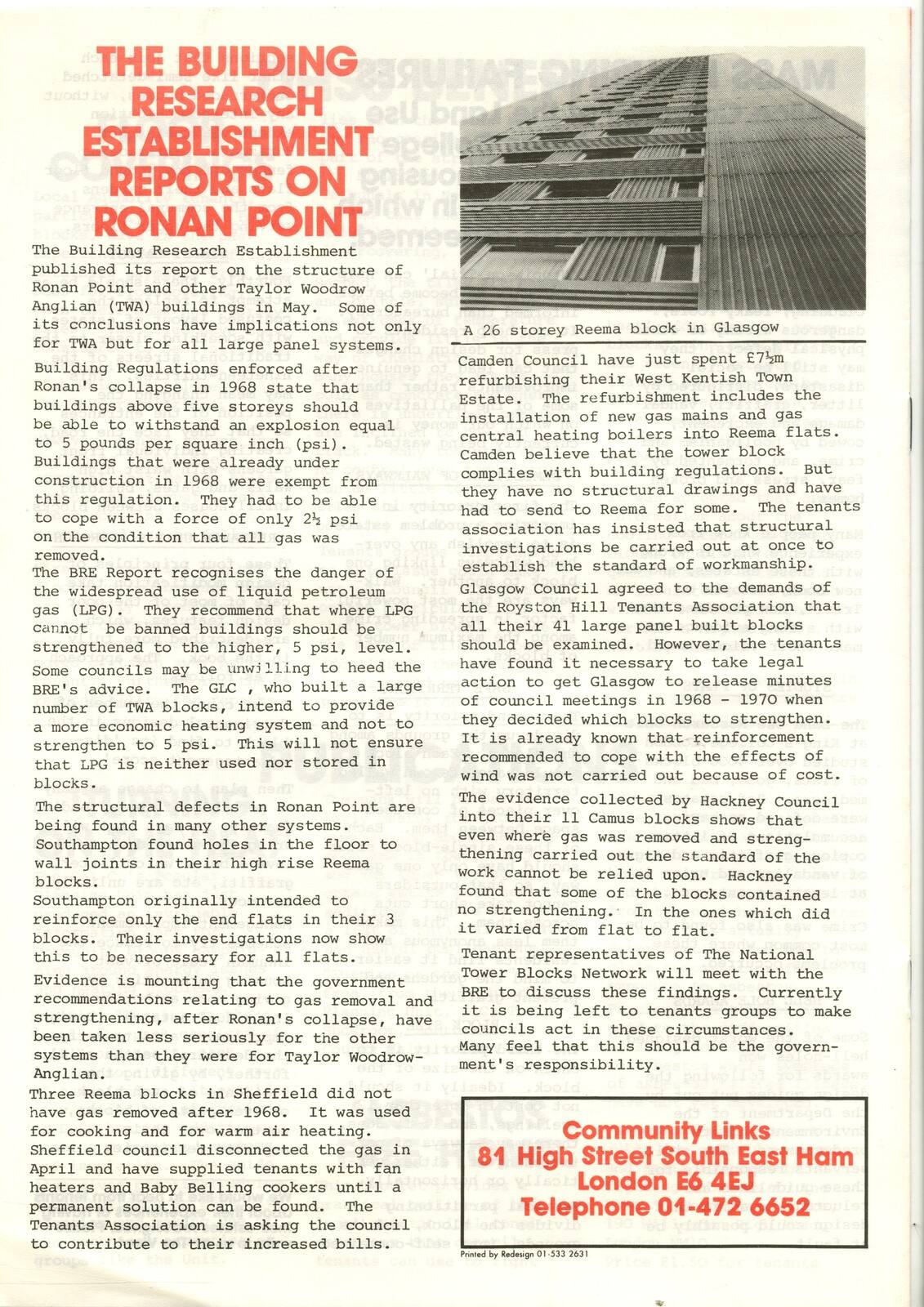
[caption: A 26 storey Reema block in Glasgow]
Camden Council have just spent £7½m
refurbishing their West Kentish Town
Estate. The refurbishment includes the
installation of new gas mains and gas
central heating boilers into Reema flats.
Camden believe that the tower block
complies with building regulations. But
they have no structural drawings and have
had to send to Reema for some. The tenants
association has insisted that structural
investigations be carried out at once to
establish the standard of workmanship.
Glasgow Council agreed to the demands of
the Royston Hill Tenants Association that
all their 41 large panel built blocks
should be examined. However, the tenants
have found it necessary to take legal
action to get Glasgow to release minutes
of council meetings in 1968 - 1970 when
they decided which blocks to strengthen.
It is already known that reinforcement
recommended to cope with the effects of
wind was not carried out because of cost.
The evidence collected by Hackney Council
into their 11 Camus blocks shows that
even where gas was removed and streng-
thening carried out the standard of the
work cannot be relied upon. Hackney
found that some of the blocks contained
no strengthening. In the ones which did
it varied from flat to flat.
Tenant representatives of The National
Tower Blocks Network will meet with the
BRE to discuss these findings. Currently
it is being left to tenants groups to make
councils act in these circumstances.
Many feel that this should be the govern-
ment's responsibility.
Community Links
81 High Street South East Ham
London E6 4EJ
Telephone 01-472 6652