“Ledbury Tenants Expose Cracks in the System”
On 14 June 2017, a fire tore through Grenfell Tower in West London. The flames raced up the building's cladding and through gaps that should have held them back. Seventy-two people were killed.
Three miles away in Peckham, a Ledbury Estate tenant named Danielle Gregory looked again at the cracks in her walls and did what the council had not. She read the building regulations, worked out that the gaps breached the fire compartmentation meant to keep each flat sealed, photographed them and sent the images straight to the London Fire Brigade. The reply was blunt — the openings would let smoke, fire and gas pass between flats. One photograph overturned years of the council's own fire risk assessments.1
She was not the only one. Across the four towers, residents had been reporting cracks for years and been told it was nothing. In the weeks after the Grenfell disaster, they formed the Ledbury Action Group and compared notes – on a closed Facebook group, in a WhatsApp thread, posting photographs of the cracks and faults in their flats as collective evidence and mutual support. Their founding principle, written down in October 2019, was simple: “No-one knows buildings better than the people who live in them.” 2 One tenant could be fobbed off. Hundreds documenting the same thing could not.
What they were documenting was terrifying once you understood it. In a fire, the construction of a tower block building is supposed to allow each flat to be compartmentalised: sealed so the fire can't spread. That was the whole basis of the ‘stay put’ advice given to tower block tenants by the authorities for decades. But at Ledbury, that seal was already broken. Residents could smell their neighbours' cooking through gaps in the walls and knew the moment someone next door lit a cigarette. If cigarette smoke could travel between the flats, so could the smoke from a fire.3
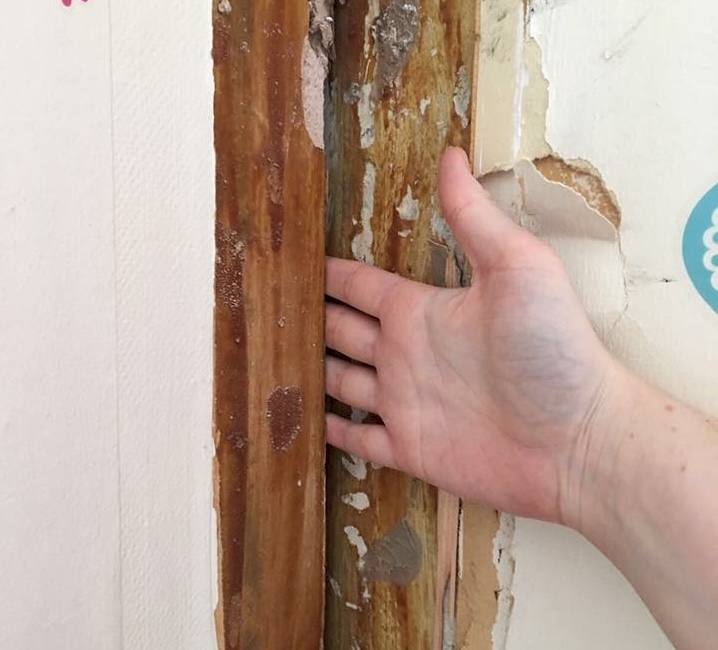
The residents brought in their own experts, among them the fire-safety surveyor Arnold Tarling, who went through the flats and described what he found. His hand could fit through the gap that carried the gas pipe from one kitchen to the next. Above a door, he slid a rod straight through into the neighbouring flat, meaning the two homes were directly connected. Joints that he inspected were packed with flammable expanding foam. He noted that there had been a fire-stopping appraisal back in 1985. How was it possible that the council was meant to have done these fire assessments back then, and hadn't? 4
The cracks were not cracks at all. They were gaps between the precast concrete panels, recurring in the same place flat after flat. The four blocks had no supporting frame: the joints between the panels were all that held them up. They were built by large panel system construction like Ronan Point, which had collapsed and killed five people in 1968. Following Ronan Point, other blocks in the series were fitted with strengthening bonds. On the Ledbury Estate, there wasn’t evidence that such work was done.5
At a packed residents' meeting on 11 July 2017, the council's engineers, Arup, told the room the gaps posed no structural risk. Asked about the gas, they answered carefully: everything had been looked at fifty years ago, and the government had concluded that some buildings needed strengthening and some didn't. They didn't say which Ledbury was. They didn't say any more.6
Their confidence rested on half a document. A 1985 government report by the Building Research Establishment had classed Ledbury as a ‘Type B’ block, a form that did not require strengthening – the half the council quoted for thirty years, and again now. The half they left out was on the same pages: the report had called for extra wall ties, warning they might already have fatigued, and stated no amount of sampling could rule out the risk.7
Residents argued that the council cared more about its reputation than their safety. They asked whether the councillors would live in the flats themselves. Then they took it to the street, marching with their demand chanted out: "Southwark, sort it out round here – we refuse to live in fear." 8
On 10 August 2017, the gas supply to the buildings was cut off. Arup, finally investigating rather than citing the old report, could find no evidence that the strengthening had ever been done. ‘Stay put’ was abandoned. Fire wardens were posted on the floors around the clock. Two months after Grenfell, 224 Southwark families were preparing to leave their homes – because someone had finally looked at them.9
The families moved out for their safety were given the right to return, but with no deadline. The council initially agreed to make the four blocks safe, a refurbishment costed at nearly £90 million and running close to nine years.10 In 2021, residents voted for the demolition and rebuilding of new socially rented homes on the site. Southwark is now actioning the results of this public ballot.
The parallel with Grenfell was never just that both buildings could burn. It was the pattern underneath: residents reporting danger for years, waved away by officials; cracks literally papered over; fire risk assessments that didn't assess the risk. At Grenfell that pattern ended in seventy-two deaths. At Ledbury, thanks to residents' persistence, it was caught in time.
They had known something was wrong long before any engineer confirmed it. The surveyor had called it natural movement; the Fire Brigade called it a risk. One of those judgements cost money. The other cost nothing and was correct.
- Correspondence between Danielle Gregory and London Fire Brigade, 27 June 2017 (TBUK4018): twelfth-floor resident sent crack photographs to the London Fire Brigade after Grenfell; the LFB confirmed the openings would let smoke, fire and gases pass between flats.
- Ledbury Action Group Charter, October 2019 (TBUK4001): “No-one knows buildings better than the people who live in them.”
- Rainbow Collective, ‘Cracks in the System’, 2018: residents’ testimony that the gaps let the smell of cooking and cigarette smoke pass between flats; Correspondence between Danielle Gregory and London Fire Brigade, 27 June 2017 (TBUK4018): compartmentation; 60-minute standard; ‘stay put’.
- Rainbow Collective, ‘Cracks in the System’, 2018: Arnold Tarling’s flat-by-flat testimony – hand through the floor gap carrying the gas pipe between kitchens; a rod five inches between flats; a rod through the gap above a door into the next flat; flammable expanding foam in the joints; plasterboard visible above corridor doors; the 1985 fire-stopping appraisal never acted on.
- Arup for Southwark Council, ‘Ledbury Estate: Structural Assessment of Bromyard, Peterchurch, Sarnsfield and Skenfrith House’, 1 November 2017 (TBUK4072): the four 13-storey blocks (Bromyard, Sarnesfield, Peterchurch, Skenfrith) built by Taylor Woodrow-Anglian in the Larsen-Nielsen large panel system, part of the LCC/GLC Morris Walk Series; serial contract of some 1,800 flats, the same system as Ronan Point; the 1969 GLC-approved strengthening angle-irons fitted to other blocks in the series but never to the four Ledbury blocks (TBUK4).
- Rainbow Collective, ‘Cracks in the System’, 2018: footage of the 11 July 2017 meeting – Arup’s answer that there were slightly different types of construction, everything examined at fifty years ago, and the government concluded some buildings needed strengthening and some did not.
- ‘The Structure of Ronan Point and Other Taylor Woodrow-Anglian Buildings’, Building Research Establishment, Department of the Environment, 1985: Ledbury classed as ‘Type B’ (joint designed for 34kPa), not requiring strengthening; the council’s defence; the same report recommended additional wall ties that may have fatigued, a risk no sampling could eliminate.
- ‘Rainbow Collective, ‘Cracks in the System’, 2018: the march on the council; the residents’ chant.
- ‘Ledbury Estate’ (TBUK4001): gas terminated 10 August 2017 after Arup found no evidence of strengthening; ‘stay put’ abandoned; 24-hour fire wardens; Grace Perry, ‘Ledbury Estate: Community’s Amazing Fight for Safe Homes’, Southwark Notes, 2017: 224 families facing evacuation two months after Grenfell.
- Residents Project Group Minutes (TBUK4050): proposed refurbishment; tenants moved out hold a Right to Return with no cut-off date other than the end of the works; costed at £89.7m over c.440 weeks.
Related Archive Documents
ACTION PACKS
Think that your block might be built with a large panel system? Here’s a guide with next steps.
Want to check if gas is safe in your block? Here’s a digest of the relevant laws and actions you can take.
Noticed cracks in the walls of your block? Here’s a letter template to inform the managers of your property.
Are you a tenant facing an emergency move from your block? Here’s a guide to help you secure clarity about the future.