“Don’t Look Down”
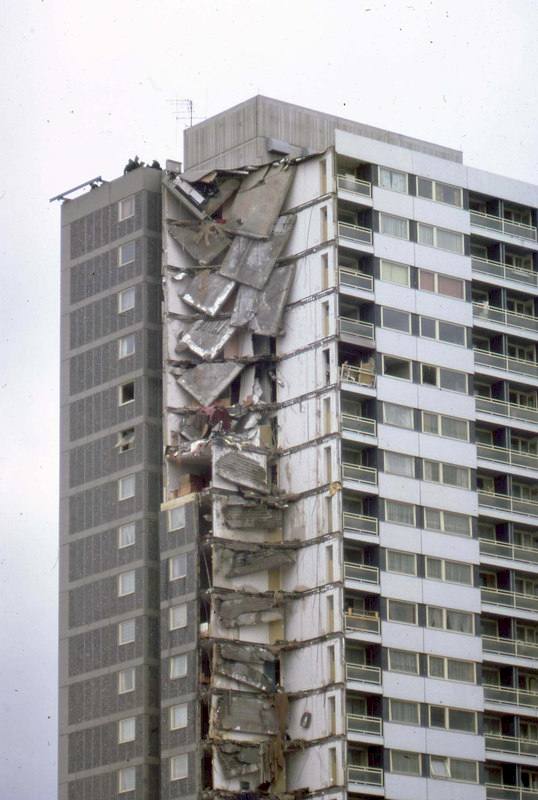
Harry Pumphrey stood by the door of his brand new nineteenth-floor flat, 91 Ronan Point, listening. The noise was like a high-speed drill on metal, travelling down the corridor from north to south. Who'd be making such a racket at 5:50am on a Thursday morning?1 What Harry didn’t know was that this was the sound of a building beginning to tear itself apart.
Content Warning
This story details a fatal building disaster and includes potentially distressing material.On the eighteenth floor of Ronan Point, Ivy Hodge lit a match for the kettle. Ignition. Explosion. She was thrown to the floor unconscious.2
Five floors down, Brenda Maughan had been asleep on her sofa. Thrown against the door, she found herself on a tiny ledge in the corner of what used to be her living room, 150 feet up in the air. Pieces of concrete, furniture and four people fell past her. Her husband inched his fingers round the door and opened it. “Don't look down,” he said. But she did, and it was all gone.3
On the seventh floor, James Chambers woke to dreadful screams. “I think they were from people falling past us.” 4
Less than three months after it was constructed, the whole south-east corner of Ronan Point had crumpled like a house of cards. Five people died in the disaster. When Ivy – the woman at the epicentre of the blast – woke up, flames were playing on the ceiling above her and she was rushed to Poplar Hospital. The firemen who reached her kitchen found nothing to suggest a serious gas leak: the supply taps were off, she had never turned them on, and had lived in the flat barely four weeks. There was no source for an explosion big enough to bring down a tower.5
From his corner shop opposite the flats, shopkeeper and former plumber James Thomas had heard everything. The low noise, getting louder, reminded him of “a good old 88 coming over” – the German bombers that had crossed London skies in the Blitz. Then two huge blasts, one after the other. Thomas was clear in his own mind: the building went first, the gas second. The collapse had caused the explosion, not the other way round.6 Twenty-three other residents and locals also heard not one blast but two.7
No one was interested in the views of a shopkeeper with no credentials, or those of the twenty-three others who heard the same. The question of which came first – the collapse or the gas – was never properly tested.
Three hours after Ronan Point fell, the firm that had built it, Taylor Woodrow-Anglian, told The Times there was not the slightest sign of structural failure. The Borough Architect, who had never set foot in Ronan Point until that day, said the flats were safe and the tenants should go back.8
The experts were wrong. Ronan Point was a large panel system block – twenty-two storeys of concrete panels stacked and bolted together, with no internal frame. When one corner went, each floor took the one below it, all the way down. A poorly built block had suffered progressive collapse, and there were hundreds like it across the country.9 But proving that – and forcing anyone in authority to admit it – would take sixteen years.
- Sam Webb, ‘Why, Why, Why?’, Letter to RIBA Journal, 1984 (TBUK1036): Harry Pumphrey at flat 91, floor 19. This letter was published as: Sam Webb, ‘WHY? WHY? WHY?’, RIBA Journal 91:12 (December 1984), p.42.
- Webb, ‘Why, Why, Why?’ (TBUK1036): Ivy Hodge, flat 90 on the eighteenth floor, lit a match to boil water and was knocked unconscious by the blast.
- Webb, ‘Why, Why, Why?’ (TBUK1036): Brenda Maughan account.
- Webb, ‘Why, Why, Why?’ (TBUK1036): James Chambers on the screams of people falling.
- Webb, ‘Why, Why, Why?’ (TBUK1036): Ivy Hodge in flat 90, under four weeks; gas supply taps found off and never turned on; non-smoker; no smell of gas. Webb’s point that there was too little gas to account for a bomb-sized explosion.
- Webb, ‘Why, Why, Why?’ (TBUK1036): James Thomas, “a good old 88 coming over”, two blasts, building first.
- Ronan Point occupancy lists, 1968 (WESA_1_3): 12 or more named residents across floors 3-19 annotated “2 bangs”; 23 in total reporting two blasts.
- Harold Jackson, ‘Flat Victims May Refuse to Return’, Guardian, 17 May 1968, p.1; ‘Flats Are Safe, Says Architect’, Daily Express, 17 May 1968, p.1.
- Structural Summary, undated (TBUK1048): Ronan Point 210 feet / 22 storeys; Large Panel System with no internal frame; Webb, ‘Why, Why, Why?’ (TBUK1036): number of comparable blocks nationwide.
Related Archive Documents
ACTION PACKS
Do you want to investigate the construction of a particular tower block? Here’s a letter template to help you to get answers.
Think that your block might be built with a large panel system? Here’s a guide with next steps.
Want to check if gas is safe in your block? Here’s a digest of the relevant laws and actions you can take.