“I Can See More Green Than Most People”
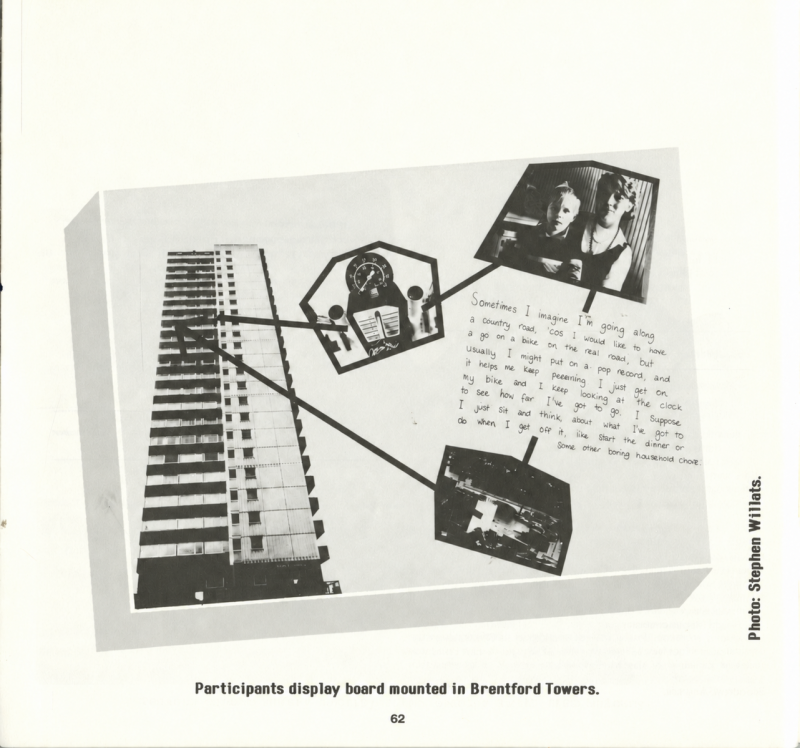
The artist Stephen Willats knocked on every door of Harvey House, a 22-storey tower on the Green Dragon Lane Estate in Brentford. He wanted to build a second tower inside the first. Not of concrete, but of its residents' own lives: what he called a ‘Conceptual Tower’, made from the way the tenants understood their world, rather than the way architects and planners had drawn it.1
To raise it, he needed their agreement, floor by floor. He asked the residents of each landing whether they would accept a display board there. It went up only once everyone agreed. The whole work rested on their acceptance.2
Fifteen residents agreed to take part. Each was asked to choose two things from their living room: an object inside it that held a personal meaning, and something they could see from its window that meant something to them. The gap between the two – the interior world and the unreachable exterior, both framed by the one room – was the subject of the work.3
Willats photographed the objects, the residents and the views, and tape-recorded their conversations about what they had chosen and why. Then the residents hand-wrote their own words onto the boards. Their handwriting. Their words. Their floor.4
A woman wrote about her budgie: “No matter how lonely I am, I’ve still got my budgie chirping away… she’ll go ‘whsstt’ and we talk and I go ‘whsstt’ and she’ll answer back… when she feels like it, of course. But I mean she is company.” The board was illustrated with linked photographs: the block, the budgie, the resident, and, far below, empty green fields.5
Someone with an exercise bike: “Sometimes I imagine I'm going along a country road, 'cos I would like to have a go on a bike on the real road, but usually I might put on a pop record, and it helps me keep pedalling.” 6
Higher up, handwritten in capitals: I CAN SEE MORE GREEN THAN MOST PEOPLE, BUT THERE'S NO WAY YOU CAN TOUCH THE TREES OR GREENERY OR FEEL THAT THEY'RE THERE, THEY'RE OUTSIDE OF YOU, BUT INDOORS YOU CAN TOUCH THEM AND TEND THEM.7
Over four weeks the boards went up floor by floor, from the ground to the twenty-second storey.8 The only way to see the work was to enter the building and climb it; the physicality of the tower was the point. In all that time, with the boards in vulnerable positions on the open landings, not a single one was defaced.9
Sarah Kent of Time Out wrote of the exhibition: “On paper it sounds unremarkable, but try it even for a morning. I couldn't get out of Harvey House fast enough.” 10 That discomfort was the point. The regular exhibition-goer who climbed those floors understood something they could not have grasped any other way. The tenants already knew it.
“The important thing is that Stephen's art is our art,” wrote the high-rise bulletin The View. “By tower block tenants, about tower block tenants and for tower block tenants.” 11
Many tenants who had been wary at first later said how much they had gained from working with Willats. Some went on to form tenants associations with neighbours they had only just met. The Evergreen Club was one group that began this way.12
- Stephen Willats, 'Brentford Towers', 1985, stephenwillats.com (via Society Through Art, HCAK 1990): the work made with residents of Harvey House, Green Dragon Lane Estate, Brentford; the tower block as “a commonly available symbol that denotes the wider social fabric in which we are all locked”; the boards creating a “Conceptual Tower... based on the personal conceptualisations of the tenants... rather than the conceptualisations of architects and planners”.
- Willats, 'Brentford Towers', 1985: “I asked residents of each floor of Harvey House whether they would accept a display board on their landing, and they were only subsequently positioned on a floor when everyone was in agreement... for the work to operate it had to be based on people's acceptance.”
- Willats, 'Brentford Towers, 1985: fifteen residents each choosing an object from their living room and something seen “from their picture windows in the same living room”; contrasting interior and exterior.
- Willats, 'Brentford Towers', 1985: Willats photographing objects and residents and tape-recording discussions; participants hand-writing chosen extracts onto their own display boards.
- National Tower Blocks Directory 1987 (TBUK2077, p.62), 'Our Art': budgie quotation, verbatim; illustrated with photos of the block, the budgie, the tenant and the green fields below.
- National Tower Blocks Directory 1987 (TBUK2077, p.62): the exercise-bike display-board text, verbatim.
- National Tower Blocks Directory 1987 (TBUK2077, p.62): the “I can see more green than most people” display-board text, verbatim.
- Willats, 'Brentford Towers', 1985: from the ground floor, a new board every two days on a different landing until the twenty-second floor.
- Willats, 'Brentford Towers', 1985: “over the four weeks of the installation, with the displays in very vulnerable positions, in a volatile environment, not a single display was defaced”; the physicality of the tower integral to the work.
- National Tower Blocks Directory, 1987 (TBUK2077, p.62): Sarah Kent's Time Out review of the Brentford Towers exhibition, verbatim; the discomfort arising because many participants were lonely or unhappy.
- National Tower Blocks Directory 1987 (TBUK2077, p.62), 'Our Art': “Stephen's art is our art. By tower block tenants, about tower block tenants and for tower block tenants.”
- National Tower Blocks Directory 1987 (TBUK2077, p.62): tenants forming associations through the work, including the Evergreen Club. Related Willats work at Skeffington Court, West London: stephenwillats.com.
Related Archive Documents
Action Packs
You can make your own voice heard: writing, photographing, recording, and sharing a story yourself. Here are some pointers for citizen journalism.