“People in High Places”
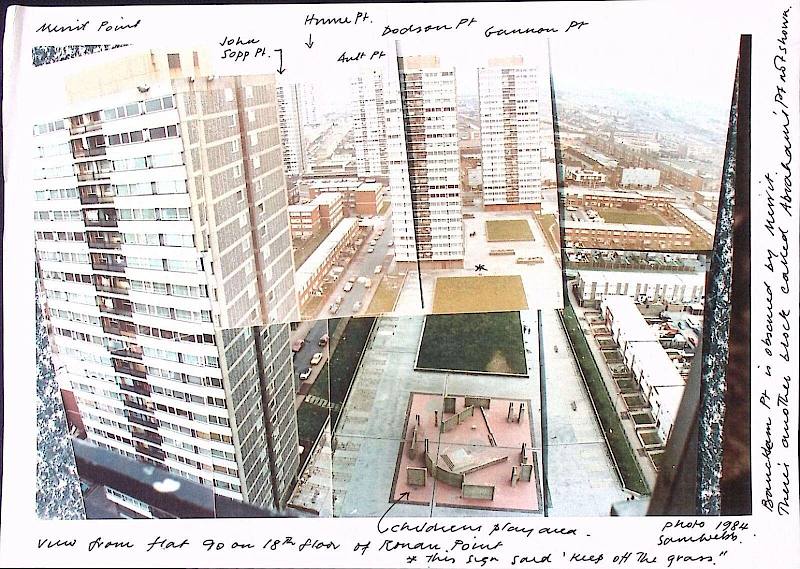
George Fairweather was one of the few experts willing to testify, in public, that these towers were unsafe to build.
Every contractor, council and architect who had built or commissioned a block from Taylor Woodrow-Anglian (TWA) had reason to want Fairweather silenced. The technical press, threatened with the loss of construction-industry advertising, was hesitant to publish criticism of industrialised building. Years earlier, students from the Architectural Association had been taken to a tower block going up at Morris Walk in Greenwich. They watched a workman hammer the bolts flat because a loadbearing panel would not fit; it was propped level on offcuts of asbestos sheet. When one of the students questioned it, the group was sent off the site. They told Fairweather what they had seen.
The men building these blocks were paid on an incentive bonus scheme. The more panels they fitted, the more they earned. If a bolt didn't fit, it got bent until it did. Fairweather said later to a younger colleague1:
Mark my words. One day, one of these things is going to fall down.
The blocks at Morris Walk were early prototypes. Taylor Woodrow-Anglian went on to build the same tower, to the same drawings, for councils across London and beyond – Hartopp and Lannoy Points in Fulham, Ronan Point in Newham, and more. Whatever was wrong at Morris Walk was wrong in all of them.
TWA had licensed the system from Denmark, where it was only permitted up to six storeys – above that, Danish rules required a proper internal frame, because of movement in the joints. In Britain, TWA fiddled with the joints and declared they could build to twenty-two storeys with no frame at all.2
Fairweather's warning had been buried. His friend and colleague, the young architect Sam Webb, took up the fight. They believed these buildings were not safe for habitation – they were structurally too flawed to ever be successfully strengthened. For the rest of his life Webb worked alongside tenants, block by block, to force the truth about how these towers were built into the open. It began in the spring of 1970, in the basement of the Ministry of Housing in Marsham Street, where Webb spent three and a half weeks reading the files closed after the Ronan Point inquiry, copying out exactly what he found into his notebook.3 He wanted to go public. The response came, through an intermediary, from Sir Elwyn Jones – who, as Attorney General, had opened the inquiry promising a full and searching investigation. Jones's message was plain: publish anything and face prosecution for criminal libel. The files were closed. The evidence was there, but Webb could not use it.4
Webb knew how to court trouble. In 1971, with Paul Foot of Private Eye, he helped uncover the Poulson affair – the corruption scandal that exposed bribery between private developers and government officials. But Ronan Point itself was still off limits. Webb was a senior architect at Camden Council. Its Borough Architect, Sydney Cook, warned him: “They hold your future in their hands.”5
Undeterred, over the years Webb wrote down everything he and George Fairweather knew about Ronan Point – the inquiry, the suppressed evidence, the files, the joints, the inadequate steel angles that had been used to “strengthen” blocks afterwards. The document that resulted is the most complete account of what happened to Ronan Point and why.6
In the autumn of 1984, Webb decided to publish, with Charles Knevitt of The Times. The centrepiece of their article was a redacted passage from the report, written by Sir Alfred Pugsley, the inquiry's own structural engineer, stating the walls of Ronan Point were not even “as strong as the glass in a good window”. It had been struck out in broad-nibbed purple pen.7
On Sunday 7 October 1984, Webb went to bed, knowing the story would hit the newsstands the following morning. Either he and Knevitt were headed for prison, or Margaret Thatcher would release the Ronan Point files.
The documents were released by the Housing Minister on 23 October 1984. The day after Knevitt's story appeared, Hammersmith and Fulham Council began scrambling to commission an independent structural investigation of Hartopp and Lannoy Points – the same type of towers as Ronan Point.8
Half the released files were missing. The signed copy of the full inquiry report, sent to the Minister in 1968, had been lost. Webb had dedicated years to this battle. It wouldn’t be the last.
- Sam Webb, Audio Interview with Hannan Majid (2019) and Sam Webb, Letter to Lynsey Hanley, 2 February 2007 (WESA_11_1_03): Morris Walk account; George Fairweather quoted verbatim.
- Sam Webb, ‘The Atrocity of Grenfell Tower’, 1 July 2017 (WESA_9_4_02); the Larsen Nielsen system licensed only to six storeys; Danish regulations required an internal frame; TWA's modification of the joints to build to twenty-two storeys.
- Sam Webb, Notebook, March 1970 (WESA_12_1).
- Webb, Letter to Hanley, 2007 (WESA_11_1_03): the 1970 Marsham Street files; Sir Elwyn Jones's criminal-libel threat conveyed via Tom Driberg; Jones as the MP who opened the inquiry.
- Sam Webb, Letter, 2 August 1999 (WESA_1_15_01): Sydney Cook quoted verbatim.
- Sam Webb, ‘Ronan Point: The Structural Implications: Interim Report’, c.1984 (WESA_1_4_01, paras 2.10. 2.14): the RIBA Code meeting; Fairweather described as the “kindest, bravest man I have ever met”.
- Sam Webb, ‘Background to Ronan Point and connections with the Poulson Affair’, 17 March 2019 (TBUK5011): background of The Times coverage.
- Webb, ‘Background to Ronan Point and connections with the Poulson Affair’, 2019 (TBUK5011); Hammersmith and Fulham’s independent investigation of Hartopp and Lannoy Points.
Related Archive Documents
Action Packs
Think that your block might be built with a large panel system? Here’s a guide with next steps.
Want to carry out your own investigation? Here’s guidance about making a Freedom of Information request.
Keen to get media attention on an issue? Here’s some advice for securing coverage.
You could try citizen journalism: writing, photographing, recording, and sharing a story yourself. Here are some pointers.