Prologue – “A Clean Slate”
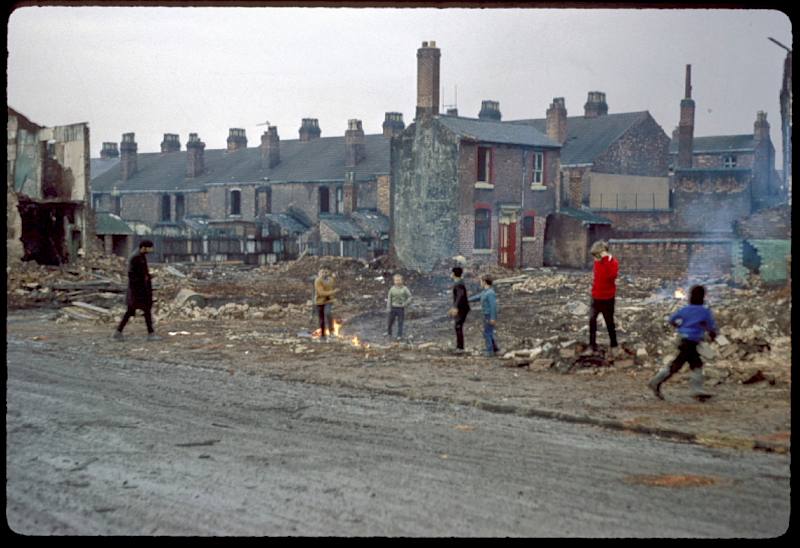
“The reality was decaying, dingy cities where underfed people shuffled to and fro in leaky shoes, in patched-up nineteenth-century houses that smelt always of cabbage and bad lavatories.” 1
This was George Orwell, in 1949, on the slums Britain was about to clear. The tower blocks that rose in their place have been judged just as damningly by pundits and commentators. But these verdicts came from outside the four walls in question. What about the people who lived in Britain’s tower blocks? What did they think? What was their experience?
This resource puts them back in the picture: the campaigns run by social housing tenants, for social housing tenants, from Glasgow to Belfast to Southampton. It shows how ordinary people challenged technocratic power and fought to be heard. Time and again they were ignored, and time and again the consequences were fatal – but they had hard-won victories too, forcing public attention onto what the powerful found it convenient to ignore.
Almost half a million high-rise flats went up in Britain between 1955 and 1975. In 1956 the Conservative housing minister, Duncan Sandys, introduced a height subsidy – the taller a council built, the more government money it received per flat. The following year the general housing subsidy was withdrawn, leaving height as the best route to public funding. Yet high-rise was never cheap; it cost more per square foot than houses. The subsidy was the only thing that made it add up.2
The blocks were expensive, and tenants paid for it for decades: most of their rent went on repaying the loans that built the towers, leaving little for upkeep – which was always first to be cut.
Where the money pooled, the safeguards thinned. A handful of firms came to dominate construction and could dictate their terms. The buildings raised in this climate were shaped less by what was safe than by what was profitable.
The London Borough of Newham shows how it worked. The council's architects drew up four 22-storey blocks; sent to the contractor, Taylor Woodrow-Anglian, they were told the job was not worth doing below a thousand flats.3 To meet the firm's offer, Newham added five more towers it had never planned: nine in all, on the bombed-out land by the Royal Docks, among them the block that would be synonymous with disaster – Ronan Point. The company that designed and certified the structural system for all nine was a wholly-owned subsidiary of Taylor Woodrow-Anglian, the firm building them. The watchdog and the contractor were one.4
Work began on Ronan Point on 25 July 1966. Six days later England won the World Cup; three of the players were West Ham men. Newham Council must have thought they were walking on water.5 What could possibly go wrong?
- George Orwell, Nineteen Eighty-Four (1949).
- Housing Subsidies Act 1956 (storey-height subsidy); general needs subsidy reduced 1957.
- Sam Webb, ‘Why, Why, Why?’, Letter to RIBA Journal, 1984 (TBUK1036). This letter was published as: Sam Webb, ‘WHY? WHY? WHY?’, RIBA Journal 91:12 (December 1984), p.42.
- Webb, ‘Why, Why, Why?’ (TBUK1036); TBUK5_006.
- Sam Webb, ‘Groundhog Day: From Ronan Point 1986 to Grenfell Tower 2017’, 2017 (WESA_9_2_02).