“Forensic Demolition”
“Have you heard about the flats?” Everything looked normal as Sheridan Hitchcock walked home from school to Ronan Point on 16 May 1968. Then she turned the corner.
“What I saw will live with me forever.” 1
Sheridan's family was rehoused in Ault Point, one of the eight sister blocks on the Freemasons Estate. Her memories of that day spurred her to action; she became the tenant representative for Ault Point and a key figure in the Newham Tower Block Tenants Campaign.2 In 1981, when two unsound blocks in Stratford were demolished, the Campaign threw a Blow-Up Party for the press. Its slogan, “2 down, 107 to go”, the number of tower blocks in Newham, gave the papers their headline.3
After the 1968 collapse, the nation was assured that strengthening measures had been carried out on the block. Residents still had abiding concerns. They wanted to know why they still heard grinding metal and walls creaking in the wind, why mice were living inside the structural joints, and why cracks were appearing in the walls. That’s why Sam Webb was invited by residents to perform an architect’s appraisal.
Yet it was the tenants who would ultimately bring equivalent expertise to the table. “They know more about the structure than a good many engineers,” Webb affirmed. “I’m quite a good teacher and they’ve been having seminars.” 4 His students were stunned by their grasp of the constructional technicalities.
Sheridan Hitchcock understood the engineering. One night she put it to the council’s engineers directly: "When are you going to open up the loadbearing H.2 joint in the flank wall?" When they did, the drypack mortar that should have been inside was missing.5
Ronan Point was put through fire testing. The gaps could let fire pass between the flats. On 18 July 1984 the council's engineers and the Building Research Establishment lit a controlled blaze in an empty flat, to prove a new seal would hold flames back for the hour that gives a brigade time to reach them. After twelve minutes they had to stop: the floor slab was cracking and the glass the cameraman filmed through had melted. Two hours later the engineers pronounced it safe. No one believed them.6
Sam Webb asked the Architects' Journal how joints filled with polystyrene could ever pass a fire test: "the tenants are dying to know. Their lives depend on it." 7 Five hundred fearful residents came to an emergency meeting.
In May 1986, eighteen years after the collapse, Ronan Point came down at last – not blown up but dismantled panel by panel. A forensic demolition, the Newham Tower Block Tenants Campaign insisted, was the only way to arrive at the truth.
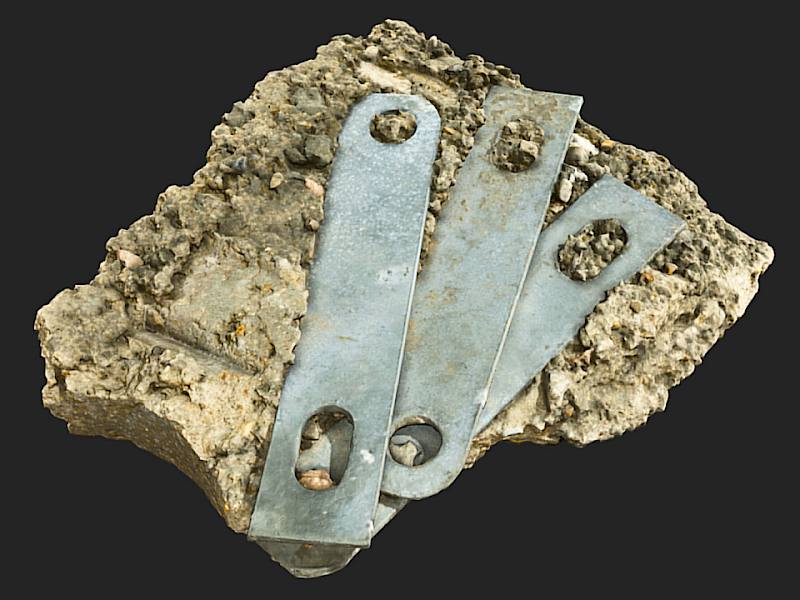
The guts of the building proved scandalously poor build quality. Joints were packed with rubbish – cigarette packets, newsprint, a tin of corned beef – and one scrap of newspaper dated 9 September 1972, four years after the collapse, stuffed in during the restorative work.8 The “strengthening” was a fraud – steel braces bolted to the outside while the joints behind them stayed hollow, holding up twenty-two storeys and everyone in them. There were misplaced and unsecured tie straps, and bolts bent by the movement of the unstable building. Sam Webb retrieved incriminating fragments and stored them in his garage for safe keeping.
Its eight identical sisters would ultimately be demolished too – nine towers in all, 990 flats. After years of legal delay, Taylor Woodrow-Anglian paid Newham Council £1.25 million in compensation.9
There were hundreds of large panel system tower blocks across the UK, built by different companies, using similar methods, held together by similar joints. Some were strengthened. Some were demolished. Many remain standing, without records of checks having taken place.
In 2017, following the Grenfell Tower fire, the government wrote to the owners of large panel system blocks, asking them to undertake structural assessments. Nearly fifty years after Ronan Point, the same letters were going out, asking the same questions.
For all these years, tower block residents have been intimately acquainted with the problems. “The wearer of the shoe always knows where it pinches most,” reflected Sam Webb in the 1980s. “The trouble is no one ever goes and asks.” 10
- Sam Webb, ‘Ronan Point: The Structural Implications: Interim Report’, c.1984 (WESA_1_4_01, para 3.49): Sheridan Hitchcock, quoted verbatim.
- Newham Tower Block Tenants Campaign, ‘Press Release Ronan Point – Up in Flames’, 12 July 1984 (TBUK1027): Sheridan Hitchcock listed as Tenant Representative for Ault Point in NTBTC; Hitchcock quoted: “The memory of the collapse in '68 is always in our minds.”
- Newham Tower Block Tenants Campaign, ‘Our Blow-Up Celebration’, 1981 (WESA_2_1_06): blow-up party details; “2 down, 107 to go” slogan.
- Webb, ‘Ronan Point: The Structural Implications: Interim Report’, c.1984 (WESA_1_4_01, para 2.30): Sam Webb quoted verbatim.
- Webb, ‘Ronan Point: The Structural Implications: Interim Report’, c.1984 (WESA_1_4_01, para 2.34-2.35): Sheridan Hitchcock quoted verbatim; opening of joint.
- Newham Tower Block Tenants Campaign, ‘Press Release’, 20 July 1984 (TBUK1023) and Newham Tower Block Tenants Campaign, Letter to the Housing Committee, August 1984 (TBUK1024): the BRE fire test of 18 July, meant to run 20 minutes, aborted after 12 as the floor slab deflected and cracked; the cameraman's glass melted.
- Sam Webb, Letter to the Architects’ Journal, 13 June 1984 (WESA_1_12_04).
- Chris Huntley, ‘70 000 Tower Block Families in Danger’, Building, 12 September 1986, p. 8; Charles Knevitt, ‘Bad Workmanship Found’, The Times, 5 September 1986, p. 2; Hugh Muir, ‘Paper Used to Pack Joints after Collapse: Ronan Probe Set to Spark New Storm’, Newham Recorder, 9 October 1986, p. 52; ‘Rubbish Joints Renew High Rise Fears’, Contract Journal, 11 September 1986, p. 4.
- Newham Tower Block Tenants Campaign, Annual Report 1985/86 (WESA_2_3): the £1,250,000 settlement from Taylor Woodrow-Anglian; scientific demolition agreed August 1985.
- Webb, ‘Ronan Point: The Structural Implications: Interim Report’, c.1984 (WESA_1_4_01, para 3.05): Sam Webb quoted verbatim.
Related Archive Documents
Ronan Point demolition debris
ACTION PACKS
Think that your block might be built with a large panel system? Here’s a guide with next steps.
Want to start a community campaign? Here’s a guide to forming or joining a residents’ association.
Noticed cracks in the walls of your block? Here’s a letter template to inform the managers of your property.
If your landlord is failing to make repairs, here’s what you can do next.
You can escalate issues to an ombudsman. Here’s how you can contact them.