“Flames Raced Up Inside the Void”
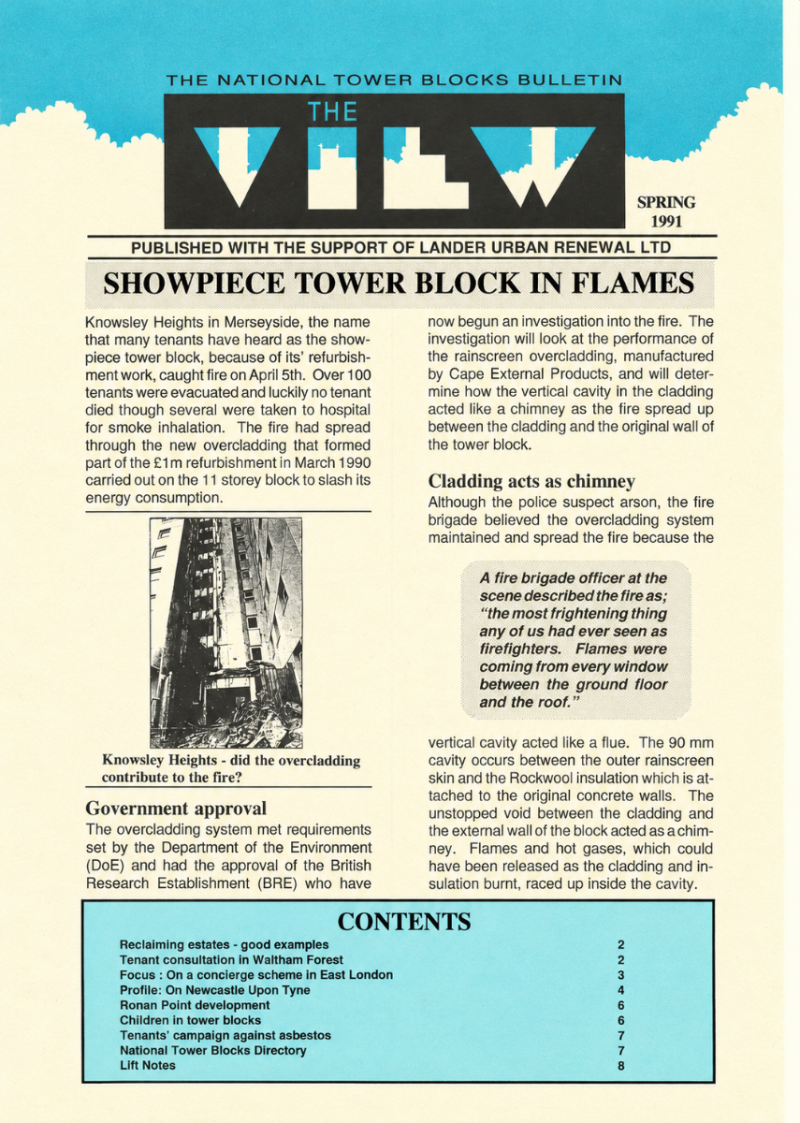
The fire started in a pile of rubbish at the foot of Knowsley Heights in Huyton, Merseyside.
Content Warning
This story details a major building disaster and includes potentially distressing material.In 1988 the block had been fitted with new rainscreen cladding, to fix the damp that had plagued it for years. Knowsley Heights was the showcase building for overcladding – £915,000 of government money, a national pilot with the Building Research Establishment monitoring it.² Knowsley Heights was meant to prove that the old, cold, damp blocks could be saved.
Tenth-floor resident Amanda Roberts was pleased. It looked fantastic, she thought, a real improvement.³
“As I was coming down the stairwell, the windows were just melting away,” she said.⁴
Caretaker Dave Soo was woken by the helicopters. He ran to help firefighters evacuate the block. By the time he arrived, the cladding was disintegrating. “It was hanging in strings,” he said.⁵
“It was the most frightening thing any of us had ever seen as firefighters,” one fire brigade officer said. “Flames were coming from every window between the ground floor and the roof.”⁶
Between the cladding and the external wall of the block, there was a cavity. Just 90mm wide, it separated the outer rainscreen skin from the Rockwool insulation attached to the original concrete walls. It was an unstopped void, without fire breaks. A chimney. Flames and hot gases raced up it unchecked.⁷ The panels themselves were glass reinforced plastic – a combustible polymer – and they were rated Class 0.⁸
Nobody had told the fire crews about the new cladding, or what it would do. Les Skarratts found the water from their hoses bouncing off it. “The fire was travelling up the building without us being able to extinguish it,” he said. “It was a very difficult fire for us, and it was made worse by the cladding falling on to us.”⁹ Somebody, he said, “took a decision to wrap a residential tower block in flammable material. As a firefighter, that made me angry.”¹⁰
Over a hundred tenants were evacuated. Three needed hospital treatment. Nobody died.¹¹ “We were very, very lucky with Knowsley Heights,” Skarratts said. “We dodged a bullet.”¹²
The government had known since December 1986 that overcladding carried a fire risk. A Department of the Environment circular stated plainly: “A risk of increased vertical fire spread has been identified during the laboratory testing of overcladding systems incorporating combustible insulants.”¹³
Two years later it committed nearly a million pounds anyway. The damp in the blocks was real, the political pressure to fix it was real, and cladding was an answer. The fire risk was noted. The fire risk was set aside.
Even after that risk was writ large in black smoke above Huyton, the authorities continued to dismiss it. Three days after Knowsley Heights burned, a government official wrote the incident was “being treated as insignificant” and that the Secretary of State would receive a “purely factual” briefing. A handwritten note records a request from the government press office on Marsham Street to “play down” the fire.¹⁴ The Secretary of State at the time was Michael Heseltine. It was Heseltine who had initiated the deregulation of building safety and Heseltine who oversaw the part-privatisation of building control in the early 1980s. More than three hundred pages of building regulations were cut to fifty-six. What replaced them was a guidance document, Approved Document B, recommending materials for construction – external cladding among them.¹⁵
Even in the wake of the fire, similar overcladding schemes were allowed to go ahead. Les Skarratts and his Fire Brigades Union colleagues couldn’t believe it. “We took it to the House of Commons, we took it to select committees, we lobbied government, we’ve told everybody that’ll listen to us that this is a national scandal.”¹⁶ And while some regulatory changes did follow – combustible insulation banned, fire barriers in cavities required – the external cladding panel standard, Class 0, remained. But Class 0 was only a measure of how panelling would resist the surface spread of flames. It did not measure what or how panels burned underneath.¹⁷ Even after Knowsley Heights, cladding was not legally required to be fireproof.¹⁸
“I felt I had completely wasted my time,” said one adviser who had spent years trying to tighten standards, and who retired burned out by 2007. “I sent all my files and papers to an industrial shredder and lived in relative peace and tranquility until Grenfell brought it all back to me. It was all so, so pathetic. There was no need for those people to die.”¹⁹
Twenty-six years later the Grenfell Tower Inquiry began its account of what had gone wrong with this fire, “because it seems to us that the events that followed laid the ground for the tragedy which occurred at Grenfell Tower in June 2017”.²⁰
- ‘Showpiece Tower Block in Flames’, The View, Spring 1991 (TBUK2_002): the rubbish fire, suspected arson, and the overcladding of the 11-storey block to cut damp and energy use.
- Peter Apps, ‘Special investigation: how the government missed the chance to prevent the cladding crisis in the 1990s’, Inside Housing, June 2021: the £915,000 Estate Action pilot grant.
- ‘Grenfell Tower: The fires that foretold the tragedy’, BBC News, 30 October 2018: Amanda Roberts on the new cladding.
- Tim Dowling, ‘The Fires That Foretold Grenfell review’, The Guardian, 30 October 2018: Roberts, verbatim.
- Emilia Bona, ‘The miracle of Knowsley Heights’, Liverpool Echo, 28 October 2018: Dave Soo, verbatim.
- ‘Showpiece Tower Block in Flames’, The View, Spring 1991 (TBUK2_002): the fire-brigade officer’s description at the scene.
- ‘Showpiece Tower Block in Flames’, The View, Spring 1991 (TBUK2_002): the unstopped 90mm cavity acting as a flue; rainscreen manufactured by Cape External Products.
- Grenfell Tower Inquiry, Phase 2 Report, 2024, Volume 1, paras 7.4 and 7.7, pp.81-82: the block clad in 1988 in Class 0 GRP rainscreen cladding, a combustible polymer.
- Phil McCann, ‘Fire that was an omen of Grenfell 26 years before’, BBC News, 5 September 2024: Skarratts, verbatim.
- Tim Dowling, ‘The Fires That Foretold Grenfell review’, The Guardian, 30 October 2018: Skarratts, verbatim.
- ‘Showpiece Tower Block in Flames’, The View, Spring 1991 (TBUK2_002): over 100 evacuated, three treated for smoke inhalation, no deaths.
- Emilia Bona, ‘The miracle of Knowsley Heights’, Liverpool Echo, 28 October 2018: Skarratts, verbatim.
- Peter Apps, ‘Special investigation: how the government missed the chance to prevent the cladding crisis in the 1990s’, Inside Housing, June 2021: the Department of the Environment circular of 9 December 1986, verbatim.
- ‘Government sought to “play down” cladding fire at pilot project it funded in 1990s, investigation reveals’, Inside Housing, June 2021: the Curtis and ‘Lyn’ notes, and the briefing for Heseltine.
- Tim Dowling, ‘The Fires That Foretold Grenfell review’, The Guardian, 30 October 2018: 300 pages of building regulations cut to 56, and Approved Document B.
- Phil McCann, ‘Fire that was an omen of Grenfell 26 years before’, BBC News, 5 September 2024: Skarratts on the FBU’s lobbying, verbatim.
- Peter Apps, ‘Special investigation: how the government missed the chance to prevent the cladding crisis in the 1990s’, Inside Housing, June 2021: the 1992 Approved Document B revision, and Class 0 retained in 2003.
- Tim Dowling, ‘The Fires That Foretold Grenfell review’, The Guardian, 30 October 2018: cladding still not required to be fireproof.
- Peter Apps, ‘Special investigation: how the government missed the chance to prevent the cladding crisis in the 1990s’, Inside Housing, June 2021: the retired adviser, verbatim.
- Grenfell Tower Inquiry, Phase 2 Report, 2024, Volume 1, para 6.3, p.69: quoted verbatim.
Related Archive Documents
Action Packs
Worried about fire safety in your tower block? Ask your landlord about whether steps are being taken to deal with unsafe cladding using this letter template.
Check up on the progress of your block’s fire risk assessment.
Notify the Fire and Rescue service about any fire safety breaches you find.
Find out about some practical actions you can carry out to minimise risk.