Where Our Story Begins
Our story begins with one tower block, one devastating collapse and a warning that echoed for over half a century. The Ronan Point tower block disaster of 1968 spurred decades of campaigning for truth and justice.
The collapse that changed everything
On 16 May 1968, a wing of Ronan Point, a newly opened 22-storey tower block in Newham, collapsed after a gas explosion in an 18th-floor flat. Four people were killed in the collapse and others were injured.
Ronan Point had been built using a large panel system. Factory-made concrete panels were assembled to form the walls and floors, with each part of the building depending on the strength of the connections around it. When the explosion dislodged a load-bearing panel, the floors above and below failed in sequence. This became known as progressive collapse.
The disaster exposed a fundamental weakness in the building’s design. An official inquiry recommended that similar blocks should be assessed and strengthened, and that building regulations should change. Ronan Point itself was repaired, declared safe and reoccupied.
For the people who lived there, however, the story was far from over.
Residents knew something was wrong
Years after the collapse, residents were still experiencing disturbing signs inside their homes. Panels appeared to be moving apart. Draughts lifted carpets. Water in fish tanks sat at an angle. People could smell cooking from flats several floors away.
These were not simply inconveniences. They suggested that gaps were opening within the structure and that the building might not contain smoke and fire as it should.
The Newham Tower Block Tenants Campaign refused to let these concerns be dismissed. In the 1980s, the campaign brought in architect Sam Webb to help investigate.
Sam had been pursuing the questions raised by Ronan Point since the day it collapsed. He gave technical force to what they already knew. He listened to their experiences, surveyed their homes and translated complex engineering into plain English. Through drawings, models and workshops, he helped residents understand their buildings and challenge those who told them everything was safe.
Working together, Sam and the tenants gathered evidence of poorly joined and bowing panels. Their campaign led Newham Council to evacuate Ronan Point in 1984 and agree to its careful dismantling.
Ronan Point is not just a building, it’s a metaphor for the political system we live in.
Sam Webb
Sam Webb addresses the RIBA
In 1983, architect Sam Webb applied to the Royal Institute of British Architects for a research grant to carry out a thorough investigation of Ronan Point in Newham. He had been contacted by the building’s residents, who were concerned about its safety. His application was rejected.
Webb carried out his investigation regardless, taking a sabbatical from his job teaching architecture at the Canterbury School of Art. His damning findings – which highlighted major cracks and gaps in the building’s structure – and collective pressure from tenants convinced Newham Council to evacuate the building. In 1986, a forensic demolition of Ronan Point confirmed that this tower block was fundamentally unsafe.
In 1988, four years after they rejected his grant application, Sam Webb was invited to give a lecture at the RIBA. The room was packed. Over two hours, he laid out the evidence he had gathered across twenty years.
Listen to the lecture
Listen to the complete lecture or explore a selection of shorter extracts using the playlist below.
Content Note: This lecture includes potentially distressing material, detailing a fatal building disaster, the death of a child, and the suicide of April Merrin.
- Friend’s description of April Merrin’s death.
- Description of Ronan Point collapse of 1968.
- Description of structural faults found during the forensic demolition of 1986.
- Explanation of structural faults in the Ronan Point system. Explanation of bolt placement.
- Injured survivor’s testimony from Ronan Point, summarised by Webb.
- Explanation of internal defects in the structure.
- Ronan Point dismantling party.
- On local authority housing and rent arrears.
- Sue McDowell’s testimony.
Credit: RIBA Collections.
Reference: Sam Webb, ‘People in High Places’, Lecture, 24 May 1988: RIBA Library, RIBA Audio Collection, W.
Sam Webb’s demonstration models
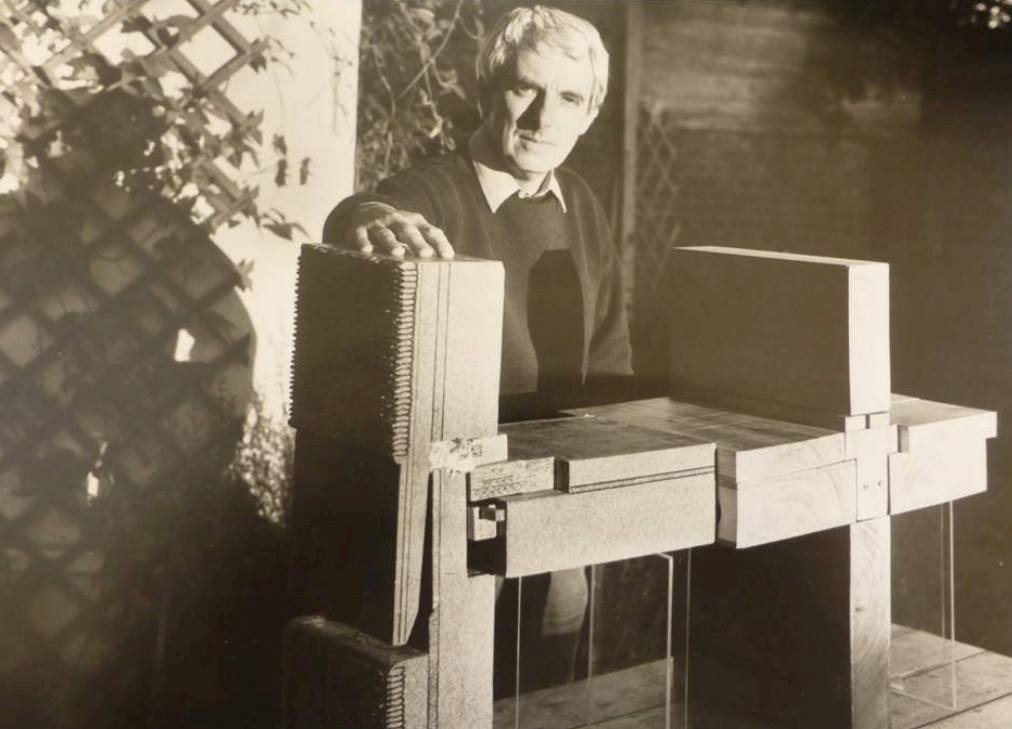
Over the years, Sam Webb offered his expertise to tenants’ groups nationwide. He also wanted to develop residents’ own expertise, using architectural education to empower people. He gave workshops training residents to spot building safety faults themselves. He drew out diagrams to clarify the constructional intricacies beneath their wallpaper. Students at Canterbury School of Architecture built him wooden models to illustrate the faulty operation of joints in large panel system buildings.