“Little Chicago”
The Hyde Park Estate rose in the 1960s on the cleared streets of ‘Little Chicago’, the back-to-back houses where Sheffield’s steelworkers’ families had lived for a century. The estate’s ‘streets in the sky’ had been imagined by avant-garde architects. They were sold on a promise: the slum streets and the people who lived in them would be carried up into the air, their communities intact. “The great majority of the local residents,” the architect Jack Lynn wrote in 1965, “could be housed without leaving the district at all.” 1
It didn’t happen like that. The people of ‘Little Chicago’ did not end up in the towers at all. They were scattered across the city instead, rehoused onto dozens of estates and hundreds of streets. Only a fraction returned to the ground they’d been cleared from. The towers were filled with people from elsewhere. The community that the ‘streets in the sky’ were meant to preserve had already been dispersed before the concrete set.²
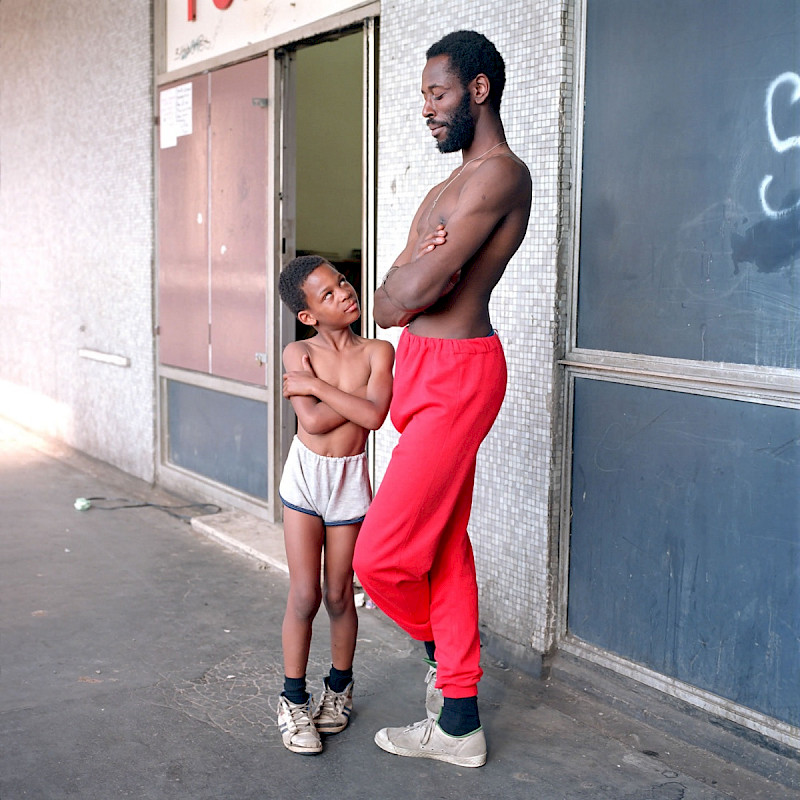
What grew on the hill instead was a new community, which was documented by the photographer Bill Stephenson in 1988. Tony ‘The Ton’ Greaves, who the admiring children believed could lift a ton (pictured). Anita Cutts and Emma Guirham, who delivered the papers on roller skates. Sue, who ran the shop and gave tenants strap when they were short, and wrote the debts on cards in the window. The kids who hung round the Pop-In centre.³ But by the 1980s, the council had decided to disperse them, too.⁴
The estate was getting run down. With the steel gone and the council near bankrupt, lifts went unrepaired, graffiti unremoved. A third of the tenants were leaving every year. Pharaoh ants thrived in the heated ductwork; residents had campaigned to get them dealt with in 1977 but a decade later they were still crawling around, building their colonies, still listed by tenants among the problems – alongside broken lifts, poor heating and nowhere for children to play. 77% of tenants said they wanted to leave. But wanting out of a failing building is not the same as agreeing to be scattered.⁵
Tenants organised to resist exactly that. The Hyde Park Community Action Project, funded by the DHSS and run by an elected residents’ committee, employed its own community worker and social worker; the tenants paid the wages and set the priorities. Angela McCreery coached residents before council meetings so they could hold their ground. Rachel Dodsworth’s weekly drop-in saw 136 people in six months. There were groups for mental health, for older residents, for under-fourteens, and a media team set up to fight the estate’s press image.⁶
It made little difference. In December 1986, 3,000 tenants were told they would be rehoused. The World Student Games were coming to Sheffield in 1991, and a half-emptied estate close to the city centre would make a convenient athletes’ village.
Paul Dingley had lived his whole life at Hyde Park. He was frightened of leaving. Dave Darbyshire was depressed and lonely, and he kept two German Shepherds against the rules. Rehousing would mean giving them up.⁷
The blocks were emptied between 1989 and 1990. Block B, the great keep on the crown of the hill, was demolished over the course of 1992 to ‘93. Two blocks survived, were reclad and handed to a housing association as Castle Court and Harold Lambert Court.⁸
For all that, the place had an undoubtable magnificence. It loomed over the city and the railway below, monumental, unmissable. Luke Una, a celebrated DJ, put Hyde Park on his 2022 album cover. It was where his life and his music had started. Photographer Bill Stephenson spent 1988 making portraits of its last residents before the towers came down.⁹
Twice now the people of this hill had been moved on to make way for an idea: first the steel families cleared so the streets could be lifted into the sky, then the community in the sky cleared so athletes could sleep where they had lived.
- Holly Smith, Up in the Air (2025), pp.39-66: Hyde Park and Park Hill as two phases of one Womersley scheme; the deck-access ‘streets in the sky’ derived from Le Corbusier’s Unité d’Habitation (Marseille) and Alison and Peter Smithson’s unbuilt Golden Lane scheme (London); Jack Lynn’s 1965 quotation.
- Smith, Up in the Air (2025), pp.50-53: Chris Bacon’s examination of Sheffield’s slum-clearance records — the effort to preserve the original community ‘an outright failure’; residents dispersed across up to 229 streets, only a fraction rehoused on the new estate. (Bacon’s documented figures are for the sister estate, Park Hill.)
- Bill Stephenson, ‘Streets in the Sky’: Portraits of the Last Residents at Hyde Park Flats, Sheffield, 1988 (billstephenson.co.uk): Tony ‘the ton’ Greaves photographed outside the Pop In with Martin, aged 8, and the origin of his nickname; Anita Cutts and Emma Guirham, roller-skating paper delivery girls; Sue’s shop, the ‘strap’ she gave tenants and the defaulters’ names written on cards in the window.
- ‘A Gallery from “Love Among the Ruins” Exhibition in Sheffield, Documenting Housing Projects Park Hill and Hyde Park’, On: Yorkshire Magazine, 26 June 2018 (on-magazine.co.uk): the December 1986 decision to rehouse 3,000 tenants for the World Student Games village.
- National Tower Blocks Directory 1987 (TBUK2078, p.64): the estate run down — lifts, graffiti, annual turnover; “the occupying army of pharoah ants”; 77% of tenants wanting to leave. Sheffield City Archives, CA-MIN/114, p.643: the Hyde Park Walk and Hyde Park Terrace ant petition, 2 February 1977.
- National Tower Blocks Directory 1987 (TBUK2078, p.64): the Hyde Park Community Action Project — DHSS-funded, elected residents’ committee; Angela McCreery; Rachel Dodsworth’s drop-in (136 in six months); the mental health, senior citizens, under-fourteens and media groups.
- Bill Stephenson, ‘Streets in the Sky’: Portraits of the Last Residents at Hyde Park Flats, Sheffield, 1988 (billstephenson.co.uk).
- National Tower Blocks Directory 1992 (TBUK2211, p.128): Block B’s hilltop ‘castle keep’ outline; demolished 1992–93; rubble to the ‘Hole in the Road’ survivors reclad as Castle Court and Harold Lambert Court.
- Bill Stephenson, ‘Streets in the Sky’, 1988 (billstephenson.co.uk).
Related Archive Documents
Action Packs
Want to start a community campaign? Here’s a guide to forming or joining a residents’ association.
Are you a tenant facing an emergency move from your block because of building safety issues? Here’s a guide to help you secure clarity about the future.