“Stay Put”
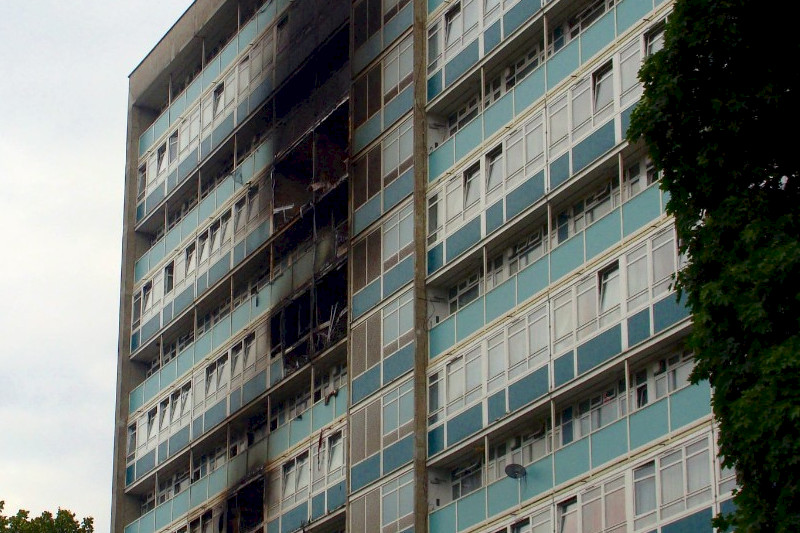
On the afternoon of Friday 3 July 2009, a portable television short-circuited in a ninth-floor flat at Lakanal House, a fourteen-storey block on the Sceaux Gardens Estate in Camberwell. The resident had left the room to tend to her baby, who was crying. When she came back, the wall beneath the window was alight. The wall panel – a thin plastic-laminate board, no more fireproof than the television that lit it – burned through within four and a half minutes. With her baby in her arms, she got out and called 999. By the time the first fire engine arrived, flames had taken hold of the building's outside wall across multiple floors.
Content Warning
This story details a fatal building disaster and includes potentially distressing material.In flat 79 on the eleventh floor, Catherine Hickman was working. She was 31, a fashion designer who had made clothes for the musician Björk. Catherine phoned 999 as smoke and then flames rose past her window. The control officer told her to stay in her flat. As conditions worsened she was told to go upstairs to the living room of her maisonette. What the call handler could not know was that a former tenant – with the council's permission – had removed part of the staircase wall. The bedroom and living room were therefore a single connected space, and the fire and smoke followed her upstairs. Catherine was told to lie on the floor during the call. [RG15] She lost consciousness and died.¹
In the flat next door, three families gathered as the flames rose; Mr and Mrs Nuhu and their two children, Helen Udoaka and her twenty-day-old baby Michelle, and Dayana Franciscquini with her two young children Felipe and Thaïs. Helen had knocked on Catherine's door but in her panic, Catherine could not open it. Mr Nuhu went upstairs to check the external balconies that led to the main escape stair. He came back down but could not persuade Dayana or Helen to leave. They had been told to stay put and await rescue.
The Nuhus left and survived. The bodies of the two mothers, two children, and the baby were found in the bathroom of flat 81.
When the fire was out, a search-and-rescue team went up in breathing apparatus. In the dark of flat 81, the senior firefighter felt for the bathroom door. He reached in and brought out a body [RG16] – Helen – then went in again, this time lifting out a soft bundle. At first, he could not identify what he was holding, but then, by the light on his helmet, he saw that he had Michelle in his arms, dead at twenty days old. He laid her down, stood and said, “I've got to get out.” Still masked, he ran until he collapsed on the stairs. When they got him outside into the air, his heartrate was at a hundred and sixty, his body at a temperature far hotter than a person should survive. His colleagues poured water over him and he was rushed to hospital. He was off work for months. When he gave evidence at the inquest, he was plainly still carrying the trauma.²
The control-room officers carried it, too. The woman who had stayed on the line to Catherine Hickman for the best part of three quarters of an hour, until she could no longer hear her breathing, was so affected that the coroner excused her from giving evidence.³
The fire had run the entire length of the main access corridor – sixty metres of it – through a false ceiling made entirely of wood. It had been fitted in the 1980s to hide new heating pipes. The walls below carried ten coats of oil-based paint, sealed under a Class 0 fireproof coating. When the heat hit, the paint behind the coating melted, slid down the walls and ignited; a flame ten metres long shot from the window at the far end. Under Section 20 of the London Building Acts, the block's external walls were supposed to hold back fire for an hour; the panels that failed managed four and a half minutes. Five days before the inquest began, the last of Section 20 was repealed.⁴
Standing in front of Lakanal House the next day, an independent housing expert was asked what had happened. “This building doesn't comply with the building regulations. Or if it does, there is something seriously wrong with them. Because buildings are not meant to behave like this.”⁵
He was right on the second count. The building had complied with the regulations – and the regulations were rotten. The panels that failed were rated Class 0, which tests only how fast flame crosses a surface: a thin skin over a flammable core passes. The building obeyed the rules. The rules let it burn.⁶
After the inquest, the coroner did what the law requires when deaths may recur: she wrote to the minister, Eric Pickles, with the recommendation to fit sprinklers in older towers and rewrite the fire regulations in plain language. The letter carried legal weight. It was ignored. Eight years later, Grenfell Tower burned.⁷
- Sam Webb, ‘Groundhog Day: From Ronan Point 1986 to Grenfell Tower 2017’, 2017 (WESA_9_2_02): Catherine Hickman; the 28-minute 999 call; flats 79 and 81; Helen Udoaka and 20-day-old Michelle; the wooden false ceiling; Section 20 repealed five days before the inquest.
- Sam Webb, Audio Interview with Hannan Majid (2019) and Webb, ‘Groundhog Day’, 2017 (WESA_9_2_02): the search-and-rescue firefighter who recovered Helen Udoaka and her twenty-day-old daughter Michelle from the bathroom of flat 81, his collapse on the stairs (heart rate c.160, core temperature beyond survivable), months off work and evident trauma when giving evidence at the inquest. Webb appeared as a court-appointed expert witness for the bereaved families.
- Webb, Audio Interview with Hannan Majid (2019): the control officer who remained on the 999 call to Catherine Hickman for roughly forty-five minutes was excused from giving evidence by the coroner.
- Lakanal House inquest (Inner South London Coroner's Court, before HHJ Frances Kirkham), Ruling on Composite Panels, 4 April 2013: Section 20 of the London Building Acts (Amendment) Act 1939, as amended, required one-hour fire resistance for the external walls; it remained in force only until 9 January 2013, five days before the inquest opened on 14 January 2013. The HPL spandrel panels fitted in the 2006–07 refurbishment burned through in about four and a half minutes.
- Webb, ‘Groundhog Day’, 2017 (WESA_9_2_02) and Sam Webb, Interim Report: Fire at Lakanal, Sceaux Gardens, Camberwell’ 3 July 2009 (WESA_5_4_02): building height 140 feet. Storey count differs between sources – Webb’s essay counts podium levels, Holly Smith’s book counts accommodation storeys.
- Coroner Frances Kirkham's Ruling after the Lakanal Inquest, 4 April 2013: the panels were required to be Class 0 but not fire-resistant. Class 0 (BS 476) measures only surface spread of flame, not fire resistance, so composite panels with a non-flammable facing could pass; Webb, Audio Interview with Hannan Majid (2019): the oil-based paint beneath the Class 0 coating melting and igniting the corridor.
- Webb, ‘Groundhog Day’, 2017 (WESA_9_2_02) and Webb, Audio Interview with Hannan Majid (2019): the Lakanal coroner's Rule 43 “prevention of future deaths” report to the Secretary of State (Eric Pickles), recommending retrofitted sprinklers and a plain-English rewrite of Approved Document B (fire safety); the recommendations not acted on before the Grenfell Tower fire of 14 June 2017.
Related Archive Documents
Action Packs
Worried about fire safety in your tower block? Ask your landlord about whether steps are being taken to deal with unsafe cladding using this letter template.
Check up on the progress of your block’s fire risk assessment.
Confused about ACM (aluminium composite) cladding? Here's an explainer.
Notify the Fire and Rescue service about any fire safety breaches you find.
Find out about some practical actions you can carry out to minimise risk.