“The Campaign”
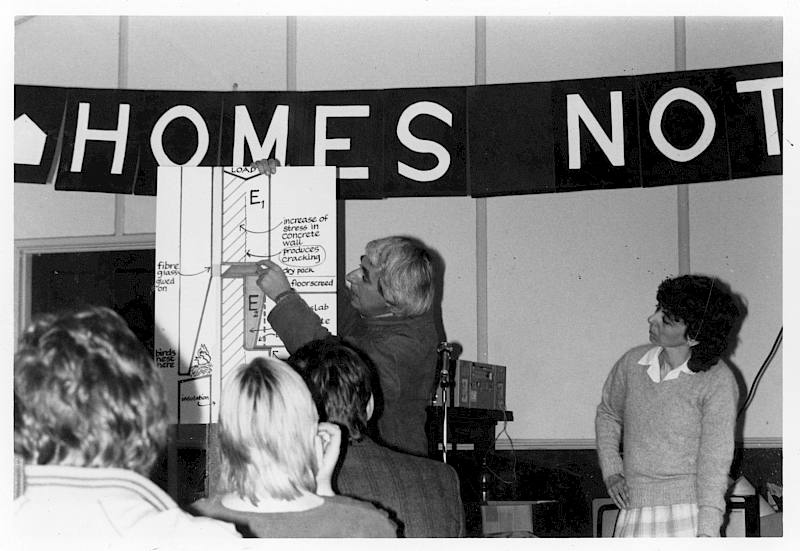
Frances Clarke was a community worker at Community Links in East Ham with a core working principle: tackle causes, not symptoms. In 1981, she helped form the Newham Tower Block Tenants Campaign. This was a local fight, run by women, over the dangerous blocks of one London borough.
Alongside her was Liz Lowe, a social care team leader who organised on the Freemasons Estate, where Ronan Point stood, and fought not merely to demolish the blocks but to rebuild them as somewhere people could live. And there was the architect Sam Webb, whose gift was that he did not lecture tenants – he armed them with technical proof.
In October 1983, Clarke, Lowe and Webb took it national, founding the National Tower Blocks Network.1 It ran for a decade. The View was their national bulletin carrying stories and campaigns from every corner of Britain, while their National Tower Blocks Directories were the most comprehensive record ever assembled of tower block life in Britain. Every relevant local authority, every tenants' association, every issue from asbestos to heating to structural failure to children, indexed and cross-referenced.2
Thousands of strangers found out they were fighting the same fight. A tenant in Sheffield discovered that a tenant in Glasgow had faced the same denial, the same evasion, from a different council, in a different system-built block. The network gave them the language, the technical knowledge and the connection to fight back.3
Then the funding ran out, the Network fell quiet, and for twenty-five years the knowledge sat on shelves. On 14 June 2017, Grenfell Tower burned.
In Peckham, a tenant named Danielle Gregory realised that she was living in an unsafe home on the Ledbury Estate. She had no technical training, only the refusal to be managed instead of answered – the instinct the Network had fostered in others since the 1980s. Gregory dug into the records and found the danger ran far beyond her estate. She identified at-risk blocks of the same construction in borough after borough. Residents had questions for those in authority. The questions were filmed and put online, where they gathered traction and national press attention. Central government wrote to every council chief executive in the country, ordering them to check the safety of their large panel system blocks. That was exactly what had been demanded – and dodged – in 1968. After a residents' meeting at Southwark's offices, walking out together, Webb told Gregory she had made history. She replied, “Who, me?” 4 Together with Frances Clarke, Liz Lowe and Sam Webb, the principles of the National Tower Blocks Network were revived in a new organisation. Tower Blocks UK carries forward the campaigns of the past so that tenants of the future never have to start from zero again.
In 2017, multiple generations were making the same case, because the slow violence had never stopped.5 The violence was not only in the explosion or the fire, but in the years of reports shelved and warnings ignored. Dame Judith Hackitt's review after Grenfell found what the campaign had known since 1981: residents are repeatedly ignored, although it is the residents who know the faults of their buildings most intimately. More than five hundred blocks of the same type as Ronan Point were still standing, housing perhaps a hundred thousand people, many never strengthened in the half-century since the first warnings.6
Danielle Gregory feared how it would end, that the estates would be cleared and sold off as private flats, a safety scandal resolved by removing the social housing itself. “If a massive safety problem ends up leading to a massive loss of social housing,” she said, “then it's a kind of double punishment.” 7
Back in January 1983, in the middle of the campaign’s first chapter, Clarke had written Webb a strategy note with the postscript: “We're getting a new carpet on Monday + I got a 3-piece suite in the sales – we'll soon be positively bourgeois.” 8 It tells you where the expertise in this fight actually sat: not with ministers or inspectors, but with a community worker running a national campaign from her own front room, and with tenants who knew their buildings from the inside out. Decades later, Gregory understood this instinctively when she said, “Knowledge is our weapon and collectivism is our power.” 9
When sending his architecture students off on site visits, Sam Webb used to give them Hemingway’s advice: take “a built-in crap detector”. That, he said, is what anyone who looks at these buildings needs: the nerve to ask the obvious question and cut through the official reassurance. For half a century the campaign had handed that, resident to resident, to those who needed it most.10
Today, residents across the United Kingdom are lobbying for improvements to the planning, management, and safety of their own homes. They are not acting in isolation; they are part of a movement that has been at work for decades. The fight is not over.
- ‘National Tower Blocks Network Conference’, 1983 (TBUK3): Photographs and records of the first National Tower Blocks Conference, East Ham, 23 October 1983.
- National Tower Blocks Directory 1987 (TBUK2045); National Tower Blocks Directory 1992 (TBUK2079). Editions of The View can be found in TBUK2, TBUK6, TBUK12 and WESA_3_3_01.
- Frances Clarke, ‘Confidential Minutes, Tower Blocks Meeting’, 12 April 1984 (TBUK1003): Frances Clarke proposed: “Through joint work with those groups we may be able to exert more pressure.”
- Sam Webb, Audio Interview with Hannan Majid (2019).: leaving Southwark Town Hall after the post-Grenfell meeting, Webb told Gregory she had made history – the residents' filmed questions on the website she created reached the minister, who then instructed every council chief executive to check their large panel system blocks, bringing the matter 'full circle' to the unmet demands of 1968.
- Jenny Preece and John Flint, 'Unhoming, Trauma and Waiting: The Post-Grenfell Building Safety Crisis in England', International Journal of Urban and Regional Research, 48:1 (2023).
- Dame Judith Hackitt, ‘Building a Safer Future’, 2018: found residents were not listened to; Adam Forrest, ‘Hundreds of Tower Blocks Across UK at Risk of Collapse, Say Experts’, Independent, 22 October 2018.: at least 575 Large Panel System blocks still standing, some 41,000 dwellings, around 100,000 people, many never strengthened since the 1968 and 1984 warnings; Peter Apps, ‘Revealed: more than 200 Ronan Point-style blocks still have gas and may not have had strengthening work’, Inside Housing, 13 March 2025: more than 200 LPS tower blocks still have a gas supply without confirmed strengthening works. Grenfell itself was a framed, non-system block: the link across these stories is the pattern of ignored warnings, not a shared construction type.
- Forrest, ‘Hundreds of Tower Blocks across UK at Risk of Collapse’.
- Frances Clarke, Letter to Sam Webb, 10 January 1983 (TBUK1001).
- Danielle Gregory, Transcript, c.2017 (TBUK6_020): quoted verbatim.
- Webb, Audio Interview with Hannan Majid (2019): Sam Webb's teaching line citing Ernest Hemingway's “built-in crap detector”.
Related Archive Documents
Action Packs
Want to start a community campaign? Here’s a guide to forming or joining a residents’ association.
Successful campaigns need a strategy. Here's a toolkit.
Drumming up support in your community? Here’s a pack of editable resources, including flyer and poster templates.
Local campaigns can become national campaigns by building a network of contacts. Here’s a directory of residents’ action groups across the UK.