Letter from Sam Webb to the Architects' Journal, 'Ronan Point'
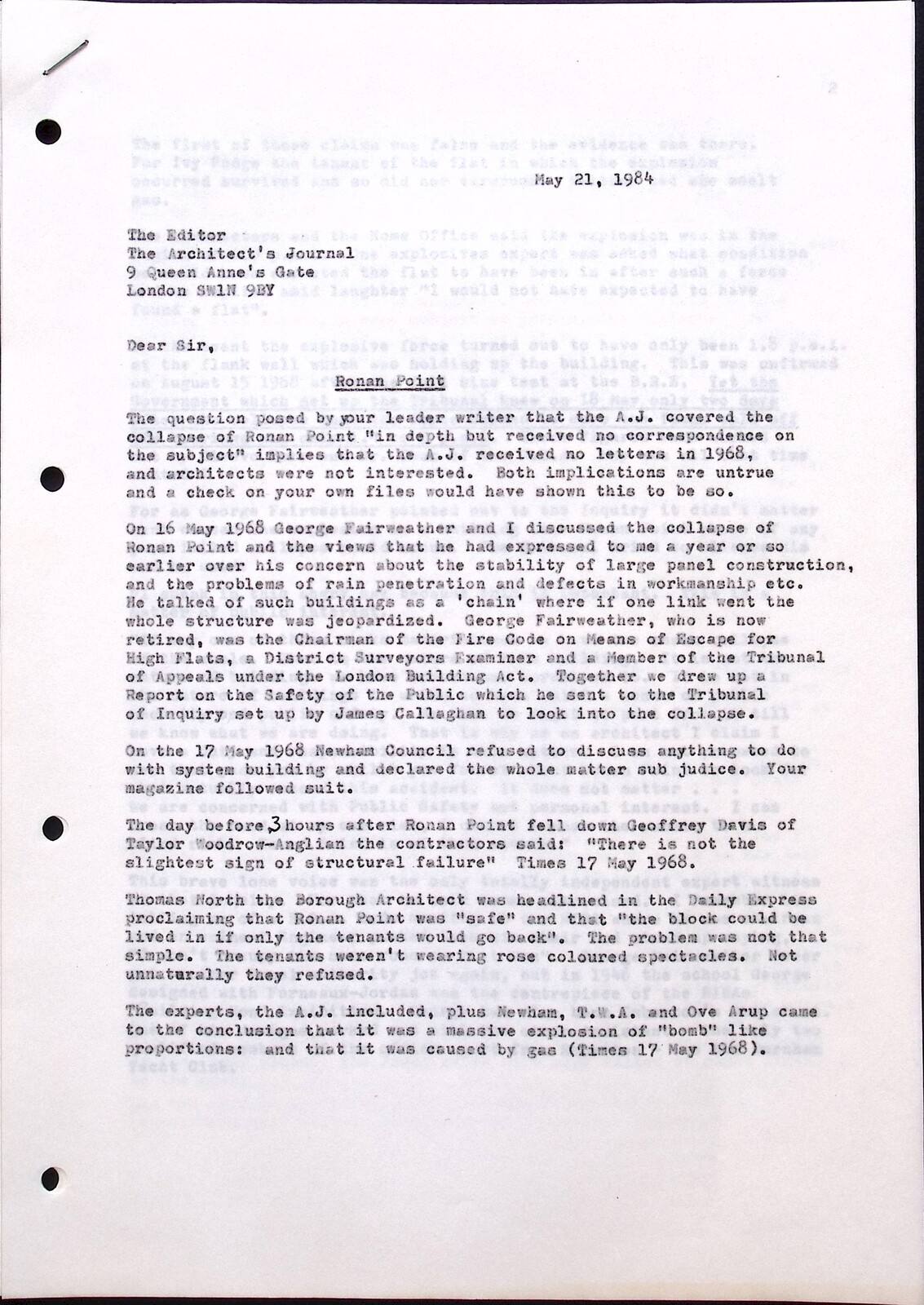
May 21, 1984
The Editor
The Architect's Journal
9 Queen Anne's Gate
London SW1N 9BY
Dear Sir,
Ronan Point
The question posed by your leader writer that the A.J. covered the
collapse of Ronan Point "in depth but received no correspondence on
the subject" implies that the A.J. received no letters in 1968,
and architects were not interested. Both implications are untrue
and a check on your own files would have shown this to be so.
On 16 May 1968 George Fairweather and I discussed the collapse of
Ronan Point and the views that he had expressed to me a year or so
earlier over his concern about the stability of large panel construction,
and the problems of rain penetration and defects in workmanship etc.
He talked of such buildings as a 'chain' where if one link went the
whole structure was jeopardized. George Fairweather, who is now
retired, was the Chairman of the Fire Code on Means of Escape for
High Flats, a District Surveyors Examiner and a Member of the Tribunal
of Appeals under the London Building Act. Together we drew up a
Report on the Safety of the Public which he sent to the Tribunal
of Inquiry set up by James Callaghan to look into the collapse.
On the 17 May 1968 Newham Council refused to discuss anything to do
with system building and declared the whole matter sub judice. Your
magazine followed suit.
The day before 3 hours after Ronan Point fell down Geoffrey Davis of
Taylor Woodrow-Anglian the contractors said: "There is not the
slightest sign of structural failure" Times 17 May 1968.
Thomas North the Borough Architect was headlined in the Daily Express
proclaiming that Ronan Point was "safe" and that "the block could be
lived in if only the tenants would go back". The problem was not that
simple. The tenants weren't wearing rose coloured spectacles. Not
unnaturally they refused.
The experts, the A.J. included, plus Newham, T.W.A. and Ove Arup came
to the conclusion that it was a massive explosion of "bomb" like
proportions: and that it was caused by gas (Times 17 May 1968).
The first of these claims was false and the evidence was there.
For Ivy Hodge the tenant of the flat in which the explosion
occurred survived and so did her eardrums. Neither had she smelt
gas.
The contractors and the Home Office said the explosion was in the
region of 600 p.s.i. One explosives expert was asked what condition
he would have expected the flat to have been in after such a force
and he replied amid laughter "I would not have expected to have
found a flat".
In the event the explosive force turned out to have only been 1.8 p.s.i.
at the flank wall which was holding up the building. This was confirmed
on August 15 1968 after the full size test at the B.R.E. Yet the
Government which set up the Tribunal knew on 18 May only two days
after the collapse that the force needed to move the flank wall off
its bearings was only 1.4 to 2 p.s.i. Those figures were worked
out by Cleeve Barr and Dr. Chan of the N.B.A. Why was all that time
wasted ?
For as George Fairweather pointed out to the Inquiry it didn't matter
what caused the explosion in a building like Ronan Point where if any
part failed collapse could occur. The Tribunal tried to silence him
and he said:
"I speak in this angry way because this is important. This is a
matter of public interest.
"If any one of these risks materialises we have the chain collapse
of the whole. That is the nature of this building. It is not the
nature of buildings we have accustomed ourselves to. It is not in
the nature of buildings in which we have built a sense of public
security and public safety. We have no right to part from it till
we know what we are doing. That is why as an architect I claim I
have a duty and responsibility in this matter. I am not prepared to
see that pass you by whilst you ferret about Ronan Point to look for
what actually caused this accident. It does not matter . . .
We are concerned with Public Safety not personal interest. I can
cross the road at my own risk, I cannot expose the public to a
blind risk. Ronan Point is of that nature."
This brave lone voice was the only totally independent expert witness
at that Inquiry. For what he said he was ostracised. I remember him
telling me of a B.S.I. code meeting at the RIBA where he was chairman
and an eminent Engineer pushed back his chair and stood up saying,
"I won't occupy the same room as that man". George Fairweather never
got another local authority job again, but in 1946 the school George
designed with Furneaux-Jordan was the centrepiece of the RIBAs
"Building Now" Exhibition. George had also been Emberton's Assistant.
One of his designs worked out with the other Assistant - the only two
qualified members of the office apart from Emberton - was the Burnham
Yacht Club.
George and I had a touching and slightly innocent belief in the
impartiality of the Architectural Press in those days. We sent
all our evidence to you and more in August 1968, after the Inquiry
finished. You returned it saying " we do not see eye to eye with
you on this subject."
In late August I sent a letter which you published on the 4th September.
This dealt with Ronan Point. On the 7th October I sent another letter
to you. It concerned defects in Quarry Hill, Trowbridge Estate
Hackney, Ronan Point and the hundred or so blocks of flats in this
country that I thought were subject to progressive collapse. My
estimate was far too low. You returned it to me a month later saying
there was no evidence to support my case. And also saying
"The Architects admit that there is damp penetration mainly at the
balconies and window joints, and agree that damp tends to find its
way out, as is often the case, at weak points like light switches
and socket outlets"
The tenants of Trowbridge Estate are still waiting sixteen years later
for someone to cure that particular little "teething problem". The
day your Editor's letter arrived the Tribunal published its Report.
At the time you told me that Trowbridge was not subject to progressive
collapse. Of course it is, and a recent report by engineers has said
so. Hackney want to pull it down, so do the GLC. Various reasons have
been put forward why it can't be blown up including proximity to a
British Oxygen Plant. No explosions can take place within three
miles of that. How convenient.
Quarry Hill has been demolished. So has YDG's iniquitous Hunslet Grange
in Leeds after campaigns by the tenants over the last eight years and
reports on its structure, fire risk and bowing panels by myself and an
incredible campaign fought by Roger Critchley and the tenants.
Today YDG's Broomhall in Sheffield is considered structurally unsound,
Balloon Wood also YDG in Nottingham is being demolished, now Ronan
Point has been evacuated. Why?
In November 1983 I carried out a survey of No. 26 Ronan Point for a
tenant. I also saw some other flats in Hammersmith built in the same
system. Since then I have inspected many flats in this system on a
number of estates in London. I have talked to structural engineers
and architects responsible for looking after the estates. I've talked
to tenants and maintenance surveyors. Many are very worried. In March
this year I carried out a survey of Ronan Point. Tenants representatives
will confirm to you that I was very guarded in what I said to them about
my survey. Nearly one thousand families live on that estate, virtually
every flat I surveyed had evidence of the breakdown of the joint between
the edge of the floor and panels causing fire risk. This was along
both sides of the block. My students and I found evidence of "creep"
in the floor slabs. The floor slabs were also tilted at right angles
to the span.
There was evidence of movement in the building consistent with it
beginning to fail due to excessive sway. Water was beginning to
enter the structural joints. It has got worse since the survey.
Although I had spoken to Newham's Engineers last year about these
faults both they and Newham's consultants and Engineers from B.D.P.
seem to have been unaware of these problems. They subsequently
stated the panels had stopped bowing, that there was no movement
in the floor slabs. They proposed taking a panel off the living
room on flat 26. This is on the sixth floor, seventy feet above
ground. They had no drawings to show how to get it off. It weighs
3 tons. In fact it can't be done without breaking the panel. This
lack of information did not prevent them ordering a crane. My
concern is the safety of the tenants. The block would have been full
of families. On behalf of the tenants I said I could not agree. We
drew up plans to issue a High Court Injunction. BDP and
The London Fire Brigade confirmed my report. Together with Newham's
engineers they produced a fire stop consisting of two small pieces
of wood at ceiling level to mask the joint. I refused to accept this
unless the F.R.S. confirmed it passed a 1 hour fire test to B.S.476.
The fire officers agreed that it would only give 10 mins. fire cover.
The Chairman of Housing Fred Jones ordered the evacuation of Ronan Point
so that it could be tested. Neither he nor I thought it safe to
carry out these tests with an occupied block. His officers did not
agree. They said he had no authority to order evacuation. A special
Housing Committee was called at which it was revealed that the Engineers
did not have a floor plan or section of the block showing where
critical joints were. This is still yet to surface. The Chief Engineer
did not know how many flats his department had surveyed in Ronan Point.
We at least knew about 51 and we knew it was a panel construction
and not a frame as they described Ronan Point in their Report to
committee.
It was reported to me by tenants and the Vice Chairman of Housing that
the panels on the front of the block moved. Three tenants on one side
of the block told my students and I that the walls creaked in windy
conditions. Another tenant told me that the panel on her flat "rattles
when it's windy". Water comes through the ceiling of her flat, as it
does in many flats. These people do not live on the 22nd floor where
you have to pay higher rates and rent for the view, but in one case
on the first. Ronan Point is not a two storey house. If I can move
a panel with a crowbar or even my hand what does a 120 mph wind do ?
Contrary to the drawings the joint between these non-loadbearing panels
is filled with 1 : 1 mortar. There is no room for movement. If one
expands the one above and below must move. As the total height of
these panels is 200 feet and they have no room for expansion up or
down what is the long term effect of this great mass going to be ?
If one drops off as Newham Engineers confirm, it could peel off all
those below. After all that's precisely what happened to them in 1968
and was witnessed by a terrified woman, Brenda Maugham, as she clung
on by her fingers 15 floors up. Three hours later the contractors
and the Borough Architect proclaimed the block "safe", and the
contractors said "there was no sign of structural failure."
Many of the joints between the edge of the floor and the wall panel
do not comply with the drawings. Some are filled with polystyrene.
On Ocean Estate Bow I found joints packed with fibreboard. All the
panels move yet all these joints should comply with E.9. Is that
why they silenced George Fairweather ?
The tenants at Freemason's Road are tired of living in a mistake,
they are sick of "experts from the Council", they are sick of their
flats ruined by floods of water, sick of climbing out of the kitchen
window 22 floors up to hang out the washing because their balcony
door is jammed, sick of experts telling them it's their own fault
because they don't like living in Ronan Point. They have refused
to park in any of the podium car parks since they were built,
because they are unsafe. These have been bricked up.
Recently we [illegible text] held a meeting. Barry Meekings who was moved out of flat 26
after my [illegible text] survey came up to me. I didn't recognise him he had
changed so much. I asked where Elaine was, "Oh she's not too well."
"Why's that ?" I asked, "She's going to have a baby." They wouldn't
consider this in Ronan Point.
Ronan Point, Merrit, Dodson, Gannon, etc. seem to me to be a rather
rickety mast head on which to hang the standard of the modern movement.
They are an engineering and contracting disaster as much as anything.
Ronan Point is the tip of the iceberg, the AMA's Report on defects in
system buildings gives a total of 1.5m defective buildings. In London
alone there are nearly 6000 flats in Taylor Woodrow-Anglian.
Contrary to widespread belief that similar faults have not occurred
abroad they have. Even in Scandinavia. Even the Swedes are finding
some of their tower blocks a disaster too.
Your leader writer came to Ronan Point for half an hour. He came in a
taxi from the Mansion House Inquiry. Taxis are a rare sight in Custom
House especially with £20 on the clock, so is a bus. He said he'd
"lived in a high-rise in the States which was OK". But that's no
comparison with E.16. He often phones me for quotes. He said he
liked the one about AID's he'd read it in the Times. Like many
journalists he asked me when Ronan Point would fall down. I don't know
but I think parts of it might fail. It is not a predictable structure
and its not altogether stable. Neither are those blocks in the Morris
Walk Series.
Perhaps it is a crime, or a sign of madness to be concerned with Ronan
Point and I.B. systems for sixteen years. Maybe I should have taken up
Post-Modernism or become an airbrush expert instead. But I didn't and
I wouldn't, but I can't help thinking of the water rusting away the
fixings of load bearing joints in a building with a factor of safety
of 1.08. And I think of my friends like Barry and Elaine, Mrs. Curry,
Shelley House and Collet and Mrs. Patterson who climbed out of her kitchen
window to hang out her washing and I think why ? Because I think if I
do nothing for them who else will ? Besides they need my help far
more than Peter Palumbo Martin. He's a multi-millionaire. We're
all doing it for love.
Yours faithfully,
Sam Webb
Copy to
Fred Jones - Chairman of Housing Newham
George Fairweather F.R.I.B.A.
Nigel Spearing M.P.
Tony Banks M.P.
Robin Corbett M.P.
Paul Foot
Joan Littlewood