Sam Webb, 'Why, Why, Why?', Draft for RIBA Journal
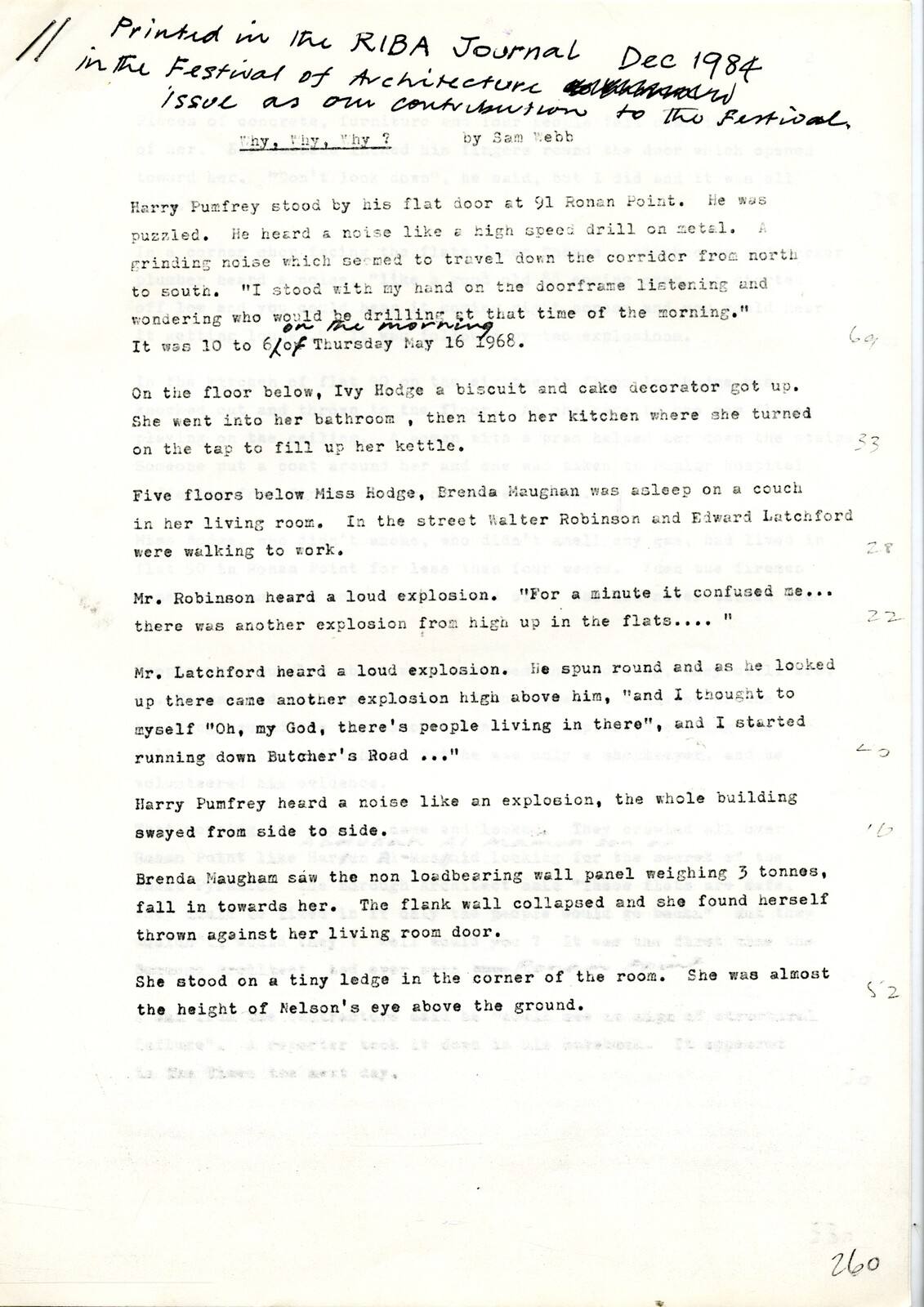
Why, Why, Why ? by Sam Webb
Harry Pumfrey stood by his flat door at 91 Ronan Point. He was
puzzled. He heard a noise like a high speed drill on metal. A
grinding noise which seemed to travel down the corridor from north
to south. "I stood with my hand on the doorframe listening and
wondering who would be drilling at that time of the morning."
It was 10 to 6 of Thursday May 16 1968.
On the floor below, Ivy Hodge a biscuit and cake decorator got up.
She went into her bathroom , then into her kitchen where she turned
on the tap to fill up her kettle.
Five floors below Miss Hodge, Brenda Maughan was asleep on a couch
in her living room. In the street Walter Robinson and Edward Latchford
were walking to work.
Mr. Robinson heard a loud explosion. "For a minute it confused me...
there was another explosion from high up in the flats...."
Mr. Latchford heard a loud explosion. He spun round and as he looked
up there came another explosion high above him, "and I thought to
myself "Oh, my God, there's people living in there", and I started
running down Butcher's Road ..."
Harry Pumfrey heard a noise like an explosion, the whole building
swayed from side to side.
Brenda Maughan saw the non loadbearing wall panel weighing 3 tonnes,
fall in towards her. The flank wall collapsed and she found herself
thrown against her living room door.
She stood on a tiny ledge in the corner of the room. She was almost
the height of Nelson's eye above the ground.
Pieces of concrete, furniture and four people fell down in front
of her. Her husband inched his fingers round the door which opened
toward her. "Don't look down", he said, but I did and it was all
gone."
In a corner shop facing the flats James Thomas a shopkeeper and former
plumber heard a noise, "like a good old 88 coming over, it started
off low and you could hear it coming right across and you could hear
it getting louder." It was followed by two explosions.
In the kitchen of flat 90 on the eighteenth floor Ivy Hodge was
knocked out and thrown to the floor. As she came to she saw flames
playing on the ceiling. A woman with a pram helped her down the stairs.
Someone put a coat around her and she was taken to Poplar Hospital
suffering from first and second degree burns.
Miss Hodge, who didn't smoke, who didn't smell any gas, had lived in
flat 90 in Ronan Point for less than four weeks. When the firemen
came, the gas taps were found turned off. She had never turned them
on.
People were puzzled about what happened that morning, they still are.
Mr. Thomas had his explanation: "You suggest a collapse of the
building caused the explosion and not the explosion causing the
collapse of the building." But he was only a shopkeeper, and he
volunteered his evidence.
That morning the experts came and looked. They crawled all over
Ronan Point like Harun Al-Rashid looking for the secret of the
Great Pyramid. The Borough Architect said "These flats are safe,
they could be lived in if only the people would go back." But they
wouldn't, would they ? Well would you ? It was the first time the
Borough Architect had ever seen Ronan Point.
A man from the contractors said he "could see no sign of structural
failure". A reporter took it down in his notebook. It appeared
in The Times the next day.
Joan Littlewood from the Theatre Workshop came, alerted by the fire
engines and ambulances. "It reminded me of the Gresford Pit disaster!"
She subsequently wrote two plays about Ronan Point.
A group of students from Hammersmith Poly marooned in a huge traffic
jam were treated to the first ever lecture on Ronan Point. It was
given by Alan Blanc.
An ashen faced architect passed me on the stairs in Camden's
Architect's Department. In his hand he had a copy of the Evening
Standard. It had one word in the headline repeated twice,
"Why, Why, Why?" Underneath was a picture of Ronan Point.
That afternoon I climbed the stairs of 28/30 Wigmore Street to the
office of George Fairweather. He was Chairman of the British Standard
Code of Practice Fire Precautions in Flats over 80 feet in height. He
had talked of something like this happening. James Callaghan the Home
Secretary had appealed for people to come forward to give evidence.
I told George he should do so. His friend Robbie, one of those
newspaper editors you read of in books phoned him too, "George you
said this would happen ..." On the 24th July he gave evidence. He
said Ronan Point was a Blind Risk.
On 6 November 1968 the day of Nixon's Election the Report was published.
It had been ready since 13 October.
Within a week of publication the Government had agreed to a dual
standard for system built flats. All new flats were to be built to
5 p.s.i. pressure, existing flats were to be strengthened to only
2 1/2 p.s.i. The force which brought down Ronan Point was between
3 p.s.i. and 12 p.s.i.
Angles were bolted on junctions of floors and walls. In April 1970
I received a reply from the Minister of Housing addressed to an M.P.
I had written to "Thank you for letting me see this letter about
structural stability in system built flats and the question of steel
angles used in strengthening work. I appreciate the points he is
making; however . . . it is really not for me to inquire into . . ."
I had asked what would happen if Ronan Point settled on those angles
which had no fire protection. Sir Hubert Bennett of the G.L.C., wrote
"In all other situations the angles are completely unloaded ... the
Council decided that fire protection of the angles was an unnecessary
expense."
In 1970 I went to Marsham Street and asked to see the Ronan Point files.
I spent three and a half weeks reading them. On October 22 1984
Ian Gow released them from the thirty year rule. It was after all,
a Public Inquiry.
In the spring of 1981 April Merrin threw herself from her kitchen window
on the 22nd floor of Dennison Point, Stratford. Sue McDowell her friend
was called to identify her body. April had been cut in two pieces by a
wall. Shocked tenants formed the Newham Tower Block Tenants Campaign.
In November 1981 Stratford and Newtown Points were blown up. This
year six more people died in the first three months. They either fell
or jumped in despair from high blocks in Newham.
The Campaign heard me speak about Ronan Point last year at the First
National Tower Blocks Conference. Sue went round to see her friend
Elaine Meekings in flat 26 Ronan Point. I carried out a survey of the
whole block. We met Fred Jones Chairman of Housing.
He told us of the Engineers Plan to remove a non loadbearing panel
from the front of flat 26 on the sixth floor. Ronan Point would have
been full of families. The engineers had ordered a crane. Frances
Clark of Community Links and I drew up plans for a High Court Injunction
to stop them. The block was evacuated and Fred Jones ordered it tested
to destruction.
They held a fire test on July 18. It was to last 20 minutes. The
Engineers stopped it after only 12, they thought the block would
collapse. Two hours later they said it was safe. No one believed them.
The tenants had told me and my students during surveys of noises like
grinding metal, of the building creaking in the wind, and of mice in
the structural joints. We didn't laugh. From the cracks in the
staircase walls I deduced that Ronan Point was sitting on the lifting
bolts and was held up by the 'strengthening' angles, that the drypack
had crushed or was never there in the first place.
from The Campaign
On 28 August 1984 a group of tenants/was being shown round.
Sheridan Hitchcock, who saw Ronan Point the day it fell down on
her way home from school said to the Engineers "It shows you just
how strong that joint was if that little old lady got up and walked
out of the flat and then the wall blew out and the building fell
down." They were standing in Miss Hodge's living room.
The Engineers opened the H.2 joint after that, [illegible] It was just like the moment
when Abdullah Al-Mamun son of
Harun Al-Rashid reached the middle of the Great Pyramid.
It was empty.
Harun Al- Rashid