National Tower Blocks Directory 1987
OUR ART — The
Work Of Stephen
Willats
“No British artist has done more in recent years towards redefining
his function within society than Stephen Willats . . . he has
gradually developed ways of ensuring that his art opens itself to
each kind of audience he contacts, incorporating the most ultimate
notions about the way they live.”
So wrote Richard Cork, the Guardian Art Critic, after reviewing
the Stephen Willats exhibition at the Whitechapel Art Gallery. The
art, like the artist, was unusual, even eccentric, but also warm,
perceptive and easy to understand. It is because Stephen Willats has
developed a particular interest in portraying tower blocks and the
life of the people within them that he has a unique place in this
book.
[caption: Willats has the ability to encourage confidence and intimacy and then to
express the results in a way that is effective, honest and stimulating.]
Willats chooses a tower block, Skeffington Court in West London
and Harvey House in Brentwood are amongst those he has chosen
in the past, and involves the tenants in creating an artistic work
which reflects their view of the world. Anyone who thinks this
sounds pretentious or improbable should visit a Willats exhibition
before passing a judgement. These are usually held within the block
and are an impressive demonstration not only of the extent of
participation but also of the depth of involvement.
Tenant Involvement
Willats has the ability to encourage confidence and intimacy and
then to express the results in a way that is effective, honest and
stimulating. Because many of the people he works with are lonely
and unhappy some people find the art to be uncomfortable. Sarah
Kent, the Time Out correspondent, said of the Brentford Tower
Exhibition “on paper it sounds unremarkable, but try it even for a
morning. I couldn’t get out of Harvey House fast enough.” But the
important thing is that Stephen’s art is our art. By tower block
tenants, about tower block tenants and for tower block tenants.
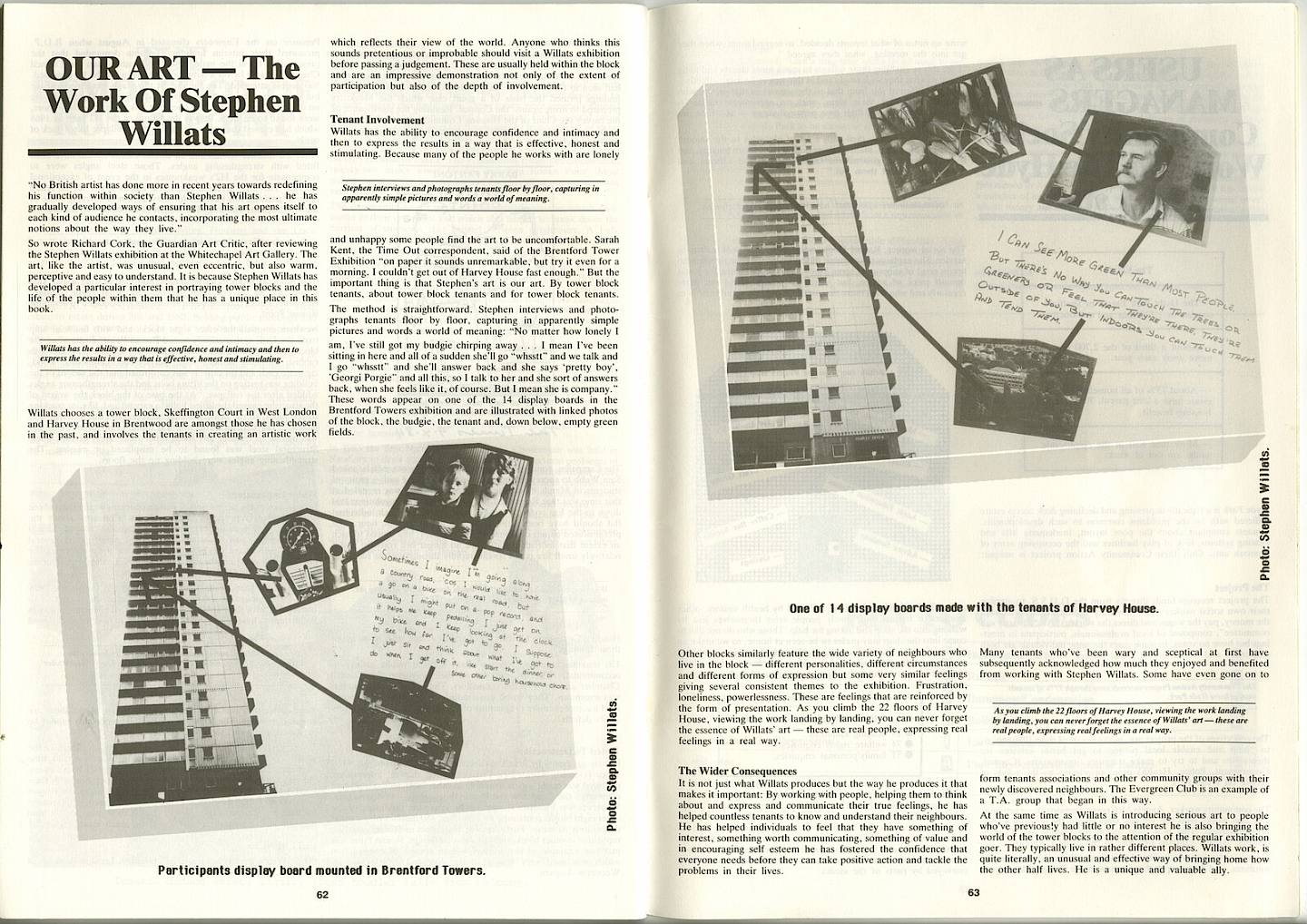
The method is straightforward. Stephen interviews and photo-
graphs tenants floor by floor, capturing in apparently simple
pictures and words a world of meaning: “No matter how lonely I
am, I’ve still got my budgie chirping away . . . I mean I’ve been
sitting in here and all of a sudden she’ll go “whsstt” and we talk and
I go “whsstt” and she’ll answer back and she says ‘pretty boy’,
‘Georgi Porgie” and all this, so I talk to her and she sort of answers
back, when she feels like it, of course. But I mean she is company.”
These words appear on one of the 14 display boards in the
Brentford Towers exhibition and are illustrated with linked photos
of the block, the budgie, the tenant and, down below, empty green
fields.
[caption: Stephen interviews and photographs tenants floor by floor, capturing in
apparently simple pictures and words a world of meaning.]
[caption: Participants display board mounted in Brentford Towers. Photo: Stephen Willats.]
[Handwritten text on display board: Sometimes I imagine I'm going along
a country road, 'cos I would like to have
a go on a bike on the real road, but
usually I might put on a pop record, and
it helps me keep pedalling I just get on
my bike and I keep looking at the clock
to see how far I've got to go. I suppose
I just sit and think about what I've got to
do when I get off it, like start the dinner or
some other boring household chore.]
[Handwritten text on display board: I CAN SEE MORE GREEN THAN MOST PEOPLE,
BUT THERE'S NO WAY YOU CAN TOUCH THE TREES OR
GREENERY OR FEEL THAT THEY'RE THERE, THEY'RE
OUTSIDE OF YOU, BUT INDOORS YOU CAN TOUCH THEM
AND TEND THEM.]
[caption: One of 14 display boards made with the tenants of Harvey House.]
Other blocks similarly feature the wide variety of neighbours who
live in the block — different personalities, different circumstances
and different forms of expression but some very similar feelings
giving several consistent themes to the exhibition. Frustration,
loneliness, powerlessness. These are feelings that are reinforced by
the form of presentation. As you climb the 22 floors of Harvey
House, viewing the work landing by landing, you can never forget
the essence of Willats’ art — these are real people, expressing real
feelings in a real way.
[caption: As you climb the 22 floors of Harvey House, viewing the work landing
by landing, you can never forget the essence of Willats’ art — these are
real people, expressing real feelings in a real way.]
The Wider Consequences
It is not just what Willats produces but the way he produces it that
makes it important: By working with people, helping them to think
about and express and communicate their true feelings, he has
helped countless tenants to know and understand their neighbours.
He has helped individuals to feel that they have something of
interest, something worth communicating, something of value and
in encouraging self esteem he has fostered the confidence that
everyone needs before they can take positive action and tackle the
problems in their lives.
Many tenants who’ve been wary and sceptical at first have
subsequently acknowledged how much they enjoyed and benefited
from working with Stephen Willats. Some have even gone on to
form tenants associations and other community groups with their
newly discovered neighbours. The Evergreen Club is an example of
a T.A. group that began in this way.
At the same time as Willats is introducing serious art to people
who’ve previously had little or no interest he is also bringing the
world of the tower blocks to the attention of the regular exhibition
goer. They typically live in rather different places. Willats work, is
quite literally, an unusual and effective way of bringing home how
the other half lives. He is a unique and valuable ally.
[caption: Photo: Stephen Willats.]