National Tower Blocks Directory 1987
USERS AS MANAGERS — Community Social Work On The Hyde Park Estate
The Estate
— The Hyde Park Estate in Sheffield
consists of 1,323 flats and maisonettes.
— About a third of the 2,700 tenants
move away each year.
— About 15% of all households on the
estate have a lone parent. 70% receive
housing benefit.
— More than half of the employable
adults are out of work.
Hyde Park is a typically depressing and declining deck access estate
afflicted with all the problems common to such developments.
Tenants complain about the poor layout, inadequate lifts and
heating systems, lack of play facilities and the occupying army of
pharoah ants. Only their Community Action project is unique:
The Project
The project receives funds directly from the D.H.S.S. to employ
their own social worker and community worker. Tenants manage
the money, pay the wages and direct the workers. An “advisory sub
committee”, composed of local professionals, participate in meet-
ings but have no votes. In some cases the same individuals are both
employers and clients of the social worker.
[caption: The Community Action Project succeeds even though 77% of tenants
want to leave Hyde Park.]
The objectives of the project are, in the words of their 1986 report,
to “help and enable local people to get better services for
themselves and to try to make statutory organisations (Council,
Government, Police, Health) more responsive to the needs of
people on Hyde Park”.
The community worker, Angela McCreery, supports these activities
and also works with the tenants who attend the Priority Estate
Project Group. This is a joint forum for tenants and Council
officers. Angela explains her role in the project Report:
“I meet with tenants beforehand. We discuss the problems, possible
solutions, and how to put these across in the Project Meetings. I
write up notes of what tenants decided, to remind them, when they
get into the meeting, what they agreed.”
“I see this as enabling those tenants to speak more clearly and to be
united in what they wish to say and in this way to be more effective.
This is a different job from that of the tenants in that group, who
have to work out their ideas, stick to agreements made —
sometimes suppressing their own personal views — and then put
across their ideas.”
“We also have had to deal with a lot of obstacles to the smooth
running of the group, many of them nothing to do with tenants, and
it has taken the goodwill of both tenants, and officers and
councillors, to sort them out.”
[caption: Disillusionment is a formidable barrier to enthusiastic participation]
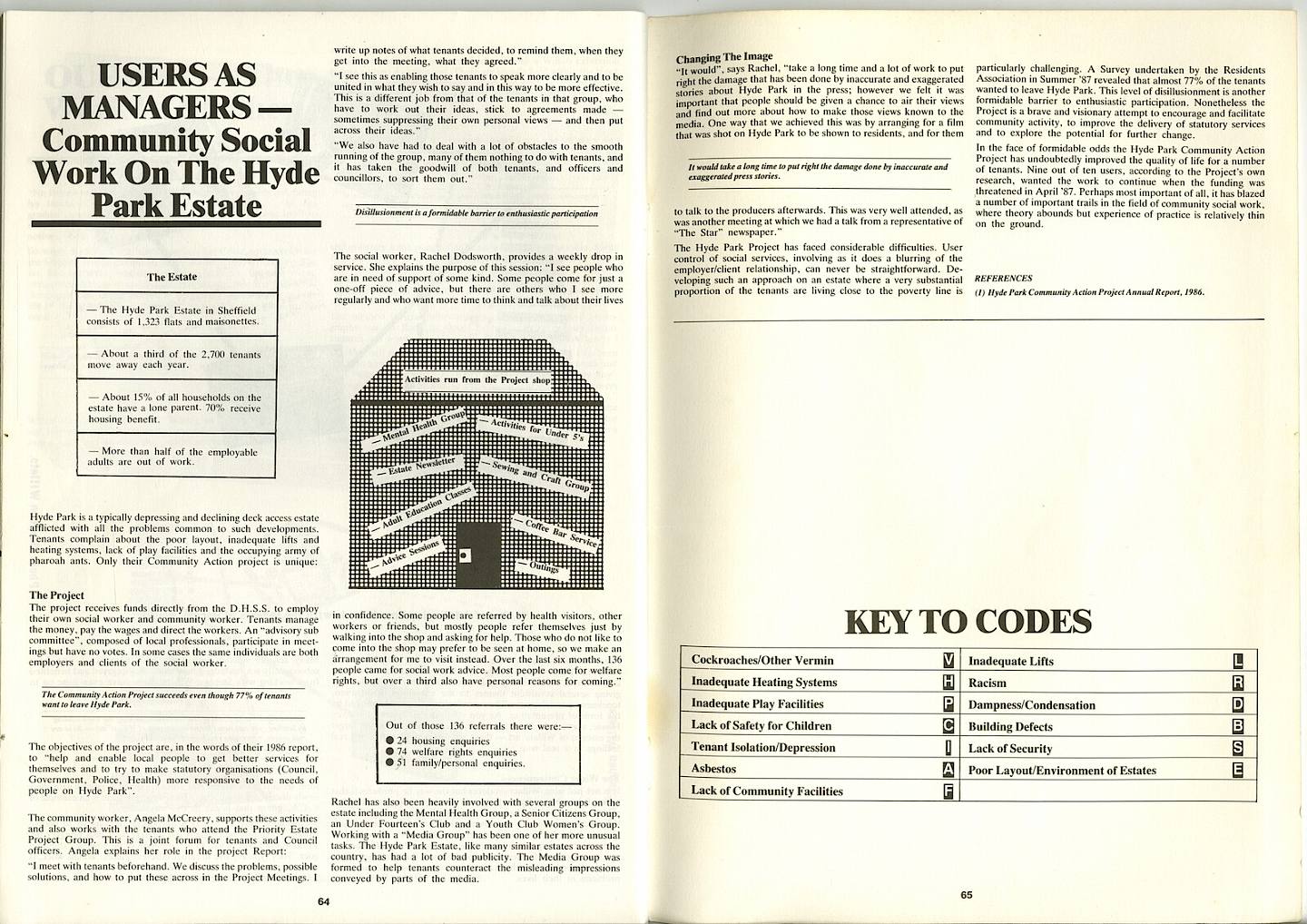
[caption: Activities run from the Project shop:
Mental Health Group
Activities for Under 5's
Estate Newsletter
Sewing and Craft Group
Adult Education Classes
Coffee Bar Service
Advice Sessions
Outings]
The social worker, Rachel Dodsworth, provides a weekly drop in
service. She explains the purpose of this session: “I see people who
are in need of support of some kind. Some people come for just a
one-off piece of advice, but there are others who I see more
regularly and who want more time to think and talk about their lives
in confidence. Some people are referred by health visitors, other
workers or friends, but mostly people refer themselves just by
walking into the shop and asking for help. Those who do not like to
come into the shop may prefer to be seen at home, so we make an
arrangement for me to visit instead. Over the last six months, 136
people came for social work advice. Most people come for welfare
rights, but over a third also have personal reasons for coming.”
[caption: Out of those 136 referrals there were:—
24 housing enquiries
74 welfare rights enquiries
51 family/personal enquiries.]
Rachel has also been heavily involved with several groups on the
estate including the Mental Health Group, a Senior Citizens Group,
an Under Fourteen’s Club and a Youth Club Women’s Group.
Working with a “Media Group” has been one of her more unusual
tasks. The Hyde Park Estate, like many similar estates across the
country, has had a lot of bad publicity. The Media Group was
formed to help tenants counteract the misleading impressions
conveyed by parts of the media.
Changing The Image
“It would”, says Rachel, “take a long time and a lot of work to put
right the damage that has been done by inaccurate and exaggerated
stories about Hyde Park in the press; however we felt it was
important that people should be given a chance to air their views
and find out more about how to make those views known to the
media. One way that we achieved this was by arranging for a film
that was shot on Hyde Park to be shown to residents, and for them
[caption: It would take a long time to put right the damage done by inaccurate and
exaggerated press stories.]
to talk to the producers afterwards. This was very well attended, as
was another meeting at which we had a talk from a representative of
“The Star” newspaper.”
The Hyde Park Project has faced considerable difficulties. User
control of social services, involving as it does a blurring of the
employer/client relationship, can never be straightforward. De-
veloping such an approach on an estate where a very substantial
proportion of the tenants are living close to the poverty line is
particularly challenging. A Survey undertaken by the Residents
Association in Summer ’87 revealed that almost 77% of the tenants
wanted to leave Hyde Park. This level of disillusionment is another
formidable barrier to enthusiastic participation. Nonetheless the
Project is a brave and visionary attempt to encourage and facilitate
community activity, to improve the delivery of statutory services
and to explore the potential for further change.
In the face of formidable odds the Hyde Park Community Action
Project has undoubtedly improved the quality of life for a number
of tenants. Nine out of ten users, according to the Project’s own
research, wanted the work to continue when the funding was
threatened in April ’87. Perhaps most important of all, it has blazed
a number of important trails in the field of community social work,
where theory abounds but experience of practice is relatively thin
on the ground.
REFERENCES
(1) Hyde Park Community Action Project Annual Report, 1986.
64
KEY TO CODES
Cockroaches/Other Vermin V
Inadequate Heating Systems H
Inadequate Play Facilities P
Lack of Safety for Children C
Tenant Isolation/Depression I
Asbestos A
Lack of Community Facilities F
Inadequate Lifts L
Racism R
Dampness/Condensation D
Building Defects B
Lack of Security S
Poor Layout/Environment of Estates E