National Tower Blocks Directory 1987
THE
DEMOLITION OF
RONAN POINT
In April 1981 a young mother killed herself by jumping from a
tower block in Stratford, Newham. She had previously requested a
transfer, explaining to Social Services, Housing and the Local
Papers that she could not bear life on the 21st floor. The waste and
the horror of her death made a great impact on her friends and
neighbours. They decided that people in tower blocks must get
organised.
Several successful meetings were held on tower block estates in
Newham and the Newham Tower Block Tenants Campaign
(N.T.B.T.C.) was established. N.T.B.T.C. moved rapidly from
estate to during 1981 and 1982, holding public meetings and
electing estate committees. The scale and the variety of problems
which emerged were enormous.
From the very beginning the Campaign identified the necessity of
working with the media. By constantly approaching journalists they
came to be regarded as the people to speak to when opinions were
sought. They were determined that tower blocks would become an
issue not only locally but nationally as well. The spectacular
demolition of two unsound blocks in Stratford in November 1981
provided them with the opportunity to proclaim their determination
nationally. They staged a ‘Blow-Up Party’ to which they invited all
the media and their slogan ‘2 down 107 to go’ was widely used by
the national papers.
Method Of Working
As the Campaign grew its work developed at three different levels:
estate, boroughwide and national:
ESTATE. The bulk of the work on the estates involved dealing with
problems specific to each block. Many blocks were designed to
include tenants meeting rooms. These rooms were generally unused
and derelict. The Campaign and Community Links, a local social
action centre, campaigned for permission to lease several of these
rooms for use as community flats. The establishment of community
rooms at the base of Gannon Point brought a breakthrough in work
on the Freemasons Estate. The Freemasons Estate comprised nine,
twenty-two storey tower blocks, including Ronan Point. Most
tenants were on the transfer list and the prevailing atmosphere was
very hostile.
The community rooms were used to provide services which were
useful in their own right and which also helped to break down the
barriers of suspicion that existed between neighbours. A bulk
buying food club, for instance, clearly demonstrated the tangible
benefits of co-operation.
BOROUGHWIDE. Many of the problems tackled on individual
estates were duplicated in tower blocks across the Borough.
N.T.B.T.C. drew together the experiences of the estates and raised
the major issues at a borough-wide level. Boroughwide campaigns
were organised to draw attention to particular problems: for
instance, heating days, cockroach days and a children's week of
action (after two toddlers fell from blocks).
NATIONAL. In all their activities the Campaign sought to draw
attention to the inadequacy of resources which had created many of
the problems in the first place. Some of this work, particularly
activities around the time of the fifteenth anniversary of the Ronan
Point disaster, attracted national publicity and these opportunities
were used to explain that the problems of Newham's tower block
tenants were shared by thousands of others across the country and
could only be solved by greatly increased spending on sound,
humane housing.
In 1983 the first National Tower Blocks Conference was held in
Newham to draw attention to the social and structural problems of
Britain’s tower block homes, to share information about local
activities and to consider ways of building on these experiences.
More than a hundred and seventy people including tenants,
architects, housing officers, community workers and elected repre-
sentatives from throughout the country participated in the day.
The national conference had brought together a variety of people
with great knowledge, one of them was Sam Webb, an architect
with a keen interest in Ronan Point.
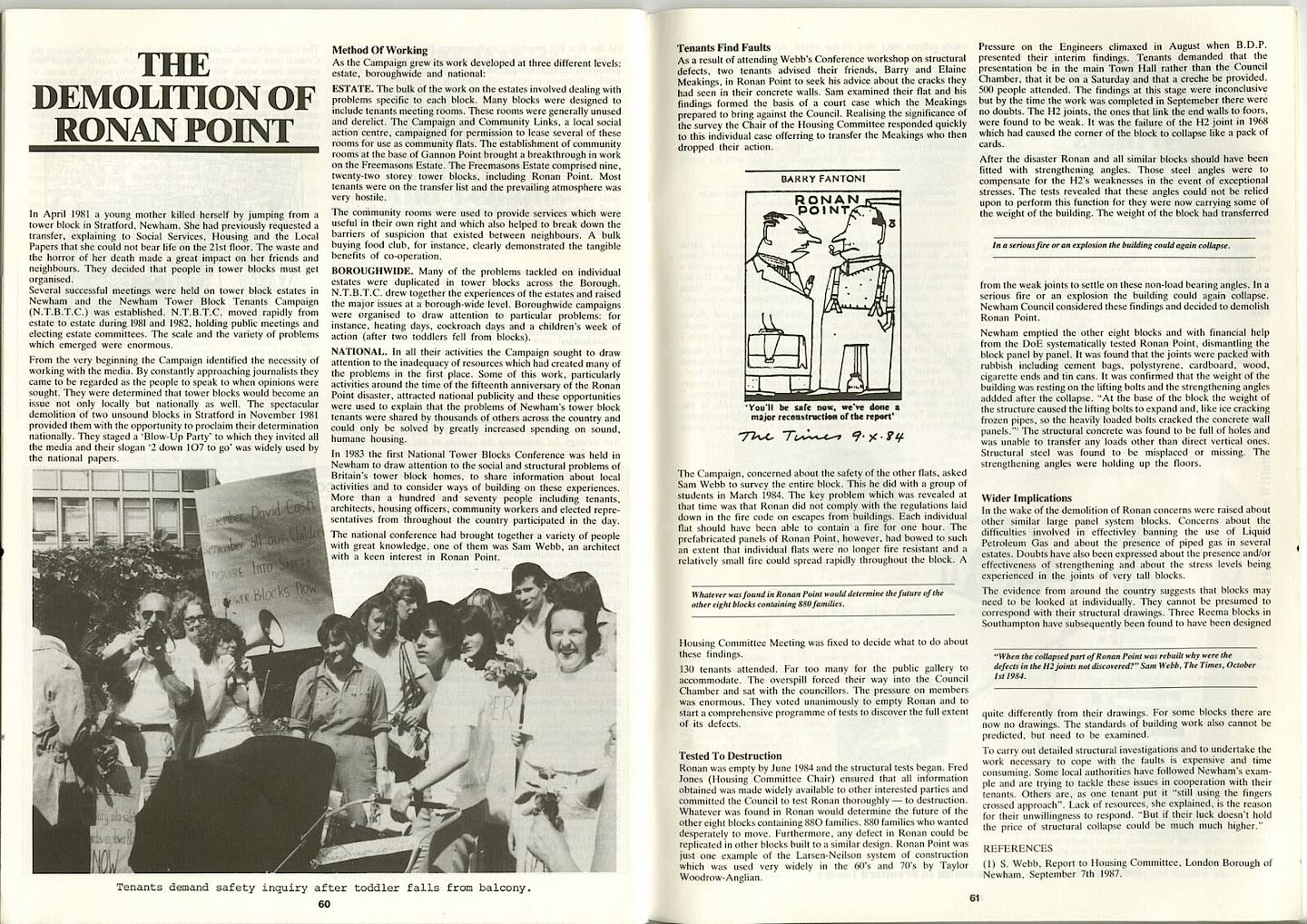
[caption: Tenants demand safety inquiry after toddler falls from balcony.]
Tenants Find Faults
As a result of attending Webb’s Conference workshop on structural
defects, two tenants advised their friends, Barry and Elaine
Meakings, in Ronan Point to seek his advice about the cracks they
had seen in their concrete walls. Sam examined their flat and his
findings formed the basis of a court case which the Meakings
prepared to bring against the Council. Realising the significance of
the survey the Chair of the Housing Committee responded quickly
to this individual case offerring to transfer the Meakings who then
dropped their action.
[caption: BARRY FANTONI
RONAN
POINT
‘You'll be safe now, we've done a
major reconstruction of the report’
The Times 9.x.84]
The Campaign, concerned about the safety of the other flats, asked
Sam Webb to survey the entire block. This he did with a group of
students in March 1984. The key problem which was revealed at
that time was that Ronan Point did not comply with the regulations laid
down in the fire code on escapes from buildings. Each individual
flat should have been able to contain a fire for one hour. The
prefabricated panels of Ronan Point, however, had bowed to such
an extent that individual flats were no longer fire resistant and a
relatively small fire could spread rapidly throughout the block. A
Whatever was found in Ronan Point would determine the future of the
other eight blocks containing 880 families.
Housing Committee Meeting was fixed to decide what to do about
these findings.
130 tenants attended. Far too many for the public gallery to
accommodate. The overspill forced their way into the Council
Chamber and sat with the councillors. The pressure on members
was enormous. They voted unanimously to empty Ronan and to
start a comprehensive programme of tests to discover the full extent
of its defects.
Tested To Destruction
Ronan was empty by June 1984 and the structural tests began. Fred
Jones (Housing Committee Chair) ensured that all information
obtained was made widely available to other interested parties and
committed the Council to test Ronan thoroughly - to destruction.
Whatever was found in Ronan would determine the future of the
other eight blocks containing 880 families. 880 families who wanted
desperately to move. Furthermore, any defect in Ronan could be
replicated in other blocks built to a similar design. Ronan Point was
just one example of the Larsen-Neilson system of construction
which was used very widely in the 60's and 70's by Taylor
Woodrow-Anglian.
Pressure on the Engineers climaxed in August when B.D.P.
presented their interim findings. Tenants demanded that the
presentation be in the main Town Hall rather than the Council
Chamber, that it be on a Saturday and that a creche be provided.
500 people attended. The findings at this stage were inconclusive
but by the time the work was completed in Septemeber there were
no doubts. The H2 joints, the ones that link the end walls to foors,
were found to be weak. It was the failure of the H2 joint in 1968
which had caused the corner of the block to collapse like a pack of
cards.
After the disaster Ronan and all similar blocks should have been
fitted with strengthening angles. Those steel angles were to
compensate for the H2's weaknesses in the event of exceptional
stresses. The tests revealed that these angles could not be relied
upon to perform this function for they were now carrying some of
the weight of the building. The weight of the block had transferred
In a serious fire or an explosion the building could again collapse.
from the weak joints to settle on these non-load bearing angles. In a
serious fire or an explosion the building could again collapse.
Newham Council considered these findings and decided to demolish
Ronan Point.
Newham emptied the other eight blocks and with financial help
from the DoE systematically tested Ronan Point, dismantling the
block panel by panel. It was found that the joints were packed with
rubbish including cement bags, polystyrene, cardboard, wood,
cigarette ends and tin cans. It was confirmed that the weight of the
building was resting on the lifting bolts and the strengthening angles
added after the collapse. “At the base of the block the weight of
the structure caused the lifting bolts to expand and, like ice cracking
frozen pipes, so the heavily loaded bolts cracked the concrete wall
panels.”' The structural concrete was found to be full of holes and
was unable to transfer any loads other than direct vertical ones.
Structural steel was found to be misplaced or missing. The
strengthening angles were holding up the floors.
Wider Implications
In the wake of the demolition of Ronan concerns were raised about
other similar large panel system blocks. Concerns about the
difficulties involved in effectivley banning the use of Liquid
Petroleum Gas and about the presence of piped gas in several
estates. Doubts have also been expressed about the presence and/or
effectiveness of strengthening and about the stress levels being
experienced in the joints of very tall blocks.
The evidence from around the country suggests that blocks may
need to be looked at individually. They cannot be presumed to
correspond with their structural drawings. Three Reema blocks in
Southampton have subsequently been found to have been designed
“When the collapsed part of Ronan Point was rebuilt why were the
defects in the H2 joints not discovered?” Sam Webb, The Times, October
1st 1984.
quite differently from their drawings. For some blocks there are
now no drawings. The standards of building work also cannot be
predicted, but need to be examined.
To carry out detailed structural investigations and to undertake the
work necessary to cope with the faults is expensive and time
consuming. Some local authorities have followed Newham's exam-
ple and are taking to tackle these issues in cooperation with their
tenants. Others are, as one tenant put it “still using the fingers
crossed approach”. Lack of resources, she explained, is the reason
for their unwillingness to respond. “But if their luck doesn't hold
the price of structural collapse could be much higher.”
REFERENCES
(1) S. Webb, Report to Housing Committee, London Borough of
Newham, September 7th 1987.