National Tower Blocks Directory 1987
Helping Hands
Tenants on the New Wortley Estate in Leeds have been involved in neighbourhood care work since 1984. They provide a range of much needed services. A team of volunteers, initially through their own neighbourhood care scheme and now through a local ‘Helping Hands’ scheme, have undertaken a variety of tasks for the elderly and people with disabilities. These include shopping, babysitting, collecting pensions and prescriptions, taking people to and from hospital, decorating and home maintenance. Volunteers also run a community shop, staff the centre’s coffee bar and provide a luncheon club for the elderly and visually handicapped.
The New Wortley Community Centre is the base for activities for all age groups. Members hope to offer something for everyone. They
The activities of many tenants and community groups in bringing tenants together and in creating some sense of community are impressive.
run playgroups, parent and toddler clubs, playschemes, and youth clubs, as well as, bingo sessions, keep fit, lunch clubs, cookery clubs and Old Time Dancing. In addition to providing services and activities themselves the Association attracts other agencies onto the estate by offering use of their premises. For instance, the local Citizens Advice Bureau runs a weekly advice session and the local councillor holds a monthly surgery in the Centre.
These examples of community activities on tower block estates in Glasgow and Leeds are not unique but they are unusual. They could be effectively copied elsewhere. There are three practical steps which housing authorities could take to help make this kind of development possible.
1 Consider the implications of their allocations policy. Does it have the potential for creating a homogenous community — within the estate, within the block, within individual parts of the block? Placing people in similar age groups close to one another is a simple but curiously rare example of an enlightened allocations policy. Another example exists in Gateshead where the Council consciously attempt to foster ‘community spirit’ by making lettings to relatives and to people with neighbourhood connections.
2 Publicise existing community facilities and provide the very basic level of resources necessary to start changing an empty building into a centre. In time residents will contribute to this process but everyone needs some encouragement. Of course some estates have no existing facilities. Here a higher level of investment is required but as the Dundasvale example shows it will be well rewarded.
3 Consider the possibility of paying for some staff time to encourage and develop the use of the community facilities. This will cost money but if it helps to convert an estate with a hostile atmosphere into an estate with a friendly feeling it could, in the long term, be worth at least as much as any of the more obvious structural improvements.
BUILDING BRIDGES — Relationships Between Councils And Tenants
Tenants And Councils Co-operating
Since work began on building the National Tower Blocks Network in 1983 we have heard about more and more Councils who are involving tenants in the decisions that effect their lives. Tenants in turn are becoming increasingly well informed and more willing to play an effective and significant part in the decision making process.
However, not all Councils react in the same way. Examples still exist of councils wishing to silence their tenants complaints. The behaviour of senior Glasgow housing officers in physically removing Glasgow tenant, Mrs. Eileen McCloy, from a workshop at the International Housing Conference both shocked and mystified the other participants.
Fortunately, the response from other councils has been more positive. In a number of cities joint council officer, member and
Tenants are increasingly well informed and wish to play an effective and significant part in the decision making process.
tower block tenant groups have been established. These groups seek to bring together all viewpoints in tackling their tower block problems.
In Sheffield, for instance, representatives of the Citywide Tenants Federation meet with councillors and members to draw up policies for their tower blocks and to discuss problems that arise. A joint working party was established in 1984 which considers management and maintenance issues and tries to develop policies which will improve tenants living conditions. It also makes recommendations to other council committees. The problems of heating have dominated discussions to such an extent that the working party has recently been reconstituted as a Heating Working Party.
Leicester Working Party
Leicester City Council established a Tower Blocks Working Party in 1985 as a result of its concern for the serious problems being experienced by tenants in two of its blocks (Oriel and Merton). The Working Party was asked by the Housing Committee to look at ways of establishing a uniform approach to include all the tower blocks in the city.
Full meetings are held which include up to five representatives of each of the ten tower blocks. Housing Officers, including Area
Joint council officer, member and tower block tenants’ groups have been established in several cities.
Managers with tower blocks in their areas, ward councillors, representatives from the City Engineers Department, the Recreation and Arts Department and the Environmental Health Office also attend. Following each full meeting there is a meeting of ward councillors and officers to assess the proposals put forward and to arrange costings and planning.
At the first full meeting a spokesperson from each tower block outlined the problems being experienced by tenants. They were principally concerned with the lack of security, vandalism, staffing levels, allocation policies and standards of cleaning and maintenance.
It quickly became clear that resources would not be available to deal with all problems in all the blocks. The Working Party therefore had to decide on the priorities for action. This is some cases involved tenants in having to agree to leave work on their own block for future years.
The Working Party also made efforts to ensure that all councillors were aware of the problems being experienced in the tower blocks. A small group of tenants’ representatives and ward councillors were responsible for informing other Councillors about the problems of the tower blocks. Tenants produced a video film which brought these problems to life and thus helped to gain understanding and support.
Code For Co-operation
Suspicion between Councils and tenants is sometimes difficult to break down even where forums for co-operation and consultation
By signing a joint statement both parties have acknowledged the need for co-operation
exist. For this reason the Flats Fight Back group in Edinburgh felt that it would be helpful to produce a Code of Conduct. Flats Fight Back is a city wide organisation for tower block tenants which was formed in 1983. Flats Fight Back produced a booklet and mounted a travelling exhibition which illustrated the problems being experienced by tenants. The council responded by adopting a comprehensive strategy for improving the quality of life in tower blocks.
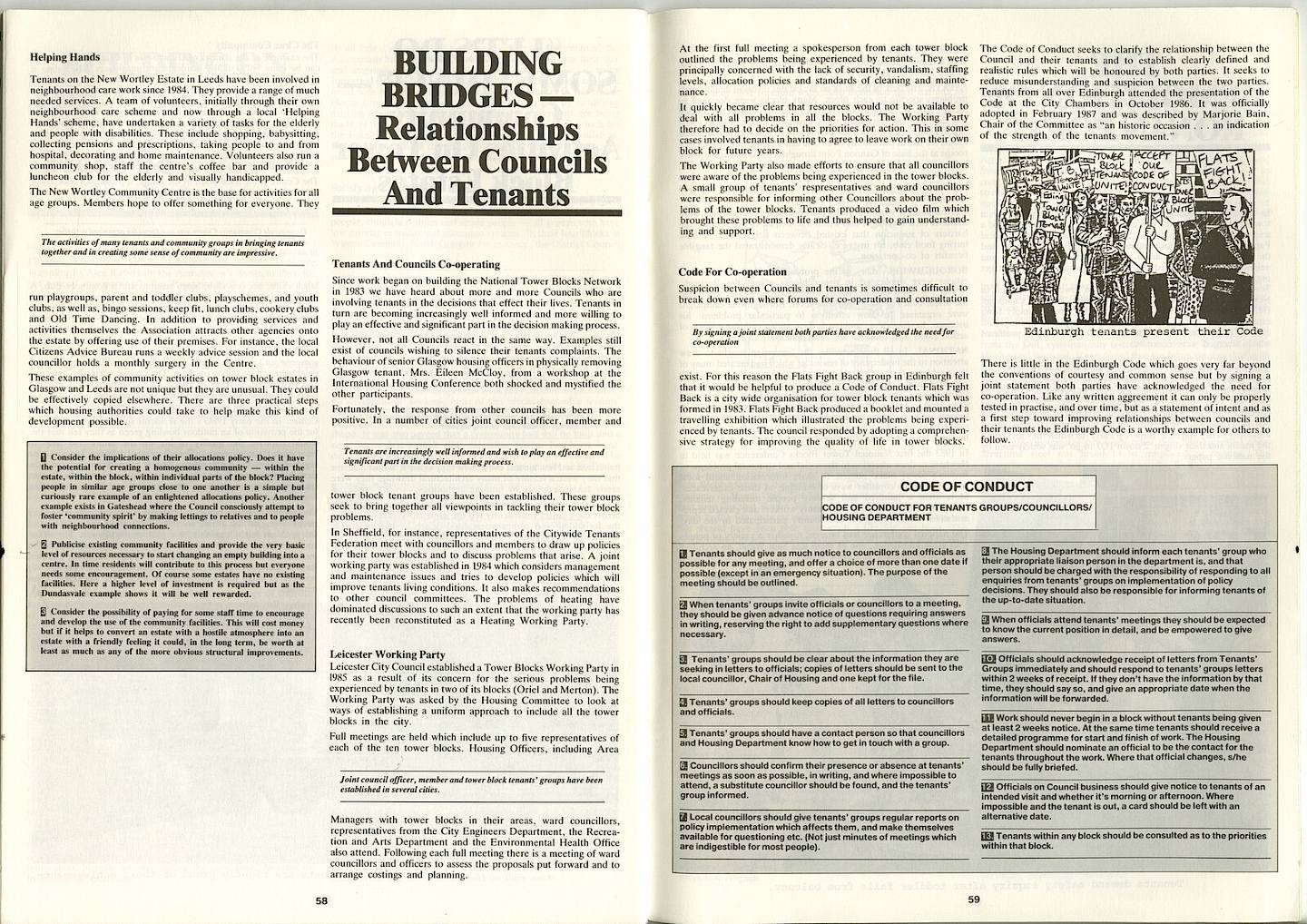
The Code of Conduct seeks to clarify the relationship between the Council and their tenants and to establish clearly defined and realistic rules which will be honoured by both parties. It seeks to reduce misunderstanding and suspicion between the two parties. Tenants from all over Edinburgh attended the presentation of the Code at the City Chambers in October 1986. It was officially adopted in February 1987 and was described by Marjorie Bain, Chair of the Committee as “an historic occasion . . . an indication of the strength of the tenants movement.”
[caption: Edinburgh tenants present their Code]
There is little in the Edinburgh Code which goes very far beyond the conventions of courtesy and common sense but by signing a joint statement both parties have acknowledged the need for co-operation. Like any written agreement it can only be properly tested in practise, and over time, but as a statement of intent and as a first step toward improving relationships between councils and their tenants the Edinburgh Code is a worthy example for others to follow.
CODE OF CONDUCT
CODE OF CONDUCT FOR TENANTS GROUPS/COUNCILLORS/HOUSING DEPARTMENT
1 Tenants should give as much notice to councillors and officials as possible for any meeting, and offer a choice of more than one date if possible (except in an emergency situation). The purpose of the meeting should be outlined.
2 When tenants’ groups invite officials or councillors to a meeting, they should be given advance notice of questions requiring answers in writing, reserving the right to add supplementary questions where necessary.
3 Tenants’ groups should be clear about the information they are seeking in letters to officials; copies of letters should be sent to the local councillor, Chair of Housing and one kept for the file.
4 Tenants’ groups should keep copies of all letters to councillors and officials.
5 Tenants’ groups should have a contact person so that councillors and Housing Department know how to get in touch with a group.
6 Councillors should confirm their presence or absence at tenants’ meetings as soon as possible, in writing, and where impossible to attend, a substitute councillor should be found, and the tenants’ group informed.
7 Local councillors should give tenants’ groups regular reports on policy implementation which affects them, and make themselves available for questioning etc. (Not just minutes of meetings which are indigestible for most people).
8 The Housing Department should inform each tenants’ group who their appropriate liaison person in the department is, and that person should be charged with the responsibility of responding to all enquiries from tenants’ groups on implementation of policy decisions. They should also be responsible for informing tenants of the up-to-date situation.
9 When officials attend tenants’ meetings they should be expected to know the current position in detail, and be empowered to give answers.
10 Officials should acknowledge receipt of letters from Tenants’ Groups immediately and should respond to tenants’ groups letters within 2 weeks of receipt. If they don’t have the information by that time, they should say so, and give an appropriate date when the information will be forwarded.
11 Work should never begin in a block without tenants being given at least 2 weeks notice. At the same time tenants should receive a detailed programme for start and finish of work. The Housing Department should nominate an official to be the contact for the tenants throughout the work. Where that official changes, s/he should be fully briefed.
12 Officials on Council business should give notice to tenants of an intended visit and whether it’s morning or afternoon. Where impossible and the tenant is out, a card should be left with an alternative date.
13 Tenants within any block should be consulted as to the priorities within that block.