National Tower Blocks Directory 1987
BUILDING ON THE ASSETS; How The Association Make Best Use Of Their Assets
The Scottish Special Housing Association owns 73 tower blocks in Glasgow, Clydebank, Paisley, Linwood and Dundee. They are, according to Alex Robertson the Association's Assistant Director, "in general very popular". Ray Paterson studied the work of the Association, as a post graduate researcher, before becoming Housing Management Liaison Officer. In his report he explained the thinking behind the Association's approach to the tower blocks:
"In order to be able to use the high rise block to its best advantage it is essential that we understand both its strengths and its weaknesses. It should then be possible to develop a policy which builds upon the advantages of multi-storey life for certain people by introducing
"while many difficulties still remain, a combination of technical improvements, management initiatives and tenants' participation has gone a long way towards improving the quality of high rise life."
some phased modifications designed to take account of specific needs and circumstances . . . while many difficulties still remain, a combination of technical improvements, management initiatives and tenants' participation has gone a long way towards improving the quality of high rise life."
The Association's work on Fortrose Street, a nine-storey deck access block in Partick and Shaftesbury Street, a 15-storey block in Anderston, demonstrates this kind of thinking. In both blocks it was found that almost three-quarters of the tenants were over pensionable age and many had some kind of disability. Tenants were generally fairly satisfied with their flats which were compact and easy to manage, but many felt very isolated.
The Association undertook a comprehensive package of improvements which included the installation of a warden call system, enabling the less able to continue to live independently. A new entry phone system was fitted. This has proved to be less prone to
"In general multi-storeys shared one fundamental weakness: they created privacy without community."
vandalism than is commonly the case, probably because the community is so homogenous and because there are so few young people in the flats. It has thus worked to maximum effect, improving the security of the buildings and their internal appearance. Finally, community rooms have been been opened and have become the focus for a wide range of social activities.
Creating Social Space
Ray Patterson found that "In general multi-storeys shared one fundamental weakness: they created privacy without community." The Association believe that building modifications can change "communal space" into "social space". "Controlled entry is only the first step in the process; the final objective is to improve the quality of these open areas, develop the opportunities for social communication, increase security and, at the same time, decrease the likelihood of vandalism".
In its four 23-storey blocks in Hutchesontown, for instance, the Association has upgraded the entrance foyers, reducing their size and improving their appearance. The surplus space is being converted into an "activities area". Eventually the foyers are to be fitted with heavy duty carpeting and potted plants. In two of the blocks community rooms are also being provided by modifying existing storage space. These communal improvements are being made as part of a comprehensive programme which also includes the installation of a new heating system and internal insulation. Finally it is intended to increase the security of the buildings by providing a more comprehensive caretaker service.
Satisfying 'Low Priority' Needs
The Association stress the importance of a sensible lettings policy. They believe that tower blocks can be satisfactory homes for elderly people, childless couples and single people — all groups who have low priority in traditional allocation systems. In their four blocks in Wester Common, North Glasgow for instance, the District Council
"Tower blocks can be satisfactory homes for the elderly, childless and single people."
have now agreed that they will no longer house families with young children and that existing tenants will be allowed to move within their blocks when a suitable vacancy occurs.
This policy has been adopted after a group of consultants undertook a detailed survey of tenant complaints. They found that there was widespread dissatisfaction and the level of vandalism was exceptionally high. With encouragement from the Association's community development workers, each of the blocks formed a tenants' committee to discuss the future of the area. The general housing management input was increased and the new policy began to take shape. It was also agreed that a community hall will be built and a new, seven-days-a-week shift caretaker system has been introduced. This has had the effect of greatly reducing vandalism. The overall effect of these improvements has been considerable. Tenant
[caption: Tower blocks satisfying particular types of housing need and preference.]
satisfaction has greatly increased and flats in the block are no longer difficult to let.
The Association are under no illusion about tower blocks. "It is perfectly true", says Ray Paterson, "that as a housing form it has distinct limitations". They have, however, demonstrated that with "imagination and sensitivity" tower block flats can "continue to satisfy particular types of need and preference". Looking to the future, "Scottish Special Housing Association will continue to make optimal use of its high rise stock, not just in Glasgow but in other areas too, and research is continuing into further conversion projects for sheltered accommodation and for other people with special housing needs". In short the Scottish Special Housing Association will continue to build on their assets.
“LET’S DO SOMETHING!” – Community Activities On Tower Block Estates
The Close Community
The example of the tenants of Dundasvale in Glasgow shows what can be done. 90% of the residents are pensioners. The estate is situated in the centre of Glasgow, 300 yards from Sauchiehall Street. The Dundasvale Tenants Association campaigned for a community centre for 5 years. An unused shop in the middle of the estate was eventually converted for community use under an Urban Aid Grant. The premises are fairly extensive and incorporate a main hall, a well-equipped kitchen, toilets, a library room, an office and downstairs a games room. An elected committee of local residents manage and run the centre. The Council are responsible for the fabric of the building, repairs, heating and lighting.
The Centre is the focal point of the estate, it provides a wide range of activities and services for residents. There are daily well-attended
[caption: Dundasvale Community Centre acts as a focus for organised activities and informal support.]
Best Intentions
Many tower blocks were originally designed to include community facilities. Rooms at the bottom and sometimes at the top of blocks were intended for community use. In most cases these rooms are not used, they are derelict and vandalised and boarded up. Why did these well meaning plans fail to meet community needs? Our research suggests a number of reasons:
First we found that most rooms were provided without furnishings, equipment or any other resources. The facilities were poorly
[caption: The forbidding and compartmentalised design of blocks acts to discourage spontaneous ‘coming together’.]
publicised and few tenants even knew they existed. Whilst it seems that they were a feature of many architectural drawings they were rarely taken seriously by housing authorities.
Second tenants who are involved in organising community activities across the country consistently tell the same story. They find that the forbidding and compartmentalised design of blocks acts to discourage spontaneous "coming together". People turn in on themselves, fit extra locks to their doors and focus on their lives within their own flats. The activities of many tenants and community groups in bringing tower block tenants together and in creating some sense of community is all the more impressive given these structural barriers.
lunch clubs, a sports club, bingo sessions and a dominoes club. A small sub branch of the library saves people having to go far to change their books. The activities are all run by volunteers. A further, less tangible role has developed out of these practical services: The Centre now acts as a focus for the informal support structures which are so important in any community and particularly vital in one which is largely composed of elderly people. If someone isn't at their regular lunch club it won't be long before a neighbour will be calling on them. The Centre is friendly, informal and welcoming. It helps to create an atmosphere quite different from that of so many large tower block estates.
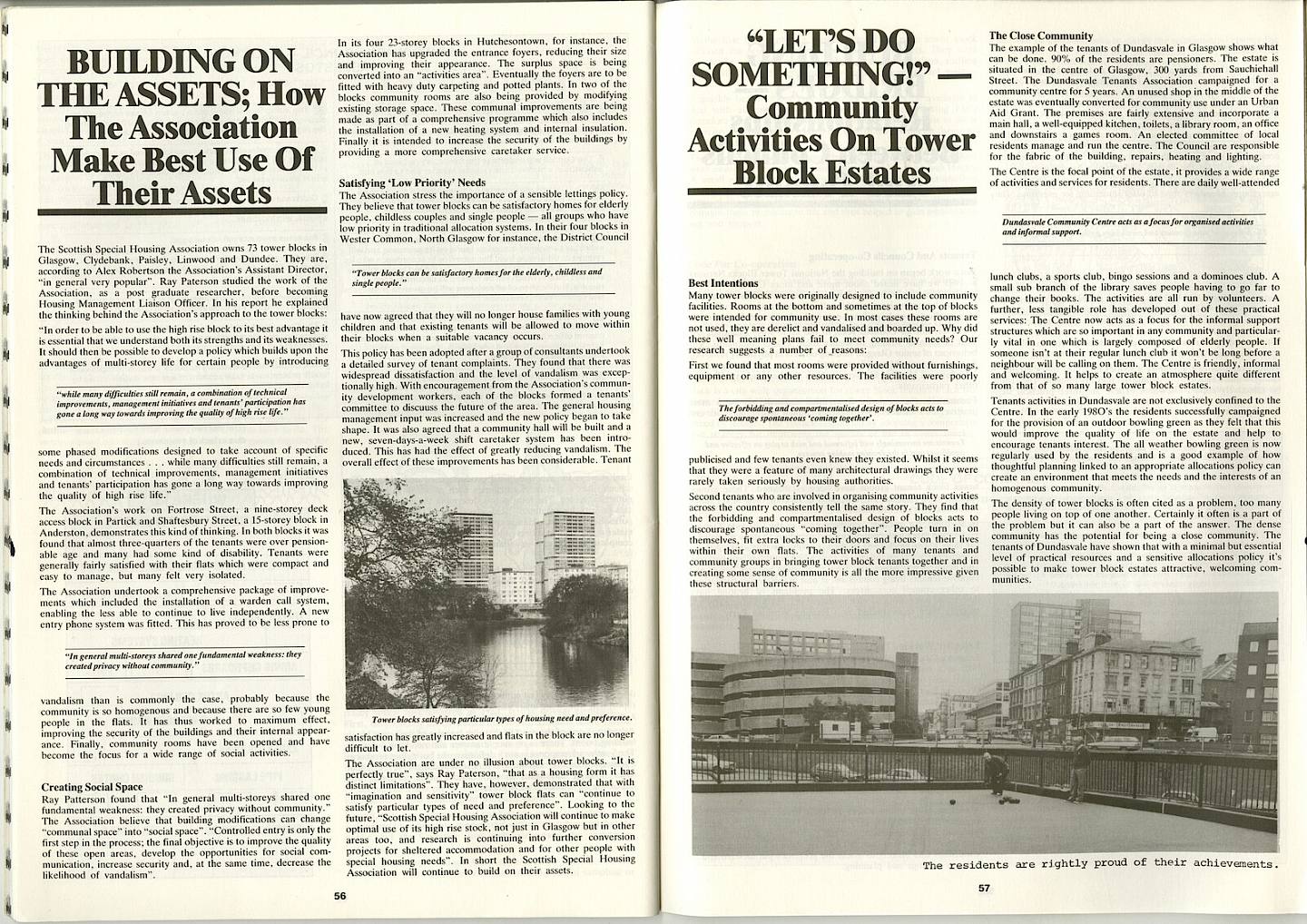
Tenants activities in Dundasvale are not exclusively confined to the Centre. In the early 1980's the residents successfully campaigned for the provision of an outdoor bowling green as they felt that this would improve the quality of life on the estate and help to encourage tenants interest. The all weather bowling green is now regularly used by the residents and is a good example of how thoughtful planning linked to an appropriate allocations policy can create an environment that meets the needs and the interests of an homogenous community.
The density of tower blocks is often cited as a problem, too many people living on top of one another. Certainly it often is a part of the problem but it can also be a part of the answer. The dense community has the potential for being a close community. The tenants of Dundasvale have shown that with a minimal but essential level of practical resources and a sensitive allocations policy it's possible to make tower block estates attractive, welcoming communities.
[caption: The residents are rightly proud of their achievements.]