National Tower Blocks Directory 1987
Provision for the Young
This led them to feel that it was appropriate to make "specific provision for this client group, especially given the growing problem, the lack of specific payments and the impact of the Board and Lodging Regulations". (The D.H.S.S. Board and Lodge Regulations introduced in 1985 imposed severe time limits on the length of stay in Bed and Breakfast accommodation for the under 26s receiving benefit. Cost limits were also introduced; if the accommodation exceeds these price limits then the young person must pay the difference.)
They chose Hebble Court, another Mixenden block for a pilot project consisting of nine furnished flats on three landings. As these prospective tenants will be younger and setting up home for the first time, more furnishing and equipment will be provided than in the Jumples Court project.
Charge to tenants:
Tenants of both schemes pay a furniture charge. These charges are taken into account when Housing Benefit is assessed. The charge for a one-bedroomed flat is £4.25 and for a two-bedroomed flat is £5.35. This allows a recovery of the initial investment over approximately five years allowing for void periods.
[caption: 1988 APRIL 1 (new regulations) GRANTS IF YOU'RE ON SUPPLEMENTARY BENEFIT (OR HOUSING BENEFIT SUPPLEMENT)]
Calderdale stress the crucial importance of management supervision: "The success of the scheme depends to a large extent on the vetting of applicants and the careful supervision and monitoring of the resulting tenancies."
Regular home visits are planned, possibly on a weekly basis, to monitor the tenancy and to provide advice and counselling. Regular contact with parents or referring agencies (Social Services/Probation) will also be rigorously maintained.
The authority also intend to introduce a 24 hour caretaking service. They hope thereby to discourage vandalism, improve security and create a more stable environment for the tenants.
Calderdale identified the need for this type of scheme in 1985. Changes in the D.H.S.S. regulations have subsequently increased
[caption: The initial investment in furnishings and equipment could be recovered over approximately five years allowing for void periods.]
the need. The Furniture Regulations introduced in August '86 make it very difficult for young unemployed people setting up home. Currently, a young person on their own is not even guaranteed a cooker or a bed. The regulations are due to be tightened further in April 1988. After that claimants will be required to apply for loans from the D.H.S.S. Social Fund for furniture. Benefit advice workers feel that single people are likely to be treated as the lowest priority for such loans.
The Calderdale scheme tackles this problem head on. Although the initial investment is significant the money is likely to be recouped within five years. In the meantime some particularly vulnerable young people will be able to live comfortably in accommodation which, although unpopular with others, may satisfactorily meet their needs. Everyone, it seems, has something to gain from this scheme.
REFERENCES
(1) Calderdale Metropolitan Borough Council, "Provision of Furnished Accommodation in Hebble Court", 1986.
"DIVIS — THE WORST HOUSING IN EUROPE?"
The Divis flats in Belfast are a household name. They have been, as the Architects Journal noted (9.7.86), "a ready subject for the thesis and dissertation and a convenient backcloth for plays, documentaries and films". Wherever the title appears a common description is frequently appended: "Divis — the Worst Housing in Europe". Why? What can be learnt and what can be done?
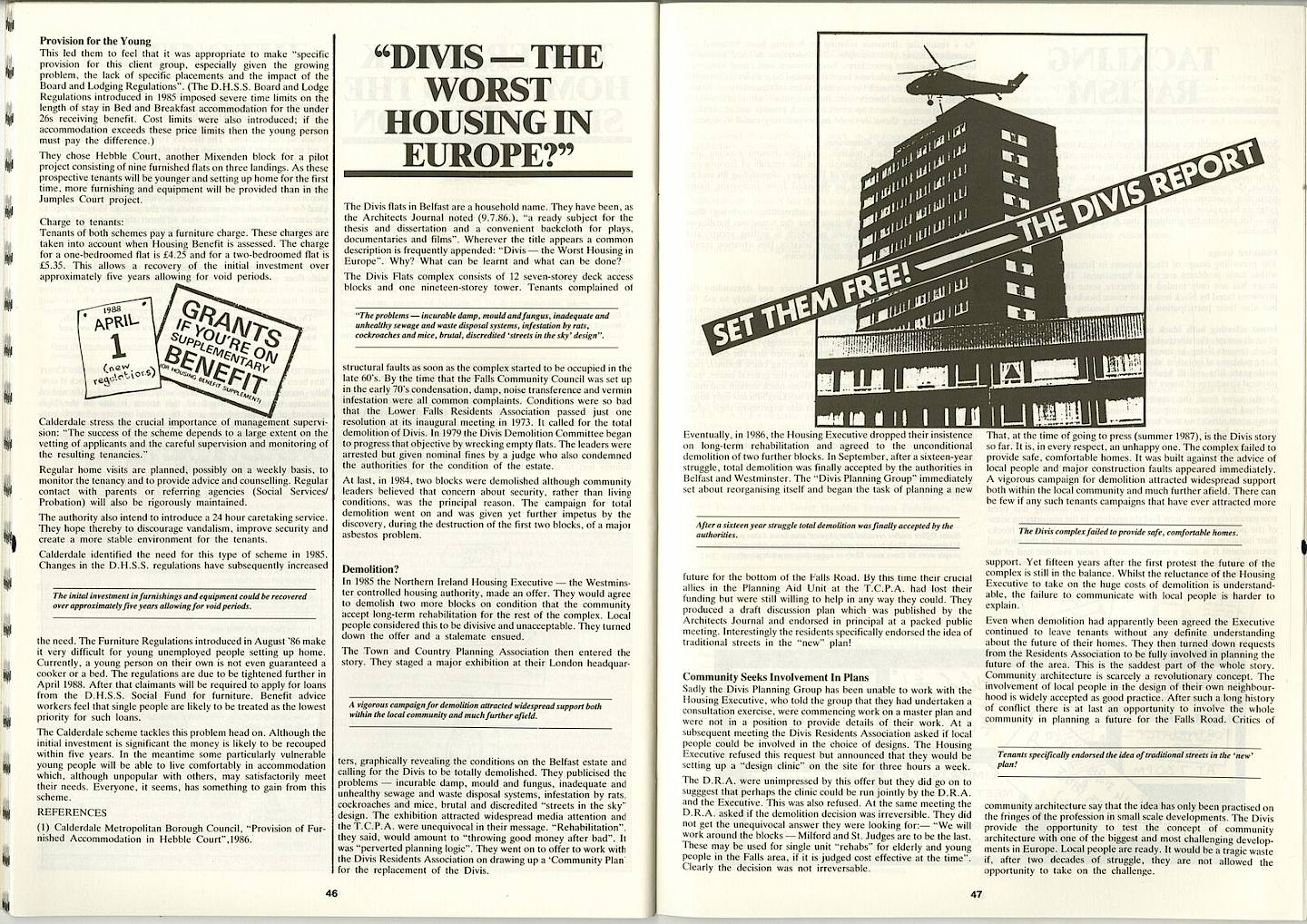
The Divis Flats complex consists of 12 seven-storey deck access blocks and one nineteen-storey tower. Tenants complained of
"The problems — incurable damp, mould and fungus, inadequate and unhealthy sewage and waste disposal systems, infestation by rats, cockroaches and mice, brutal, discredited 'streets in the sky' design".
structural faults as soon as the complex started to be occupied in the late 60's. By the time that the Falls Community Council was set up in the early 70's condensation, damp, noise transference and vermin infestation were all common complaints. Conditions were so bad that the Lower Falls Residents Association passed just one resolution at its inaugural meeting in 1973. It called for the total demolition of Divis. In 1979 the Divis Demolition Committee began to progress that objective by wrecking empty flats. The leaders were arrested but given nominal fines by a judge who also condemned the authorities for the condition of the estate.
At last, in 1984, two blocks were demolished although community leaders believed that concern about security, rather than living conditions, was the principal reason. The campaign for total demolition went on and was given yet further impetus by the discovery, during the destruction of the first two blocks, of a major asbestos problem.
Demolition?
In 1985 the Northern Ireland Housing Executive — the Westminster controlled housing authority, made an offer. They would agree to demolish two more blocks on condition that the community accept long-term rehabilitation for the rest of the complex. Local people considered this to be divisive and unacceptable. They turned down the offer and a stalemate ensued.
The Town and Country Planning Association then entered the story. They staged a major exhibition at their London headquar-
[caption: A vigorous campaign for demolition attracted widespread support both within the local community and much further afield.]
ters, graphically revealing the conditions on the Belfast estate and calling for the Divis to be totally demolished. They publicised the problems — incurable damp, mould and fungus, inadequate and unhealthy sewage and waste disposal systems, infestation by rats, cockroaches and mice, brutal and discredited "streets in the sky" design. The exhibition attracted widespread media attention and the T.C.P.A. were unequivocal in their message. "Rehabilitation", they said, would amount to "throwing good money after bad". It was "perverted planning logic". They went on to offer to work with the Divis Residents Association on drawing up a 'Community Plan' for the replacement of the Divis.
[caption: THE DIVIS REPORT SET THEM FREE!]
Eventually, in 1986, the Housing Executive dropped their insistence on long-term rehabilitation and agreed to the unconditional demolition of two further blocks. In September, after a sixteen-year struggle, total demolition was finally accepted by the authorities in Belfast and Westminster. The "Divis Planning Group" immediately set about reorganising itself and began the task of planning a new
[caption: After a sixteen year struggle total demolition was finally accepted by the authorities.]
future for the bottom of the Falls Road. By this time their crucial allies in the Planning Aid Unit at the T.C.P.A. had lost their funding but were still willing to help in any way they could. They produced a draft discussion plan which was published by the Architects Journal and endorsed in principal at a packed public meeting. Interestingly the residents specifically endorsed the idea of traditional streets in the "new" plan!
Community Seeks Involvement In Plans
Sadly the Divis Planning Group has been unable to work with the Housing Executive, who told the group that they had undertaken a consultation exercise, were commencing work on a master plan and were not in a position to provide details of their work. At a subsequent meeting the Divis Residents Association asked if local people could be involved in the choice of designs. The Housing Executive refused this request and announced that they would be setting up a "design clinic" on the site for three hours a week.
The D.R.A. were unimpressed by this offer but they did go on to suggest that perhaps the clinic could be run jointly by the D.R.A. and the Executive. This was also refused. At the same meeting the D.R.A. asked if the demolition decision was irreversible. They did not get the unequivocal answer they were looking for: — "We will work around the blocks — Milford and St. Judges are to be the last. These may be used for single unit "rehabs" for elderly and young people in the Falls area, if it is judged cost effective at the time". Clearly the decision was not irreversable.
That, at the time of going to press (summer 1987), is the Divis story so far. It is, in every respect, an unhappy one. The complex failed to provide safe, comfortable homes. It was built against the advice of local people and major construction faults appeared immediately. A vigorous campaign for demolition attracted widespread support both within the local community and much further afield. There can be few if any such tenants campaigns that have ever attracted more
[caption: The Divis complex failed to provide safe, comfortable homes.]
support. Yet fifteen years after the first protest the future of the complex is still in the balance. Whilst the reluctance of the Housing Executive to take on the huge costs of demolition is understandable, the failure to communicate with local people is harder to explain.
Even when demolition had apparently been agreed the Executive continued to leave tenants without any definite understanding about the future of their homes. They then turned down requests from the Residents Association to be fully involved in planning the future of the area. This is the saddest part of the whole story. Community architecture is scarcely a revolutionary concept. The involvement of local people in the design of their own neighbourhood is widely accepted as good practice. After such a long history of conflict there is at last an opportunity to involve the whole community in planning a future for the Falls Road. Critics of
[caption: Tenants specifically endorsed the idea of traditional streets in the 'new' plan!]
community architecture say that the idea has only been practised on the fringes of the profession in small scale developments. The Divis provide the opportunity to test the concept of community architecture with one of the biggest and most challenging developments in Europe. Local people are ready. It would be a tragic waste if, after two decades of struggle, they are not allowed the opportunity to take on the challenge.