National Tower Blocks Directory 1987
FIGHTING THE COLD
The Windy City
The image of the windswept tower block is not just a journalistic cliché. The GLC report on the “Abatement of Wind Nuisance in the Vicinity of Tower Blocks” shows how the architecture and design of tower block estates makes them significantly more windy than the surrounding areas. This makes all tower block flats harder to heat and those on the upper floors particularly difficult. On many estates the problem has been compounded by dampness or condensation.
Heating systems have proved to be inadequate or to produce extortionate fuel bills. Many can’t be controlled by individual tenants. One London tenant, for instance, told us that the written guideline she received from the housing authority advised her to “open the window if it gets too hot”. Another, with a night storage system, told us that she had to open the windows in the morning and switch on the electric fire in the evening. All her neighbours who were at home in the day had the same problem though many couldn’t afford an electric fire and simply went to bed at tea time in the winter months.
Community Energy Research have led the way in responding to these very common problems. The West Midlands Heating Group is a campaigning forum composed of voluntary sector advice and welfare agencies and tenants’ groups concerned with tackling the problems of fuel poverty. They set up C.E.R. as a free or low cost independent energy advice service for local groups (not individuals) as well as for housing authorities and local council departments. Most of their work has been on tower block estates or in other kinds of hard to heat housing.
C.E.R. works in four ways:
1 They compile technical reports. These cover heatloss, insulation and other characteristics of the heating system and are used in tenant campaigns for enabling benefit take up or for well informed improvement work.
2 They undertake energy audits and surveys. Using computers they are able to calculate tenants heating costs and to analyse proposed heating or insulation measures in individual blocks.
3 Training is another priority area for C.E.R. This covers all technical aspects of heating, dampness, energy advice and heating benefits.
4 Finally C.E.R. run a policy research programme continuously developing local energy policies which promote jobs, energy efficiency and the relief of fuel poverty.
The work done for voluntary agencies in Birmingham is free or low cost, whilst the cost of services for groups elsewhere is arranged by negotiation. Their reports have been especially regularly used to support tenant group applications for heating benefits from the D.H.S.S. These have covered heat loss, heating systems, dampness and related building defects and have compared tenants’ income with computer predicted heating costs as an objective basis for the allocation of Heating Additions to benefits. Other significant reports have backed up campaigns for improvements to heating systems and insulation.
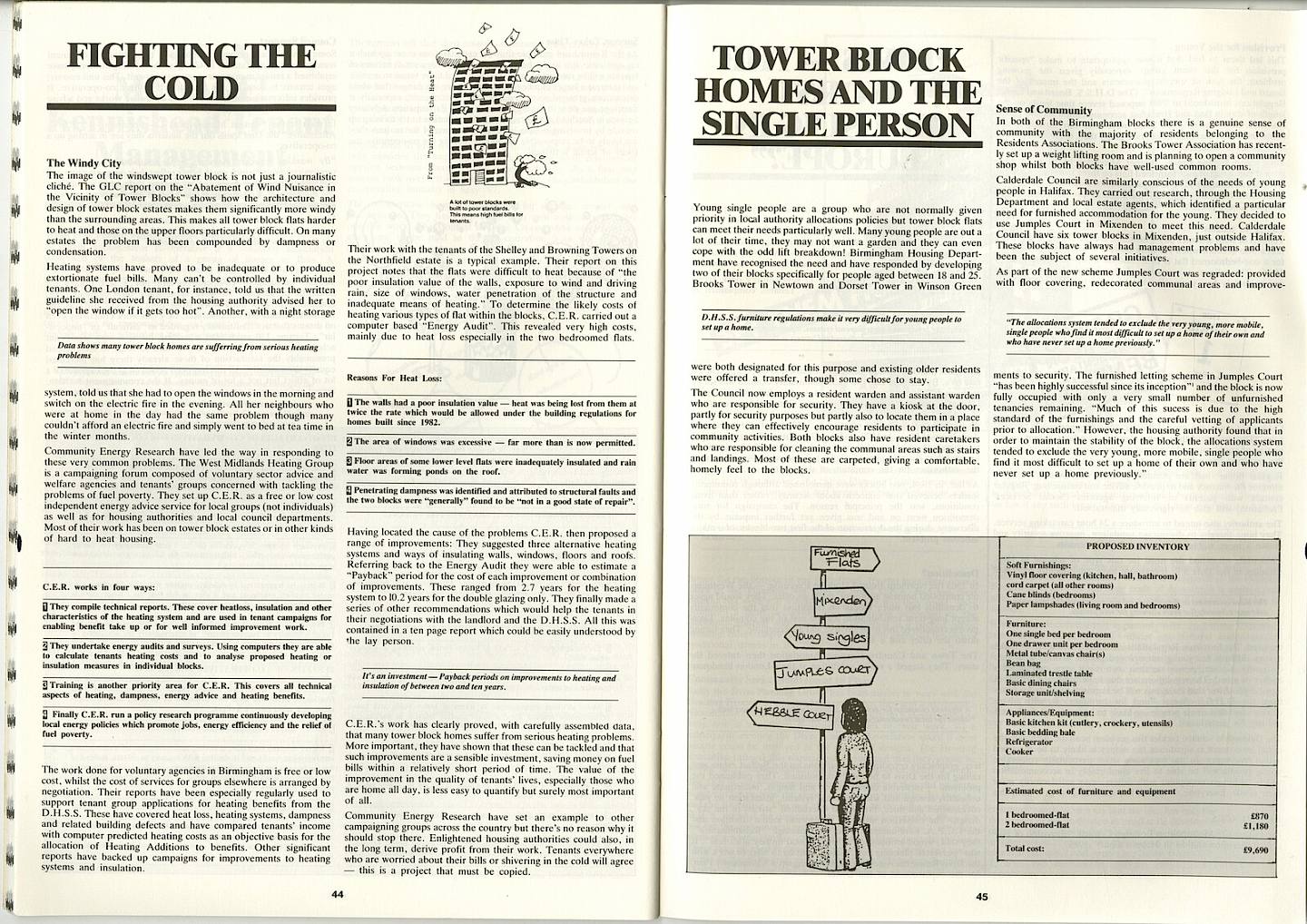
[caption: A lot of tower blocks were built to poor standards. This means high fuel bills for tenants. From “Turning on the Heat”]
[caption: Data shows many tower block homes are suffering from serious heating problems]
Their work with the tenants of the Shelley and Browning Towers on the Northfield estate is a typical example. Their report on this project notes that the flats were difficult to heat because of “the poor insulation value of the walls, exposure to wind and driving rain, size of windows, water penetration of the structure and inadequate means of heating.” To determine the likely costs of heating various types of flat within the blocks, C.E.R. carried out a computer based “Energy Audit”. This revealed very high costs, mainly due to heat loss especially in the two bedroomed flats.
Reasons For Heat Loss:
1 The walls had a poor insulation value — heat was being lost from them at twice the rate which would be allowed under the building regulations for homes built since 1982.
2 The area of windows was excessive — far more than is now permitted.
3 Floor areas of some lower level flats were inadequately insulated and rain water was forming ponds on the roof.
4 Penetrating dampness was identified and attributed to structural faults and the two blocks were “generally” found to be “not in a good state of repair”.
Having located the cause of the problems C.E.R. then proposed a range of improvements: They suggested three alternative heating systems and ways of insulating walls, windows, floors and roofs. Referring back to the Energy Audit they were able to estimate a “Payback” period for the cost of each improvement or combination of improvements. These ranged from 2.7 years for the heating system to 10.2 years for the double glazing only. They finally made a series of other recommendations which would help the tenants in their negotiations with the landlord and the D.H.S.S. All this was contained in a ten page report which could be easily understood by the lay person.
[caption: It’s an investment — Payback periods on improvements to heating and insulation of between two and ten years.]
C.E.R.’s work has clearly proved, with carefully assembled data, that many tower block homes suffer from serious heating problems. More important, they have shown that these can be tackled and that such improvements are a sensible investment, saving money on fuel bills within a relatively short period of time. The value of the improvement in the quality of tenants’ lives, especially those who are home all day, is less easy to quantify but surely most important of all.
Community Energy Research have set an example to other campaigning groups across the country but there’s no reason why it should stop there. Enlightened housing authorities could also, in the long term, derive profit from their work. Tenants everywhere who are worried about their bills or shivering in the cold will agree — this is a project that must be copied.
TOWER BLOCK HOMES AND THE SINGLE PERSON
Sense of Community
In both of the Birmingham blocks there is a genuine sense of community with the majority of residents belonging to the Residents Associations. The Brooks Tower Association has recently set up a weight lifting room and is planning to open a community shop whilst both blocks have well-used common rooms.
Calderdale Council are similarly conscious of the needs of young people in Halifax. They carried out research, through the Housing Department and local estate agents, which identified a particular need for furnished accommodation for the young. They decided to use Jumples Court in Mixenden to meet this need. Calderdale Council have six tower blocks in Mixenden, just outside Halifax. These blocks have always had management problems and have been the subject of several initiatives.
As part of the new scheme Jumples Court was regraded: provided with floor covering, redecorated communal areas and improvements to security. The furnished letting scheme in Jumples Court “has been highly successful since its inception” and the block is now fully occupied with only a very small number of unfurnished tenancies remaining. “Much of this sucess is due to the high standard of the furnishings and the careful vetting of applicants prior to allocation.” However, the housing authority found that in order to maintain the stability of the block, the allocations system tended to exclude the very young, more mobile, single people who find it most difficult to set up a home of their own and who have never set up a home previously.
[caption: D.H.S.S. furniture regulations make it very difficult for young people to set up a home.]
[caption: “The allocations system tended to exclude the very young, more mobile, single people who find it most difficult to set up a home of their own and who have never set up a home previously.”]
Young single people are a group who are not normally given priority in local authority allocations policies but tower block flats can meet their needs particularly well. Many young people are out a lot of their time, they may not want a garden and they can even cope with the odd lift breakdown! Birmingham Housing Department have recognised the need and have responded by developing two of their blocks specifically for people aged between 18 and 25. Brooks Tower in Newtown and Dorset Tower in Winson Green were both designated for this purpose and existing older residents were offered a transfer, though some chose to stay.
The Council now employs a resident warden and assistant warden who are responsible for security. They have a kiosk at the door, partly for security purposes but partly also to locate them in a place where they can effectively encourage residents to participate in community activities. Both blocks have resident caretakers who are responsible for cleaning the communal areas such as stairs and landings. Most of these are carpeted, giving a comfortable, homely feel to the blocks.
[caption: [Drawing of a road sign post with signs saying: "Furnished Flats", "Mixenden", "Young singles", "JUMPLES COURT", "HEBBLE COURT"]]
PROPOSED INVENTORY
Soft Furnishings:
Vinyl floor covering (kitchen, hall, bathroom)
cord carpet (all other rooms)
Cane blinds (bedrooms)
Paper lampshades (living room and bedrooms)
Furniture:
One single bed per bedroom
One drawer unit per bedroom
Metal tube/canvas chair(s)
Bean bag
Laminated trestle table
Basic dining chairs
Storage unit/shelving
Appliances/Equipment:
Basic kitchen kit (cutlery, crockery, utensils)
Basic bedding bale
Refrigerator
Cooker
Estimated cost of furniture and equipment
1 bedroomed-flat: £870
2 bedroomed-flat: £1,180
Total cost: £9,690