National Tower Blocks Directory 1987
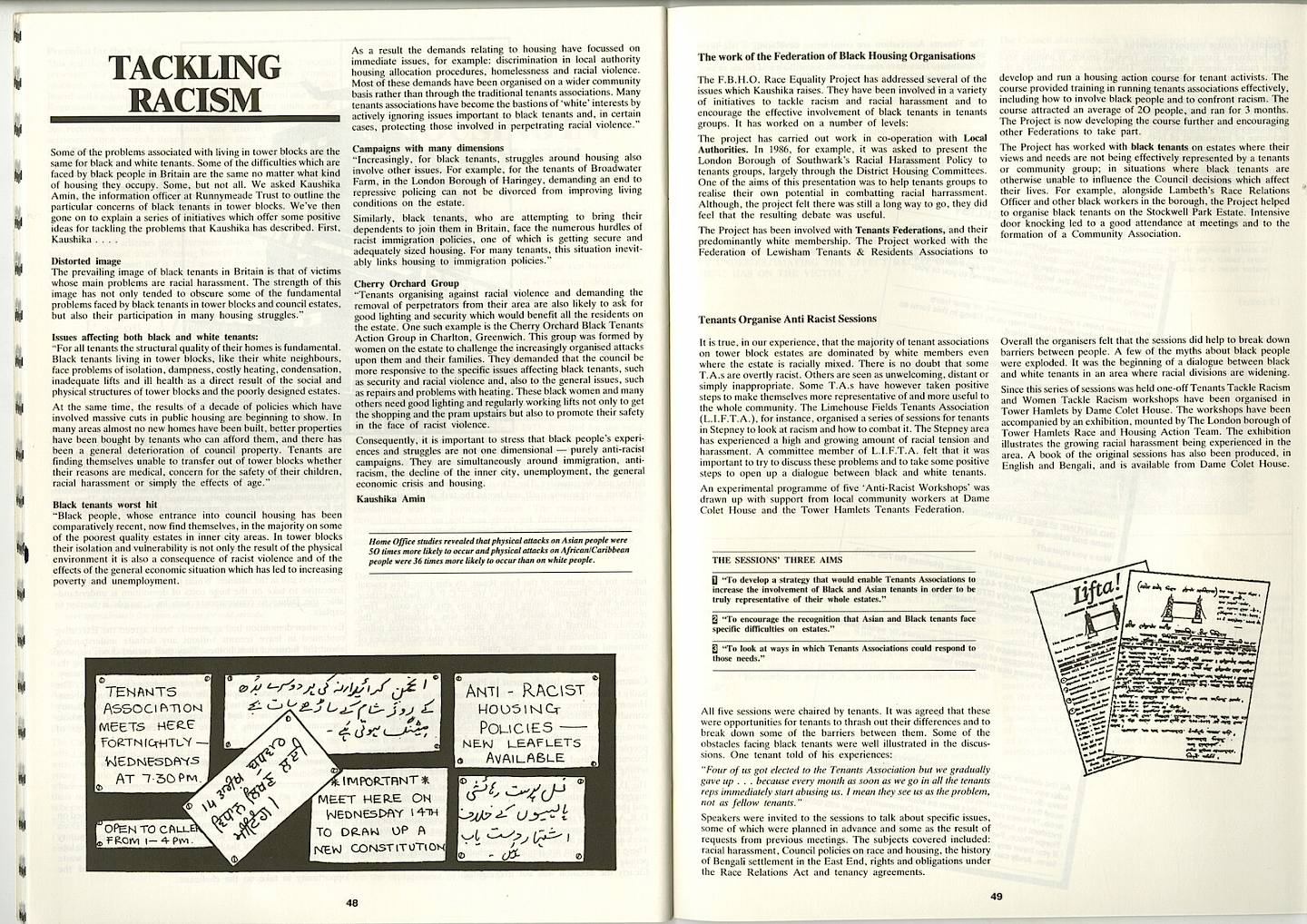
TACKLING RACISM
Some of the problems associated with living in tower blocks are the same for black and white tenants. Some of the difficulties which are faced by black people in Britain are the same no matter what kind of housing they occupy. Some, but not all. We asked Kaushika Amin, the information officer at Runnymeade Trust to outline the particular concerns of black tenants in tower blocks. We've then gone on to explain a series of initiatives which offer some positive ideas for tackling the problems that Kaushika has described. First, Kaushika . . .
Distorted image
The prevailing image of black tenants in Britain is that of victims whose main problems are racial harassment. The strength of this image has not only tended to obscure some of the fundamental problems faced by black tenants in tower blocks and council estates, but also their participation in many housing struggles."
Issues affecting both black and white tenants:
"For all tenants the structural quality of their homes is fundamental. Black tenants living in tower blocks, like their white neighbours, face problems of isolation, dampness, costly heating, condensation, inadequate lifts and ill health as a direct result of the social and physical structures of tower blocks and the poorly designed estates.
At the same time, the results of a decade of policies which have involved massive cuts in public housing are beginning to show. In many areas almost no new homes have been built, better properties have been bought by tenants who can afford them, and there has been a general deterioration of council property. Tenants are finding themselves unable to transfer out of tower blocks whether their reasons are medical, concern for the safety of their children, racial harassment or simply the effects of age."
Black tenants worst hit
"Black people, whose entrance into council housing has been comparatively recent, now find themselves, in the majority on some of the poorest quality estates in inner city areas. In tower blocks their isolation and vulnerability is not only the result of the physical environment it is also a consequence of racial violence and of the effects of the general economic situation which has led to increasing poverty and unemployment.
As a result the demands relating to housing have focussed on immediate issues, for example: discrimination in local authority housing allocation procedures, homelessness and racial violence. Most of these demands have been organised on a wider community basis rather than through the traditional tenants associations. Many tenants associations have become the bastions of 'white' interests by actively ignoring issues important to black tenants and, in certain cases, protecting those involved in perpetrating racial violence."
Campaigns with many dimensions
"Increasingly, for black tenants, struggles around housing also involve other issues. For example, for the tenants of Broadwater Farm, in the London Borough of Haringey, demanding an end to repressive policing can not be divorced from improving living conditions on the estate.
Similarly, black tenants, who are attempting to bring their dependents to join them in Britain, face the numerous hurdles of racist immigration policies, one of which is getting secure and adequately sized housing. For many tenants, this situation inevitably links housing to immigration policies."
Cherry Orchard Group
"Tenants organising against racial violence and demanding the removal of perpetrators from their area are also likely to ask for good lighting and security which would benefit all the residents on the estate. One such example is the Cherry Orchard Black Tenants Action Group in Charlton, Greenwich. This group was formed by women on the estate to challenge the increasingly organised attacks upon them and their families. They demanded that the council be more responsive to the specific issues affecting black tenants, such as security and racial violence and, also to the general issues, such as repairs and problems with heating. These black women and many others need good lighting and regularly working lifts not only to get the shopping and the pram upstairs but also to promote their safety in the face of racist violence.
Consequently, it is important to stress that black people's experiences and struggles are not one dimensional — purely anti-racist campaigns. They are simultaneously around immigration, anti-racism, the decline of the inner city, unemployment, the general economic crisis and housing."
Kaushika Amin
[caption: Home Office studies revealed that physical attacks on Asian people were 50 times more likely to occur and physical attacks on African/Caribbean people were 36 times more likely to occur than on white people.]
[image text extraction]
TENANTS ASSOCIATION MEETS HERE FORTNIGHTLY WEDNESDAYS AT 7.30PM.
OPEN TO CALLER FROM 1- 4 PM.
[Urdu script: انجمن کرایہ داران کی ہر دوسرے ہفتے کے روز شام کے ساڑھے سات بجے میٹنگ ہوتی ہے۔]
[Punjabi script: 14 ਅੱਠਵਾਂ ਦਫਤਰ ਦਿਆਨ ਵਿਖੇ ਲਈ ਮੀਟਿੰਗ।]
* IMPORTANT * MEET HERE ON WEDNESDAY 14TH TO DRAW UP A NEW CONSTITUTION
ANTI - RACIST HOUSING POLICIES - NEW LEAFLETS AVAILABLE
[Urdu script: نسل پرست رہائشی پالیسیوں کے خلاف اشتہار دست یاب ہیں]
The work of the Federation of Black Housing Organisations
The F.B.H.O. Race Equality Project has addressed several of the issues which Kaushika raises. They have been involved in a variety of initiatives to tackle racism and racial harassment and to encourage the effective involvement of black tenants in tenants groups. It has worked on a number of levels:
The project has carried out work in co-operation with Local Authorities. In 1986, for example, it was asked to present the London Borough of Southwark's Racial Harassment Policy to tenants groups, largely through the District Housing Committees. One of the aims of this presentation was to help tenants groups to realise their own potential in combatting racial harassment. Although, the project felt there was still a long way to go, they did feel that the resulting debate was useful.
The Project has been involved with Tenants Federations, and their predominantly white membership. The Project worked with the Federation of Lewisham Tenants & Residents Associations to develop and run a housing action course for tenant activists. The course provided training in running tenants associations effectively, including how to involve black people and to confront racism. The course attracted an average of 20 people, and ran for 3 months. The Project is now developing the course further and encouraging other Federations to take part.
The Project has worked with black tenants on estates where their views and needs are not being effectively represented by a tenants or community group; in situations where black tenants are otherwise unable to influence the Council decisions which affect their lives. For example, alongside Lambeth's Race Relations Officer and other black workers in the borough, the Project helped to organise black tenants on the Stockwell Park Estate. Intensive door knocking led to a good attendance at meetings and to the formation of a Community Association.
Tenants Organise Anti Racist Sessions
It is true, in our experience, that the majority of tenant associations on tower block estates are dominated by white members even where the estate is racially mixed. There is no doubt that some T.A.s are overtly racist. Others are seen as unwelcoming, distant or simply inappropriate. Some T.A.s have however taken positive steps to make themselves more representative of and more useful to the whole community. The Limehouse Fields Tenants Association (L.I.F.T.A.), for instance, organised a series of sessions for tenants in Stepney to look at racism and how to combat it. The Stepney area has experienced a high and growing amount of racial tension and harassment. A committee member of L.I.F.T.A. felt that it was important to try to discuss these problems and to take some positive steps to open a dialogue between black and white tenants.
An experimental programme of five 'Anti-Racist Workshops' was drawn up with support from local community workers at Dame Colet House and the Tower Hamlets Tenants Federation.
Overall the organisers felt that the sessions did help to break down barriers between people. A few of the myths about black people were exploded. It was the beginning of a dialogue between black and white tenants in an area where racial divisions are widening.
Since this series of sessions was held one-off Tenants Tackle Racism and Women Tackle Racism workshops have been organised in Tower Hamlets by Dame Colet House. The workshops have been accompanied by an exhibition, mounted by The London borough of Tower Hamlets Race and Housing Action Team. The exhibition illustrates the growing racial harassment being experienced in the area. A book of the original sessions has also been produced, in English and Bengali, and is available from Dame Colet House.
THE SESSIONS' THREE AIMS
1 "To develop a strategy that would enable Tenants Associations to increase the involvement of Black and Asian tenants in order to be truly representative of their whole estates."
2 "To encourage the recognition that Asian and Black tenants face specific difficulties on estates."
3 "To look at ways in which Tenants Associations could respond to those needs."
All five sessions were chaired by tenants. It was agreed that these were opportunities for tenants to thrash out their differences and to break down some of the barriers between them. Some of the obstacles facing black tenants were well illustrated in the discussions. One tenant told of his experiences:
"Four of us got elected to the Tenants Association but we gradually gave up . . . because every month as soon as we go in all the tenants reps immediately start abusing us. I mean they see us as the problem, not as fellow tenants."
Speakers were invited to the sessions to talk about specific issues, some of which were planned in advance and some as the result of requests from previous meetings. The subjects covered included: racial harassment, Council policies on race and housing, the history of Bengali settlement in the East End, rights and obligations under the Race Relations Act and tenancy agreements.
[caption: Lifta! 18th October 1986... [illegible] ... [illegible] ... [illegible]]