National Tower Blocks Directory 1987
WE CAN
MANAGE!
Kennishead Tenant
Management
Co-operative
What Is A Tenant Management Co-operative?
A tenant management co-operative is a voluntary association composed of the tenants of a group of houses or flats. A
co-operative requires the landlord who owns the flats to enter into
an agreement with the co-operative. Whether the landlord is the
Council the co-operative manages the flats on their behalf, after
agreeing which aspects of management it will have responsibility
for. An allowance is paid by the council to the co-operative for
carrying out its responsibilities and part of this can be used to
employ staff to administer the co-operative.
“Co-ops provide tenants with the opportunity to exercise real control over
their living conditions. The co-operative takes decisions and manages the
flats rather than merely having a say in council decisions. For local
authorities co-ops enable a wider choice of tenure within the public
sector but within a framework agreed by the council. Co-ops are likely to
ensure more satisfied tenants, committed to creating or maintaining
attractive and easy to let estates.”
T.P.A.S.
The Kennishead Example
The Kennishead Tenants Management Co-operative in Glasgow is
an example of such a co-operative on a high rise estate. There are
five 22-storey blocks and five blocks of maisonnettes on the estate.
The blocks contain 660 flats in all. Of these 440 are three-
bedroomed so there are a lot of families on the estate. With the
maisonnettes there are 758 flats altogether. The estate is very
isolated geographically and conforms to the bleak, windswept
image. The Tenants Association in Kennishead have described the
problems on their estate as including: unreliable lifts, vandalism,
anti-social tenants, water penetration and condensation plus de-
pression amongst tenants caused by unemployment and loneliness.
Tenants were particularly critical of the Council’s letting policy:
because of the unpopularity of the estate numbers of people with no
other choice had been housed there; these were sometimes people
who were seen as particularly vulnerable or anti-social. Seven
people on the estate committed suicide during an 18 month period.
The tenants felt that their estate was deteriorating rapidly and that
something serious needed to be done to halt the decline. They
decided that the answer to these problems lay in their own hands.
Their newsletter explained: “The past situation where the develop-
ment has been managed by absentee managers has proved not to
work in Kennishead. Kennishead should be managed and overseen
by the people who live there 24 hours per day.” In November 1984
they decided to begin negotiations with the Council with a view to
becoming a full tenant management co-operative.
It took time to gain the interest of a broad base of tenants and to
fully consider the implications. Initially there were divisions of
opinion between tenants of the different blocks. As a first step
tenants took over lettings within the blocks. They established the
co-operative formally in May ‘87.
The co-operative is now responsible for lettings, repairs, and
maintenance. They have appointed their own contractor to carry
out this work. The Council and the co-operative negotiated an
allowance to be paid to the Co-operative from the council’s
accounts. The allowance is related to the degree of responsibility
taken by the Co-operative.
The Co-operative have recently received an environmental grant
from the council to carry out external work: painting the unused
ground floor flats, tarring footpaths, and fencing off the maisonnet-
tes so that people can have individual gardens.
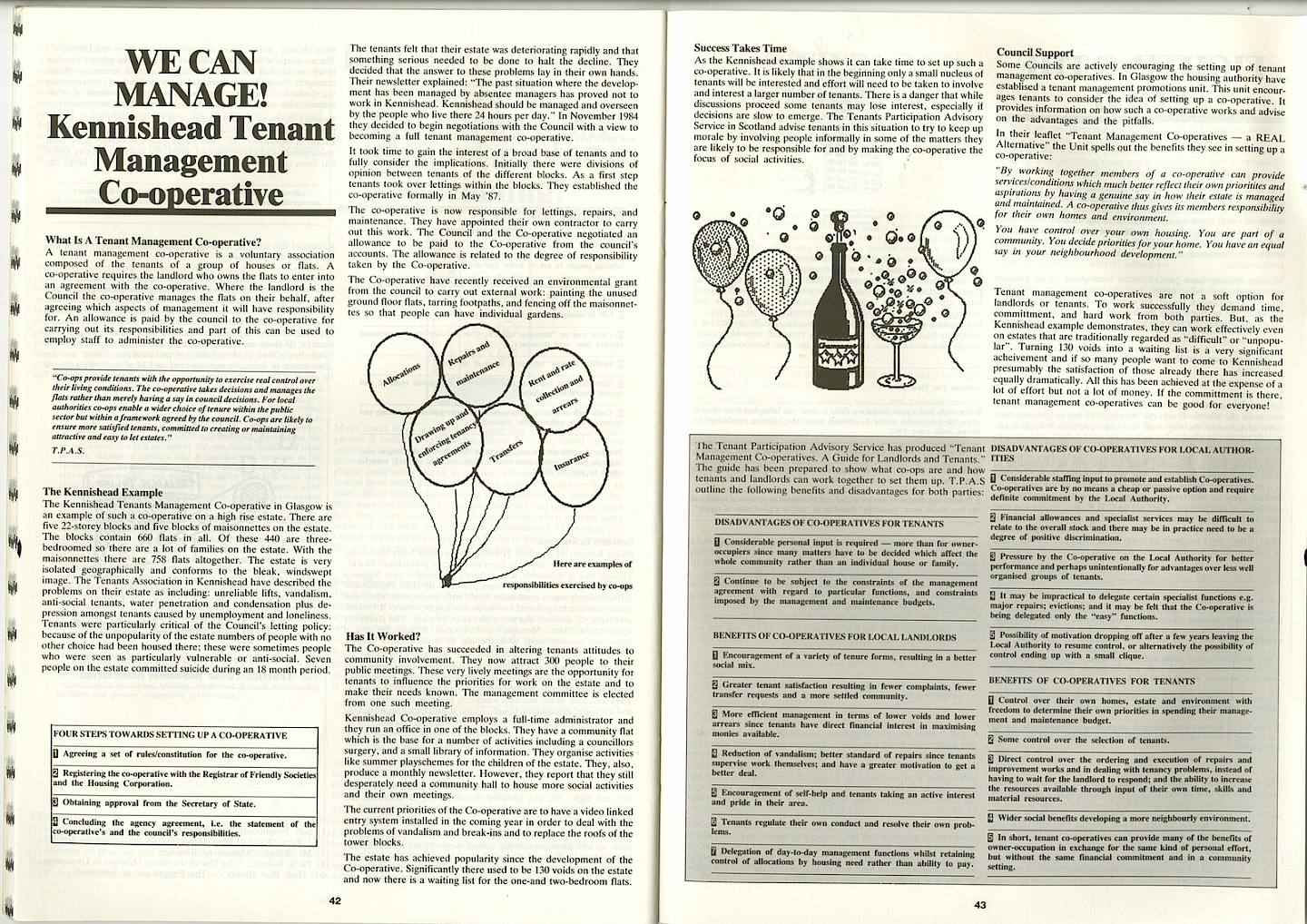
[caption: Here are examples of
responsibilities exercised by co-ops]
Has It Worked?
The Co-operative has succeeded in altering tenants attitudes to
community involvement. They now attract 300 people to their
public meetings. These very lively meetings are the opportunity for
tenants to influence the priorities for work on the estate and to
make their needs known. The management committee is elected
from one such meeting.
Kennishead Co-operative employs a full-time administrator and
they run an office in one of the blocks. They have a community flat
which is the base for a number of activities including a councillors
surgery, and a small library of information. They organise activities
like summer playschemes for the children of the estate. They, also,
produce a monthly newsletter. However, they report that they still
desperately need a community hall to house more social activities
and their own meetings.
The current priorities of the Co-operative are to have a video linked
entry system installed in the coming year in order to deal with the
problems of vandalism and break-ins and to replace the roofs of the
tower blocks.
The estate has achieved popularity since the development of the
Co-operative. Significantly there used to be 130 voids on the estate
and now there is a waiting list for the one-and-two-bedroom flats.
FOUR STEPS TOWARDS SETTING UP A CO-OPERATIVE
1 Agreeing a set of rules/constitution for the co-operative.
2 Registering the co-operative with the Registrar of Friendly Societies
and the Housing Corporation.
3 Obtaining approval from the Secretary of State.
4 Concluding the agency agreement, i.e. the statement of the
co-operative’s and the council’s responsibilities.
Success Takes Time
As the Kennishead example shows it can take time to set up such a
co-operative. It is likely that in the beginning only a small nucleus of
tenants will be interested and effort will need to be taken to involve
and interest a larger number of tenants. There is a danger that while
discussions proceed some tenants may lose interest, especially if
decisions are slow to emerge. The Tenants Participation Advisory
Service in Scotland advise tenants in this situation to try to keep up
morale by involving people informally in some of the matters they
are likely to be responsible for and by making the co-operative the
focus of social activities.
Council Support
Some Councils are actively encouraging the setting up of tenant
management co-operatives. In Glasgow the housing authority have
establised a tenant management promotions unit. This unit encour-
ages tenants to consider the idea of setting up a co-operative. It
provides information on how such a co-operative works and advise
on the advantages and the pitfalls.
In their leaflet “Tenant Management Co-operatives — a REAL
Alternative” the Unit spells out the benefits they see in setting up a
co-operative:
“By working together members of a co-operative can provide
services/conditions which much better reflect their own priorities and
aspirations by having a genuine say in how their estate is managed
and maintained. A co-operative thus gives its members responsibility
for their own homes and environment.
You have control over your own housing. You are part of a
community. You decide priorities for your home. You have an equal
say in your neighbourhood development.”
Tenant management co-operatives are not a soft option for
landlords or tenants. To work successfully they demand time,
committment, and hard work from both parties. But, as the
Kennishead example demonstrates, they can work effectively even
on estates that are traditionally regarded as “difficult” or “unpopu-
lar”. Turning 130 voids into a waiting list is a very significant
acheivment and if so many people want to come to Kennishead
presumably the satisfaction of those already there has increased
equally dramatically. All this has been achieved at the expense of a
lot of effort but not a lot of money. If the commitment is there,
tenant management co-operatives can be good for everyone!
The Tenant Participation Advisory Service has produced “Tenant
Management Co-operatives. A Guide for Landlords and Tenants.”
The guide has been prepared to show what co-ops are and how
tenants and landlords can work together to set them up. T.P.A.S
outline the following benefits and disadvantages for both parties:
DISADVANTAGES OF CO-OPERATIVES FOR TENANTS
1 Considerable personal input is required — more than for owner-
occupiers since many matters have to be decided which affect the
whole community rather than an individual house or family.
2 Continue to be subject to the constraints of the management
agreement with regard to particular functions, and constraints
imposed by the management and maintenance budgets.
BENEFITS OF CO-OPERATIVES FOR LOCAL LANDLORDS
1 Encouragement of a variety of tenure forms, resulting in a better
social mix.
2 Greater tenant satisfaction resulting in fewer complaints, fewer
transfer requests and a more settled community.
3 More efficient management in terms of lower voids and lower
arrears since tenants have direct financial interest in maximising
monies available.
4 Reduction of vandalism; better standard of repairs since tenants
supervise work themselves; and have a greater motivation to get a
better deal.
5 Encouragement of self-help and tenants taking an active interest
and pride in their area.
6 Tenants regulate their own conduct and resolve their own prob-
lems.
7 Delegation of day-to-day management functions whilst retaining
control of allocations by housing need rather than ability to pay.
DISADVANTAGES OF CO-OPERATIVES FOR LOCAL AUTHOR-
ITIES
1 Considerable staffing input to promote and establish Co-operatives.
Co-operatives are by no means a cheap or passive option and require
definite commitment by the Local Authority.
2 Financial allowances and specialist services may be difficult to
relate to the overall stock and there may be in practice need to be a
degree of positive discrimination.
3 Pressure by the Co-operative on the Local Authority for better
performance and perhaps unintentionally for advantages over less well
organised groups of tenants.
4 It may be impractical to delegate certain specialist functions e.g.
major repairs; evictions; and it may be felt that the Co-operative is
being delegated only the “easy” functions.
5 Possibility of motivation dropping off after a few years leaving the
Local Authority to resume control, or alternatively the possibility of
control ending up with a small clique.
BENEFITS OF CO-OPERATIVES FOR TENANTS
1 Control over their own homes, estate and environment with
freedom to determine their own priorities in spending their manage-
ment and maintenance budget.
2 Some control over the selection of tenants.
3 Direct control over the ordering and execution of repairs and
improvement works and in dealing with tenancy problems, instead of
having to wait for the landlord to respond; and the ability to increase
the resources available through input of their own time, skills and
material resources.
4 Wider social benefits developing a more neighbourly environment.
5 In short, tenant co-operatives can provide many of the benefits of
owner-occupation in exchange for the same kind of personal effort,
but without the same financial commitment and in a community
setting.