Hunslet Grange: An Experiment and Its Victims
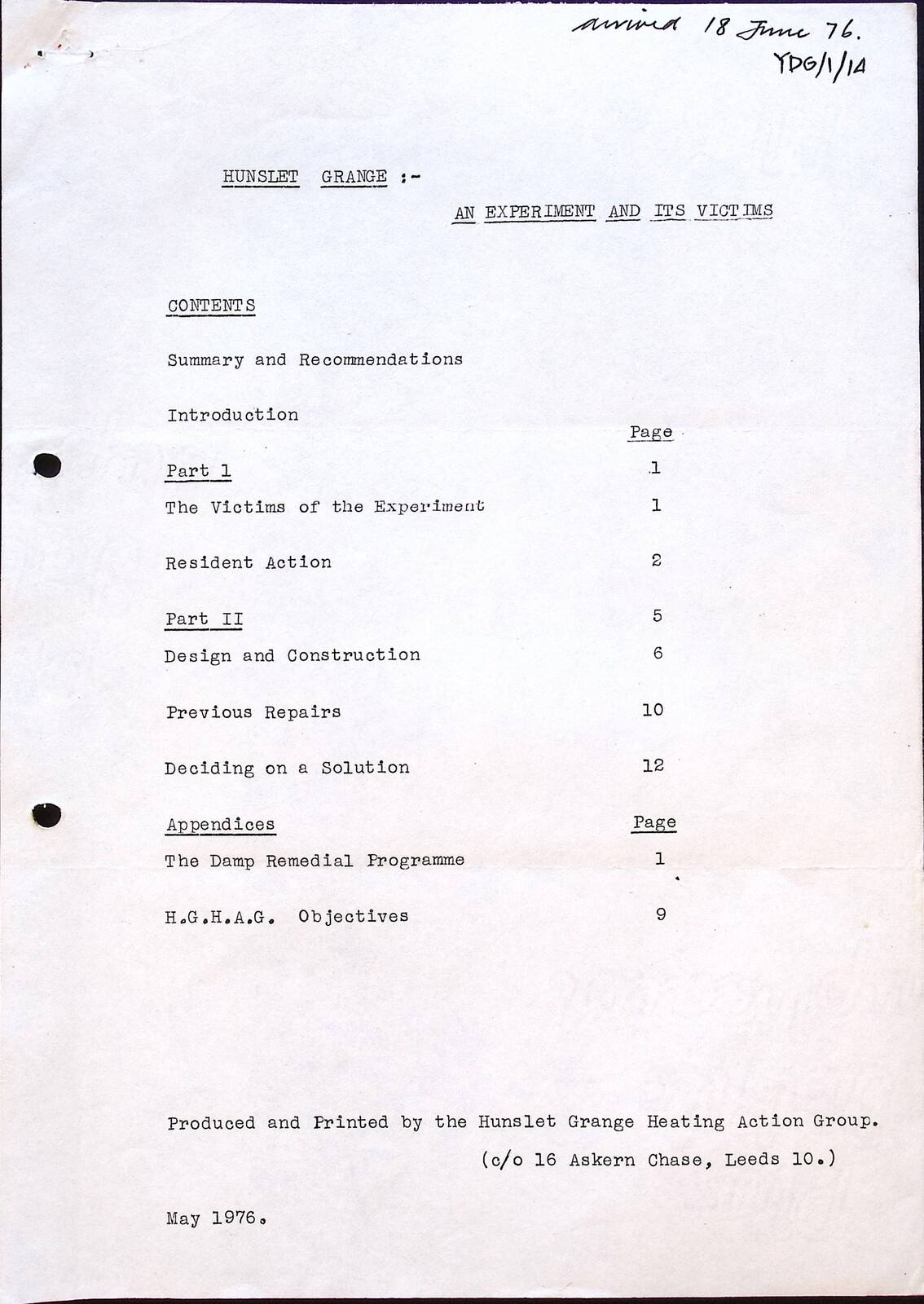
HUNSLET GRANGE :-
AN EXPERIMENT AND ITS VICTIMS
CONTENTS
Summary and Recommendations
Introduction
Page
Part 1 1
The Victims of the Experiment 1
Resident Action 2
Part II 5
Design and Construction 6
Previous Repairs 10
Deciding on a Solution 12
Appendices Page
The Damp Remedial Programme 1
H.G.H.A.G. Objectives 9
Produced and Printed by the Hunslet Grange Heating Action Group.
(c/o 16 Askern Chase, Leeds 10.)
May 1976.
SUMMARY AND RECOMMENDATIONS
The Hunslet Grange Heating Action Group was formed by residents concerned about the problems of high electricity bills, ineffective central heating, lack of repairs and difficulties in paying electricity bills, all of which plagued the estate. Because of our efforts in campaigning on these issues the Council is now preparing a report on the problems of Hunslet Grange, which hopefully will include recommendations for a once and for all solution. We have offered to work with the Council in preparing this report but they have not been interested in our co-operation.
Therefore, we have written our own report on conditions in Hunslet Grange and the way towards a solution. The report is based on months of work by residents of Hunslet Grange, who have been dealing with the problems of individuals, carrying out surveys, researching through journals and talking with people in the building profession .
On the basis of this work, we have reached the following conclusions:
1. The residents of Hunslet Grange are the victims of a Council House building experiment carried out by the building professions in the late 1960's.
2. The deplorable living conditions - damp, draughts, etc - in Hunslet Grange are a result of the structural inadequacies of the development.
3. The residents of Hunslet Grange are not only having to pay the recent unreasonable price increases in electricity, but also are being further penalised because of the structural faults in the flats and the badly maintained and possibly inappropriate central heating system.
4. Also residents of other council estates are suffering because too much of the limited money for council house repairs is being spent on ineffective "patch and repair" programmes in Hunslet Grange.
5. Leeds Council and all ratepayers are also victims. The Council must go on paying for Hunslet Grange for the next 50 years. It must take a stand now, either to protect its investment, or to cut its losses.
6. The failure of the recently completed damp remedial programme shows the folly of carrying out a programme of works without thoroughly investigating the problem and without attempting to implement a total solution.
7. It is the responsibility of Leeds Council to ensure that the residents of Hunslet Grange have decent living conditions.
8. We have not jumped on the "Knock-Them-Down" bandwagon, but we do considerit an alternative which must be seriously considered along with others.
We want:
1. A full analysis of the structure of the flats and its relationship to the deteriorating living conditions. This should include an analysis of the design of the flats, the construction techniques, the materials, and the specifications of design and construction.
2. An appraisal of previous structural repairs carried out, giving details of why necessary, their cost, the amount of disturbance to residents and their success.
3. An evaluation of possible solutions using the following criteria: cost (including compensation to residents), sources of finance, disturbance to residents, methods of implementation (including resident involvement), time scale.
Only with this information can proper technical decisions be made. We also stress that any solution to the problems of Hunslet Grange must be worked out and implemented in an atmosphere of full co-operation between the Council and residents.
And we want action now.
INTRODUCTION
"Neither builders, architects nor local authorities are rushing to take credit for the long list of faults in modern buildings. But it is clear that most of them resulted from the changing technology of building which came in the sixties."
(Nigel Hawkes, Observer, 28/3/76)
We are writing this report to ensure that a full investigation is carried out into the problems of Hunslet Grange. We are not offering a set of simple solutions - the simple things have been tried. But we hope to point the way to the right solution and to stress the need for close co-operation between the Council and residents if this solution is to be found and implemented.
The residents of Hunslet Grange are the victims of a housing experiment. The industrialised building technique used in Hunslet Grange in the late 1960's was seen as a breakthrough in council house building. In reality it turned out to be a short lived experiment for the architectural profession but not for the residents of Hunslet Grange. The pressures which brought about experiments of this type were:
1) government pressure to increase building rates coupled with the beginning of the disillusionment with high rise development.
2) pressure within the building industry to increase productivity, and thus profitability, by introducing labour saving techniques like the factory and system building techniques.
3) "proprietary systems which were being forced on local authorities by high pressure salesmanship, ammounting at times to outright blackmail, had been designed for constructional economy and convenience with little thought for human need".
(The Architect's Journal 9/9/70 p.566)
Perhaps this is unfair to the Yorkshire Design Group architect who did seem genuinely interested in developing these techniques into imaginative decent housing for people, although he does state that Hunslet Grange on the Y.D.G. Mark I was a crude attempt and that more time was needed to improve the construction method and its design limitations.(1) But he never got this chance.
Nor have the residents of Hunslet Grange had their chance. They have been abandoned by the authorities and the architectural profession. But the experiment is still going on for them, and they are having to pay the cost of this experiment through high fuel costs, unhealthy living conditions and mental stress.
(1) See Yorkshire Architect, Nov./Dec. 1970 p. 341-344
PART I
CHAPTER ONE
THE VICTIMS OF THE EXPERIMENT
Since the day Hunslet Grange was finished it has taken its toll on the residents. The five to seven storey blocks, clad in concrete slabs and faced with a flint chip covering of dark grey, creates a depressing environment. From too many flats the only view is onto other blocks of flats. Many young women with babies are trapped in their homes on the upper floors all day, everyday. They are very isolated and in some cases become totally withdrawn. When the first residents moved in, the site factory still existed, producing more slabs for the next phase. There was mud everywhere - no paths, no landscaping - wellington boots were an essential item for all residents. The collapse of Ronan Point, and subsequent conversion from gas to electricity of the occupied flats, at a time when other flats were still being completed, meant that the estate was empty or only partially occupied for a long time - a factor which contributed to its bleak appeasance, and it being regarded with suspicion throughout the city.
Facilities on the estate took time to appear, landscaping was done only slowly and unimaginatively. The grass mounds created were for the contractors convenience (to bury rubble) not for aesthetic reasons. Other areas were just flat and often badly drained. Play areas were called for and appeared, but residents were disappointed by the equipment provided. A more traditional sunken playground promised for the central area has never been built. The estate had several shop units and a pub built into it. The first shop was not let immediately and some of the units have still not been successfully let. Other shopping facilities got worse, as local shops were boarded up or knocked down pending the appearance of the Hunslet District Centre. But the District Centre is only now being built, and the Health Centre is still a promise. All these facilities have only appeared after residents have raised questions about delays and pressured the authorities into getting on and keeping their promises. And still what about the playground, the extension to car parking facilities, the modifications to rubbish chutes? This struggle to get adequate facilities is commom to many estates. But beyond this, Hunslet Grange has been plagued from the start with structural problems.
After only one winter in Endon Croft, a group of residents wrote to the Housing Committee threatening action if something was not done in their flats about damp. Residents organised to fight damp in 1972. A full account is given of this in the next chapter. To-day the residents are still suffering from the inadequacies of the estate, but with one difference the are now having to directly pay, in the form of high electricity bills, for the inadequate design and construction of the estate, and for the lack of repairs and maintainance by the Council.
- 1 -
Hunslet Grange has never had the stability of other council estates in Leeds. In the beginning the Housing Department found it difficult to let because of the length of time large parts of it remained vacant during conversion from gas to electricity after the Ronan Point disaster. Its association with Ronan Point did not make it particularly attractive, nor did its drab appearance. It was difficult to let because there was no general housing shortage in Leeds at the time, and because old Hunslet people who had been moved out to Seacroft or Middleton during redevelopment did not want to return to Hunslet Grange. It became a Housing Managers nightmare.
But the estate had to be let to someone, as the council was losing large sums in rent. It was generally only those in greatest housing need who would accet a flat. Typically they were the newcomers to Leeds, the young couples trying to escape from their in-laws, the single parent families, etc. Many saw Hunslet Grange as a place to live until they could buy a house or transfer to another estate. The proportion of young families just beginning to establish themselves has always been high, and these are the people least able to afford to pay for the mistakes of the Council.
There are other victims
The residents of Hunslet Grange are not the only victims of this experiment. Residents of other estates in Leeds are also losing out because of the disproportionate amount of money that has been spent on repairs and improvements on Hunslet Grange after only 6-10 years of life. A continued policy of ill-thought out patchwork improvements will only aggrevate the situation.
Leeds Council and all the ratepayers of Leeds are also victims. The Council must go on paying for Hunslet Grange for the next 50 years. It must take a stand now either to protect its investment in Hunslet Grange, or to cut its losses. It is short-sighted of the Council to continue to pump money into Hunslet Grange for minor improvements when they know major actionis needed. The Council is rapidly losing the value of 1250 dwellings. For its size the wait-list at Hunslet Grange is very small. It is becoming a place of last resort. The Housing Department is rightly concerned that many people on the waiting list would not be able to live there. A vicious destructive process has started in Hunslet Grange with the inevitable result that everyone will lose, unless positive action is taken now.
- 2 -
SOME OF THE VICTIMS
A) A young family with 3 children in a small 2 bedroom 5th floor flat without a balcony, are victims of both penetrating damp and condensation. Condensation on the windows is so bad that the sills have begun to rot. Wall paper, covered with black mould, falls away from the walls under the window. The ceilings are stained where water has penetrated through the blocks. The ceiling paper hangs loose in the hall. Not surprisingly the 4 month old baby has already spent time in hospital with bronchitis.
B) A resident in a 3 bedroom ground floor flat received an electricity bill in March for £109 of which £61 was for the off-peak units consumed. The central heating had not been working properly since Christmas and not at all for 6 weeks of the quarter. Despite repeated visits by the YEB no effective repairs were carried out. For a time when turned on the system made a deafening clatter audible down the 'phone in the housing department.
C) A young mother whose husband is in full-time employment but who still can't afford to run the central heating has to put up with spreading mould in 2 bedrooms and the kitchen - wallpaper, curtains, carpets and a 3 piece suite have been ruined. Draughts make the living room a hostile place. She has been criticised by her doctor for not keeping the baby warm enough.
D) The D's are an elderly couple who live in a top floor small 2 bedroom flat. The flat had damp causing black mould and rotting furnishings in both bedrooms, and so was included in a damp remedial programme. The programme meant the couple had to move temporarily to another flat while the work was done. The move was a considerable strain on them, Mr D had a collapse following it and was ill for several months. Once back in their flat the couple were horrorstruck when they found that the mould again returned, together with water pools forming on floors. They try to keep a perfect house, but are now extremely disillusioned, and are not well enough to cope with extra work of mopping puddles. Their electricity bill for the March quarter was over £70, a strain despite their methodic saving.
E) Mr and Mrs E and their 2 children used to live in a middle floor maisonette. Mr E is handicapped, and is dependant on a wheelchair. In common with many other families on the estate they felt that life on the ground floor would be better - both for the youngest child, and for Mr E. They therefore applied for, and were granted, a transfer to a ground floor maisonette. But their new maisonette is a nightmare. Fuel bills in their middle floor maisonette were reasonable, and the family found little difficulty in keeping warm at reasonable cost. Their bills now have more than doubled. The flat is riddled with draughts - which after several months have been (how effectively?) patched up. The heating system seems unable to get the flat warm. One of the bedrooms is damp, smells foisty, and the carpet is rotting. The fuel bills are a continual worry and strain as the family is on a very limited income. They try to cut back the heating, but the housing department told them to turn up the heating and open the windows to try to get rid of the damp. The doctor is worried about Mr E - his incapacity means that he needs adequate warmth. Since moving into the new maisonette he has twice been in hospital, the damp and cold being likely contributory factors.
CHAPTER TWO
RESIDENT ACTION
The Hunslet Grange Heating Action Group (HGHAG) was formed in February of this year to take action on the problem of high electricity bills and heating costs. Our investigations revealed that not only are the residents of Hunslet Grange having to pay the recent unreasonable price increase in electricity, but they are being further penalised because of the structural faults in the flats and the inefficient central heating system. The structural faults, which include ill-fitting external slabs, and gaps between floors and external walls, lead to problems of damp and draughts, making the flats even more expensive to heat. This situation is recognised by the Yorkshire Electricity Board (YEB). In a leaflet they published recently on heating all-electric council houses, Hunslet Grange is singled out as costing more than the others.
HGHAG wrote to the Housing Committee asking them to discuss the heating problems of Hunslet Grange at their meeting on 24th February. The Chairman would not guarantee to discuss Hunslet Grange, but there was an item on the agenda relating to all-electric council houses. To impress upon the Committee the urgency of the situation HGHAG organised a demonstration outside the local rent office and lobbied the members of the Committee explaining the nature of the problem, the need for the Council to accept some responsibility, and the need for immediate action. During the 3 hours of the demonstration 698 residents signed a petition of support which was later presented to the Housing Committee.
The Committee was 'sympathetic but saw the problem as one of difficulties of payment and agreed to arrange a meeting with the YEB and the Department of Health and Social Security (DHSS). One member suggested that representatives of resident's groups should attend. We later took up this point but were not asked to the meeting. We did, however, submit a report on payment problems to the Housing Committee before the meeting.
After the failure of the Housing Committee to act HGHAG drew up a list of objectives for further action.(2) The first objective was:
"To invite the Housing Committee to Hunslet Grange for a guided tour conducted by the Action Group, before the Housing Committee has its proposed meeting with representatives of the YEB and DHSS."
The Chairman refused this invitation but did as a 'first step' offer to arrange for a representative of the Housing Department technical staff, a representative of the Housing Department together with a heating engineer, the Assistant Director of Housing (Tenancy) and the Area Housing Manger to come to make
(2) For the full list of objectives see Appendix 2.
- 3 -
an investigation. We accepted the offer and lined up a number of flats which represented a cross-section of problems for them to see. We also arranged for a technical representative of the YEB to join the tour.
The tour took place on 10th March and when it was over we were told by the Assistant Director of Housing that a report would be prepared for the Chairman of the Housing Committee. Since the tour we have twice written to the Director of Housing asking to meet with officers involved in the preparation of this report and giving reasons for seeking this involvement. In our second letter, of 27th April 1976, we outlined the points which we felt had to be included in any meaningful examination of the problems of Hunslet Grange, namely:
1. A full analysis of the structure of the flats and its relationship to the deteriorating living conditions. This should include an analysis of the design of the flats, the construction techniques, the materials, the specifications and standards of construction.
2. An appraisal of previous structural repairs carried out, giving details of why necessary, their cost, amount of disturbance to residents and their success.
3. An evaluation of possible solutions using the following criteria, cost (including compensation to residents), sources of finance, likelihood of success, security of finance, disturbance to residents, methods of implementation, (including resident involvement), time-scale.
We have also asked the Chairman of the Housing Committee to attend a meeting 'to discuss the Council's attitude to the flats, and the way in which it proposes to help residents ease the burden of high electricity bills'. He saw no useful purpose in such a meeting.
It is interesting to compare the attitude of the Council towards co-operating with us with that of the YEB. Shortly after the tour the representative of the YEB gave H.G.H.A.G. a copy of the report he had prepared for the Council and also attended a meeting to more fully explain his proposals. We are deeply concerned about the Council's attitude and what it may mean for the future. Any solution to the problems of Hunslet Grange must be worked out and implemented in an atmosphere of full and active co-operation between the Council and residents.
The role of a former residents' group, the Damp Action Group, and their action in relation to the recently completed damp remedial programme illustrates this point. (For the full story see Appendix 1).
- 4 -
PART II
In this part we expand on the issues which we raised in our letter of the 27th April 1976, to the Director of Housing and which must be considered in any meaningful examination of the problems of Hunslet Grange. We are not architects, building surveyors or heating engineers, but we have approached these types of people and have read what we could about the design and construction of Hunslet Grange and related problems. We have done this because our experience has shown the need for a thorough examination of the problems and proposed solutions for Hunslet Grange before a commitment is made.
- 5 -
CHAPTER THREE
DESIGN AND CONSTRUCTION
The starting point for the examination must be a full analysis of the structure of the flats and its relationship to the deteriorating living conditions. As a basis for this analysis we first look at the major problems in the flats and then suggest how these are related to the structure.
DAMP
Condensation: Damp through condensation is not the fault of the resident. We believe it is caused by the poor ventilation in the flats and the abundance of cold surfaces, like unplastered walls and aluminium window frames, upon which warm air created by ordinary living condenses. Aluminium windows are notorious for condensation in any type of dwelling. We at first suspected that the cold walls were primarily due to a deterioration in the insulation in the slabs, through water penetration between the slabs, or cutbacks in specifications during construction. (The insulation referred to is approximately a 1" thickness of expanded polystyrene between 1" of cladding and about 6" of solid concrete, which forms the interior wall of the flat). While inadequate insulation may be the cause in some instances, we feel a far more important cause is the difficulty of heating the concrete walls. Concrete is a high density material and requires a vast ammount of heat to raise its temperature. For effective room heating the temperature difference between walls and air needs to be lessened. If this temperature difference can not be reduced, the warm air will condense on the cooler concrete walls.
Large quantities of continuous heat are needed to keep air and wall temperatures in line. The concrete absorbs heat and will tend to draw heat from the room. In an experiment carried out by Gratwick in 1967 using a typical dense concrete panel construction exactly the same as the ones used in Hunslet Grange he found that:
"Using an internal air temperature of 70°F maintained from built-in under floor electric heating at 15 watts loading per square foot and allowing reasonable ventilation, nearly eight weeks continuous heating was needed before any internal air temperature rise above 70°F indicated that the wall slab was at that temperature".(3)
He goes on to say:
"Without continuous general heating the structural slab will seldom really warm sufficiently to ensure freedom from condensation, especially in kitchens, bathrooms, and bedrooms".(4)
Although it takes considerable energy to heat the walls, once heated (given efficient overall insulation of walls, window frames doors etc.) the concrete should retain the heat and can have an almost 'radiant effect'-especially in periods of sudden temperature drop. However with ill fitting slabs, doors and windows and an inadequate central heating system, such an effect in Hunslet Grange is a mere pipe dream.
As well as temperature changes another important factor in determining condensation is the moisture content of the air in the flats. The heating system in the flats continually circulates the same air.
(3) Gratwick, R.I. - Dampness Vol. I & II London: Crosby Lockwood & Son Ltd., 1967-68. Pg. 224.
(4) Op Cit, Pg 225.
- 6 -
The air becomes moisture laden and surfaces need only be slightly cooler before it will condense on them. This problem is further aggrevated by the drying cupboards discharging into the bathroom or kitchen. A more satisfactory arrangement would be if cooler air were brought in from outside, warmed, circulated and then allowed to escape with the moisture it had collected. (For further comment on the central heating system see page 8 ).
From this information, at the basic and rather desperate level the Housing Department's cry of "open your windows and turn up the heating" has some logic in it. But the reality of the situation is different. Residents faced with the huge increase in electricity over the past winter are being forced to turn down their heating. A recent sample survey of the estate showed that 30% of the residents were no longer using their central heating , and a further 45% were restricting its use.(5) This not only affects conditions in their own flat but it increases the heat loss from surrounding flats making them more difficult to heat. And in the long term can cause a deterioration in the structure itself.
Penetrating Damp: Most of the early penetrating damp was caused by cracks in walkways and balconies. Much of this has been effectively stopped by the use of flashband. But there are a number of cases of penetrating damp which are called "inexplicable" by the Housing Department, for example, sudden floods of water through cracks in the roof slabs which form the ceilings in the flats. [this passage underlined by hand] Some such floods have been traced to burst pipes, of which the flats seem to have more than their fair share. In other cases we suspect that water is getting in between the wall slabs and finding its way through to weak ceiling joints. There are other cases of penetrating damp where the damp patch on the wallpaper directly corresponds to the joint between the external wall slabs. Also on the sides of windows, especially in the gable end flats, the damp is due to water penetration between the window frame and the end slab wall, and not to condensation as it is often claimed.
Draughts: Roaring draughts are the most common complaint in the flats. Droughts from under the skirting boards raising carpets off the floor. Draughts through warped balcony doors, or around ill-fitting window frames. Draughts through cracks between the external hardboard panelling on the ground floor flats or from behind cupboards.
We feel the main cause of penetrating damp and draughts and the subsequent heat loss, are ill-fitting slabs which are the result of:
- the continual movement of the structure
- problems that arose during the construction and handling of the slabs
- the lack of a proper sealer between the slabs.
(5) A sample survey carried out by the Department of Social Administration , York University.
- 7 -
Our reasons for these conclusions can be summed up briefly:
Movement: Movement is inherent in the construction of the flats. The flats are simply concrete blocks piled one on top of another. There is no superstructure, that is, no frame or backbone, to the flats. This situation may be further aggravated by the unstable site, which was formerly a marsh, and has old coal workings underneath.
Movement will not only explain the gaps between the slabs but also the warped balcony doors, ill-fitting windows and door frames, and the comparatively large number of burst pipes for a new building. The Housing Department is beginning to admit to the link between movement and repairs. Until recently draughts from under skirting boards were dealt with by cementing up the cracks, only to find in a short time that it had crumbled away. Now they, or rather the contractors, are putting a flexible polystyrene strip into the crack to allow for movement of the block.
Slabs: The slabe were produced in an on site factory, which was situated between the Leeds Athletics Institute and Endon Croft. By using a continuous batching plant, wet concrete could be fed direct to moulds for floors and wall panels. When dried the slabs were craned into place. Because the slabs are meant to fit together without a binding it is vital that they be designed and built to the highest specifications to allow for maximum movement without gaps appearing. It is equally important that great care be taken in handling the slabs so as not to chip or damage them. Accounts by HGHAG members who worked on the construction of the flats suggests that the condition of the slabs could be investigated as possible causes of poor fit between blocks. The condition of some of the wall slabs is called into question by the amount of repair work which has had to be done on them.
Sealing: The gaps between the blocks are not sealed. The exposed joints between the wall slabs do have a rubber inlay. We have been told that at the time of construction there was no sealer available that would move with the blocks. Thus any movement above the narrow tolerance will lead to gaps between wall slabs and floor blocks, and allow wind and rain to penetrate the structure.
THE CENTRAL HEATING SYSTEM
The one weapon that the resident has against the cold concrete and the draughts is the central heating system. The system has a large night storage heater from which hot air is blown out through ducts. It is questionable whether in fact it is a central heating system as in each flat at least one bedroom does not have a heating duct.
The Y.E.B. recommended this system when the original gas central heating was replaced after the collapse of Ronan Point. They say that the system has a similar output capacity as the original gas one, and that on the basis of the information that they were given it should heat the flats. However they are concerned that the thermal insulation of the dwelling is not as good as they were told.
Obviously draughts and cold surfaces are going to make it difficult for any heating system to make an impression on the flats. Residents complain of running their heating at full blast, and yet not being able to warm their flats. From what we have said before about heating concrete there must be some question as to whether the present system is the most technically suitable. And also whether a subsidised background heating system might be a more efficient and just method of heating the flats.
- 8 -
The question of value for money is also important at this time of high electricity costs. Off-peak storage heaters made sense when electricity prices were low and the off-peak rate even lower. Now that prices in general have risen, and the gap between off-peak and normal domestic tariff has been reduced, the inefficiencies of storage heaters have become more critical. The system is insensitive and although the resident pays for the storage unit to charge up fully the full charge may not be needed due to changes in the weather etc. Conversly in cold weather the system may become exhausted and the resident is only left with a two bar electric fire in the living room to heat the flat. Further expense is incurred because the resident must pay on the full tariff to run the fan to blow the hot air around the flat.
Also see page [blank] for an account of how the system may be increasing the problem of damp rather than attempting to solve it.
Adequate or not the system is a nightmare for the residents. The complicated system of storage heater intake controls, thermostats (some flats have two), duct flaps and filters can be overwhelming. It is a difficult system for the residents to operate but even more difficult for them to decide if it is working below capacity, for example when an element burns out. The procedure for getting repairs done is also a trial. All systems needing repairs must be reported to the Housing Department, who pass the notice on to the Public Works Department or to the Y.E.B. depending on where it is guessed the fault lies. This is because there is a division of responsibility with some types of fault being the concern of the Public Works Department (for example thermostats) while others are the concern of the Y.E.B. (for example the heater itself). Obviously from the residents report it may be difficult to guess where the fault lies and so repairs are initially referred to the wrong agency. This inevitably leads to delays in repairs being carried out.
It is interesting to compare this with an owner-occupier who has direct access to the Y.E.B. service department, and their 24 hour emergency service. Residents of Hunslet Grange have to wait until Monday morning and go through the whole procedure.
No-one knows the the capabilities of the central heating system because no-one knows how efficiently the the individual systems are working. If the system can be shown to effectively heat the flats at a reasonable cost, after the necessary works are carried out to the structure, then in order to ensure its continued efficiency a regular repair and maintainance scheme must be started. The Y.E.B. agree with the necessity of such a scheme. We also feel that such a scheme should be started immediately as a short term measure.
Conclusion: Thus in seeking solutions to the problems of Hunslet Grange the Council should begin by examining:
1) the implications of the specifications of the design and construction of the blocks not being high enough to allow for the movement of the structure on site, and consequently, draughts and damp being able to penetrate the structure.
2) the inability of the central heating system to efficiently heat the flats, or to be made to do so at a reasonable cost to the residents.
- 9 -
CHAPTER FOUR
PREVIOUS REPAIRS
Hunslet Grange seems to have been undergoing repairs or modifications since the day it was built:
1) Problems of damp occurred in Endon Croft and Leek Chase as early as 1968.
2) After the Ronan Point collapse £500,000 was spent on strengthening the gable ends and changing the heating system from gas to electricity. [marked by hand in margin]
3) Major reinforcement has already been carried out on the link bridges.
4) Continual flash banding has to be carried out to stop rain penetration.
5) Chipping-out and patching-up of aggregate wall panels is at present taking place.
6) There have been major structural works on parts of Pottery Vale which is only 5 years old.
7) Sound insulation has been carried out on blocks which skirt the M1 link.
The necessity of these repairs raises questions about the structure of the flats and tends to support our points in the previous chapter. But of even more concern to us is the failure of the damp remedial programme.
Damp Remedial Programme
The Council has already tried one patch and repair solution to the problems of damp and draughts in the flats. It is with great restraint that we simply term this programme a failure.
With the 18 month remedial programme only completed last autumn, 43% nearly half of the flats treated, have had some reccurance of damp. And if the experience of one of the 2 experimental flats, where work was carried out in 1973, is anything to go by, the incidence of damp, and its severity, is likely to get considerably worse after another winter.
We calculate that the major work carried out on 215 flats cost approximately £800 per flat - total cost £172,000. The work has also involved considerable disturbance and cost to the residents, and much staff time on the part of the Housing Department. [marked by hand in margin]
We give the full story of the damp remedial programme in Appendix 1. It is essential reading for anyone concerned with finding a solution to the problems of Hunslet Grange. Here we will concentrate on some of the technical aspects of the programme.
- 10 -
The full damp remedial programme consisted of:
1) Extra ventilation - an extractor fan installed in the kitchen window, ventilation holes bored into doors and cupboards, and window baffles provided.
2) Insulation - a dry-lining was applied to the inside of the external walls; mainly on the gable-ends and under windows.
Before starting the programme 2 experimental flats were done. As well as extra ventilation and insulation they had extra heaters installed in the bedrooms without a central heating duct to theoretically achieve better background heating. The extra heating was not included in the full programme , partly due to opposition from the residents who doubted whether the heater would be effective. They were also rightly worried about having to pay for the heater at a time when electricity costs were on the increase.
Extra ventilation, insulation, and extra heating are the steps recommended by the government for combating condensation. Obviously, the failure to provide effective extra heating has been one of the reasons for the return of damp to the treated flats, but the pattern of the returning damp leads us to question the dry-lining.
The flats in which damp has returned typically have black mould growing out along the ceiling from the dry-lined wall aand pools of water on the floor at the base of the wall. One possibility is that water is now condensing on the next coldest surface - now that the wall itself is relatively warm - that is, on the ceilings and floors. Or perhaps moisture is building up behind the insulated wall and is getting there because:
- the original damp was due to penetration through the slab joints, or
- water is coming out of the concrete which has never dried properly, or
- warm moist air from the flat is getting behind the dry-lining and condensing, on the now even colder concrete wall.
Possibly some combination of these factors is the most logical explanation when the number of flats involved is considered. All have serious implications for any future remedial work, especially if it includes dry-lining. To be effective the dry-lining must be air tight. Obviously, it is not. This could be the fault of poor materials, a cheap job or bad workmanship. But it could also be because the constant movement of the structure makes the application of an air tight dry-lining impossible.
It is essential that a complete appraisal of all the repairs carried out on the estate, including the damp remedial programme is carried out. The appraisal should give details of why the repairs were necessary, their cost, the amount of disturbance to residents and the success or lack of it of the repairs. The amount spent on these repairs should also be compared with the cost of repairs on other estates. Only by doing this analysis will it be possible to fully examine the effectiveness of the piece-meal repairs.
- 11 -
CHAPTER FIVE
DECIDING ON A SOLUTION
All suggested solutions must be evaluated using the following criteria: cost (including compensation to residents), sources of finance, likelihood of success, disturbance to residents, methods of implementation (including resident involvement,) time-scale, and future management policy.
Discussion of costs is bound to raise the question of responsibility for defects. We are not concerned with apportioning blame. Our interest is in tomorrow not yesterday. But extreme situations like Hunslet Grange, call for extreme solutions and extreme solutions will cost money. We do not ask for preferential treatment at the expense of other residents on other estates.
We have not jumped on the "Knock-Them-Down" bandwagon. But we do consider it an alternative which must be seriously considered along with others.
We have only touched on the problems of social and personal stress affecting people living in the flats. But clearly if the flats are to stay it must be within the context of a management and letting policy which takes into account the pressures on residents who live in medium rise deck-access developments.
- 12 -
- 1 -
APPENDIX 1
The Damp Remedial Programme
This section outlines the history of the "damp remedial programme" and the results of a survey by H.G.H.A.G. of the flats in the programme. It is important to go into this in some detail as it shows:
1. The Council's lack of commitment to finding a solution to the problem of Hunslet Grange.
2. The trials of the residents in persuading the Council of the seriousness of the problem, in living through the remedial programme, and in finding the programme has failed, but most important it shows,
3. The folly of implementing a limited programme without a thorough investigation of the problem.
Recognition of the Damp Problem: The problem of dampness in Hunslet Grange has a long history - as long, in fact, as the life of the flats. On 30th September, 1968 some of the first residents wrote to the Housing Department,
"The tenants of the upper floors of Endon Croft and Leek Chase have elected a committee from whom this letter comes to you.
We have in our possession a petition signed by 1 person from each of 32 dwellings, all complaining of the damp in their homes. Some have carpets completely ruined by the water, others have walls which are green mouldy.
All these complaints have been reported to your assistant Mr.....
For the last 5 months the workmen on the site have been trying to cure this but cannot find a solution. They now say that they do not know what to try next.
The various complaints we have about the damp are too numerous to write about and we would like to arrange a meeting with you.
Dampness is caused both by water penetration and by condensation. Residents have suffered from spoilt decorations, black mould on walls, plaster bettles, rotting carpets, ill-health, etc. At first the Housing Department would not admit that there was a widespread problem. Residents recieved assurances that a certain amount of condensation was only to be expected, and that in most cases it was caused by their misuse of the heating and ventilation facilities. "Open your windows and turn up the heating", "the mould will wipe off", residents were told.
- 2 -
Some years later the Community Association on the estate raised the problem of damp with the City Architect's Department, pointing out that the worst damp tended to occur in flats at the end of blocks, which suggested that dampness is not caused by the habits of residents but by the design of the building.
During early 1973, the Council decided to carry out a survey of the estate to find out how widespread the problem was, and which flats were the worst affected. The survey discovered that 40% of the flats had some problem of dampness. Residents at this time were told that the Council was trying to take legal action against Shepherds, the contractors, about the responsibility for the faults in the flats. This was given as the reason for no work starting. However, eventually, despite no legal settlement the Council decided to experiment with some remedial work on 2 flats that were particularly bad. The work that they did, followed the 3 point approach, recommended in a government advisory leaflet on condensation:
1) Extra ventilation - an extractor fan was installed in the kitchen window, ventilation holes were bored into doors and cupboards, and window baffles provided.
2) Extra heating - electric heaters were installed in bedrooms that lacked a central heating duct - so that there could, theoretically - be better background heating in the flats.
3) Insulation - a dry lining was applied to the inside of the damp external walls.
The work on the 2 experimental flats was completed in the autumn of 1973.
The Damp Action Group: Over the winter of 1973/74 a Damp Action Group (DAG) formed amongst residents of the estate, because of the concern about the action to be taken by the Council. The Group learned that work was to start over the whole estate on the installation of the additional heaters and on increasing ventilation. Also that gable-end flats (the ones generally the worst effected) were to be included early in the programme.
However the Group were told that wall insulation was not possible at that time due to a shortage of joiners and materials. DAG was not given an assurance when the insulation work would be carried out.
- 3 -
DAG became very concerned that the remedial programme planned would do nothing to solve the problems of the worst affected flats. They also decided to carry out their own survey of the problem, and found that there were discrepancies in the Council's survey - some flats that the Council's survey had shown to have little or no damp were shown by DAG's survey to have a severe problem and vice versa.
Cause of the Damp
There was further disagreement over the cause of the damp. The Council mostly labelled it "condensation" - but was it always? There were some obvious cases of rain penetration where water streamed in after heavy rain, and others where the problem was certainly condensation. But there were also other less obvious instances where it was not clear whether it was rain penetrating from the outside or condensation, or a mixture of the two. The Council had been taking action over obvious cases of rain penetration from walkways and balconies by the use of Flashband, a waterproof sealant. But in some flats the origin of the penetration seemed to be some distance from the flat affected, and in these cases great difficulty was found in effectively solving the problem. However there was a lot of argument in less clear cut cases about the cause of the damp, with residents claiming that water was penetrating into their flats, and the Council claiming that their damp was just caused by condensation.
Work Starts
The heating and ventilation programme to be carried out in every flat on the estate started in May 1974.
Resident Reaction
Residents regarded the programme of work with great sceptism. The resident with no problem of damp felt that he was to be disturbed for a programme of work that gave him no benefit, and could even be negative. Residents felt that their flats were draughty enough without ventilation holes being bored into them. The idea of the extractor fan was generally welcomed - but even this was missed off the beginning of the programme because the new window frame needed could not be installed due to an aluminium shortage. Later, when extractor fans were installed residents were often disappointed as the new window unit was a single pane and they often found that the condensation was worse on it than on the original double glazed pane. The heaters were welcomed with dismay. The estate already had a reputation for high electricity costs. To quote a YEB spokesman at this time:
- 4 -
"Hunslet Grange is one of our worst areas. We have always put this down to the hot air central heating system, which was originally intended for gas. The estate is one of our highest domestic users, compared with other comparable estates in Leeds." [marked in red in margin]
He said that he would be very concerned about the installation of additional heaters particularly at this time of rapidly increasing electricity costs. News had already been released about the planned increases of 65% over the next year in electricity costs which was to hit off peak consumers particularly hard.
If residents without a damp problem were sceptical, those with damp were more so.
"How is a heater in my bedroom going to solve the problem of black mould on my staircase."
"If heaters do work and get rid of the damp, then it is me who is going to have to pay for a solution to their mistake."
The heater in order to be effective would have to be on at a low heat for most of the time, but particularly during the night. The following quote from a DAG report written in May 1974 summarises the feelings of the residents:
"it is ludicrous to suggest that the initial programme of work that aims to increase the heating and ventilation in a flat will solve the problem of those worst affected - or if it did it would probably make the tenant bankrupt in the process. Some residents already open windows wide and use heaters they have bought themselves, but are still affected by damp".
Call for effective programme
On the 4th May 1974, the group in a letter to Merlyn Rees M.P., a copy of which he sent to the then Housing Committee Chairman Councillor Kevin Gould asked
"Can we be given an assurance that flats with a severe problem will have a complete effective programme carried out as soon as possible?".
Also included in this letter were the following points:
a) if heaters do help alleviate the problem why must residents bear the cost?
b) is the partial programme of work (ie the heating and ventilation work) worth all the disturbance it will cause?
c) will even the full programme (ie including insulation) resolve the problems of the worst flats?
As a result of this letter and other publicity about the damp, representatives from the Housing and Architecture Departments met members of DAG. DAG expressed its concern about the uselessness of the partial programme, and its concern over the confusion of the cause of damp. Other issues such as lack of weep holes in window frames, cracks in ceilings, [underlined by hand] and gales blowing in around windows and through
- 5 -
cracks under the skirting board were raised, [underlined in red by hand] and there was a plea for a totally effective approach to the problems in any flat.
This meeting was closely followed by a public meeting called by the Council at which Councillor Gould said that the insulation of badly affected flats was to be given top priority, and that heaters would not be installed at least in the first stage. This represented a change in the policy of the Housing Department and a step towards DAG's objectives. Comments from the floor again raised other problems in the flats, and there was again expressed a hope that there would be a total approach to the problems of a flat when work was carried out on it. Following this meeting the work on the flats stopped and all the flats were put into one of two programmes.
The "minor programme" which was just the ventilation work, was carried out on all the flats on the estate unless the resident refused access. It involved little resident disturbance.
The new "full programme" included insulation and ventilation but no extra heaters and it started in the autumn of 1974. The work was carried out on about 220 flats. The flats were chosen by a combination of those arising from the original Council survey and from flats discovered by the DAG survey. In addition all the residents received a letter telling them about the work, and asking them to come forward if they were not on the list but had a problem with damp. During the course of the work more flats needing action came to light, and some on the original list did not need the work doing, or the tenant did not want the disturbance - so the final list of the flats treated differed from the list at the outset. The work was completed at the end of 1975. The majority but by no means all of the flats were on gable ends. The major programme involved the resident moving out of his flat temporarily, usually for a period of about six weeks. This obviously meant a lot of disturbance and could be a difficult time especially for elderly residents and for those with a young family. But residents put up with the disturbance expecting the work done to solve the problem of their damp.
Limitations of the Programme
Even at the beginning of the programme there was an awareness amongst both residents and the Housing Department that the programme was unlikely to result in the total answer to the damp problems.
Residents were aware that a programme to stop condensation would not cure damp caused by water penetration. They wanted work on damp flats to take into account the fact that some of the problems could be due to penetrating damp. They had been told by an architect that it was sometimes very difficult to distinguish
- 6 -
between the two causes of damp even by an expert, and that a "trial and error" approach might be needed.
Moreover, as the discrepancies between the Council's and DAG's surveys had shown the list of flats chosen for inclusion in the full programme could only at best reflect the current situation. Damp could well develop in other flats later. What would happen if the tenant came along after the completion of the programme and reported damp? Neither of these two issues were fully come to terms with at the start of the programme.
H.G.H.A.G. Damp Survey
When H.G.H.A.G. started to look at the problems of the flats, we were approached by tenants complaining about damp having reoccured. A survey was organised of all the flats on the original list for the full programme - together with flats which while not on the original list had come to light in the course of the programme and so had had the work done. Information was gained from 207 out of a possible 279 flats. (This figure is higher than the number of flats in the programme (215) as it included ones on the original list that had not in fact had the work done). As well as questions about damp, residents were asked if they had any other outstanding faults or repairs in their flats.
Full programme carried out, damp reoccured 63
Full programme carried out, no damp reoccured 82
On initial list, work not done, still damp 18
On initial list, work not done, no damp 25
Flat empty or tenant refused to co-operate 19
207
Therefore out of the 145 flats contacted where the remedial work has been done, 43% were found to have some reoccurence of damp. The amount of damp varied from a very small patch to extensive black mould, and continual pools of water forming on the floor. The typical pattern was for the damp to appear on the ceiling in the form of black mould, and on the floors as wet patches which could rot carpets. The wall surfaces which had been insulated were generally unaffected, although there were some cases where damp had occured on the insulated walls. The damp in most cases was not as bad as the worst examples prior to the commencement of the work. However it must be stressed that the survey was carried out when the remedial programme had only been completed for a few months. [last sentence underlined]
- 7 -
Conditions in the Experimental Flats
The following are extracts from 2 reports written by a resident of one of the 2 experimental flats that had work carried out on them in the summer of 1973, prior to the commencement of any remedial programme. The first report was written in 1974, less than a year after the work had been done. The second was written this past winter, 1976.
First report, 1974
Living Room and Small Bedroom - rain seeping in between the ceiling and pelmet in heavy rain. Kitchen - water penetration onto ceiling after snow.
Bedroom - a great deal of condensation on the windows causing spillage from the window sill onto the wall below. Leakage of water from the outside from the skirting board is occuring along part of one wall and at present is slowly rotting the bedroom carpet. I am at present trying to seal the gap between the floor and skirting board. Spots of damp were appearing on the ceiling during the winter but appear to be drying out. This is occuring again as in the kitchen at the abbutment of the roofing slabs. Condensation in the bedroom can be decreased effectively by use of the storage heater but unless this is kept on all the time condensation will reappear as the air cools. This is of course a very expensive method of combatting condensation.
Second Report, 1976
Living room - the problem of rainwater seeping in through the ceiling and the curtain pelmet was finally repaired ten months after it was reported. However the problem has not been completely cured and repairs have been made which are only a temporary soution to the problem. The central heating system has been found to be inadequate during the really cold spells. There seems to be a constant draught although not too excessive it is enough to put a chill in the air for which the heating system seems powerless.
Small bedroom - again as in the living room temporary repairs have had to be made to stop rain water seeping in. More serious than this though is the fact that the damp has appeared on the ceiling all along the outside wall. This includes the built in wardrobe as well which is now deemed unusable. The damp although minor appears to be getting worse, particularly over the last few months, when a rapid increase has been noticed. The damp has gone from being small spots to large patches of black damp. The room has a very noticable damp foisty smell to it always now.
Storeroom - small spots of black damp have appeared in here and again the room has taken on a noticeably cold damp smell.
Bathroom - the filter on the ventilation fan unit in here has to be regularly cleaned since it picks up a white dust which soon renders it quite inefficient. The problem of this white powdered dust occurs throughout the flat and can be seen
- 8 -
quite clearly only a few days after cleaning. What the nature of this powder is I am not sure, but it is similar to plaster dust and occurs constantly. We have also found that "undesirable odours" filter up through the ventilation shaft for the fan unit.
Kitchen - the fault of the crack along the ceiling which let in rain water was repaired at the same time as the fault in the living room and has not reoccured since. However, a damp patch is occuring where the rain seeped in and ran along the ceiling.
Bedroom - again as in the small bedroom conditions are deteriorating. Damp has appeared on the ceiling along the outside wall and is steadily getting worse particularly over the last few months. Despite many attempts to cure the problem water is still seeping through between the floor and the skirting board in the corner of the two exterior walls. This is despite remedial work being carried out on the exterior. As yet it occurs in-frequently although continuously which has not helped in solving exactly where this seepage occurs.
Hallway - damp is occuring on the ceiling in here in line with that of the two bedrooms which again is down an outside wall.
Conclusions
Most of the damp conditions indicated were mentioned to the Council Official who visited the flat during the autumn of 1975. He felt at the time that they were not serious enough to warrant any action at the time. However, since his visit conditions have deteriorated dramatically, and I feel action now needs to be taken during this coming summer, otherwise the flat will be uninhabitable by the forthcoming winter.
- 9 -
Appendix 2
Hunslet Grange Heating Action Group Objectives (formulated 25th February 1976).
1. To invite the Housing Committee to come to Hunslet Grange for a guided tour, conducted by the Action Group, before the Housing Committee has its proposed meeting with representatives of the YEB and the DHSS.
2. To demand that the Council commission and publish in full an independant investigation into our heating problems. The report should make recommendations on improving the efficiency of the central heating system, in relation to the structural faults of the flats, and suggest alternative forms of heating.
3. To campaign for quick effective repairs to ensure an adequate standard of heating at reasonable cost can be achieved in the flats.
4. To press the Department of Health and Social Security for more realistic heating additions, and to extend these benefits to those on low incomes other than Supplementary Benefit.
5. To demand that the YEB take a more reasonable attitude to the problems of disconnections and payment of electricity bills.
6. To seek advice on the best use of electricity in the flats.
7. To press the Council to further consider the possibility of a heating subsidy.
8. To make links with and assist other residents' group in their fight against high electricity costs.
9. To support the national "Right to Fuel" campaign in its attempt to pressure Central Government into reducing electricity charges.