WESA_12_1_01p38
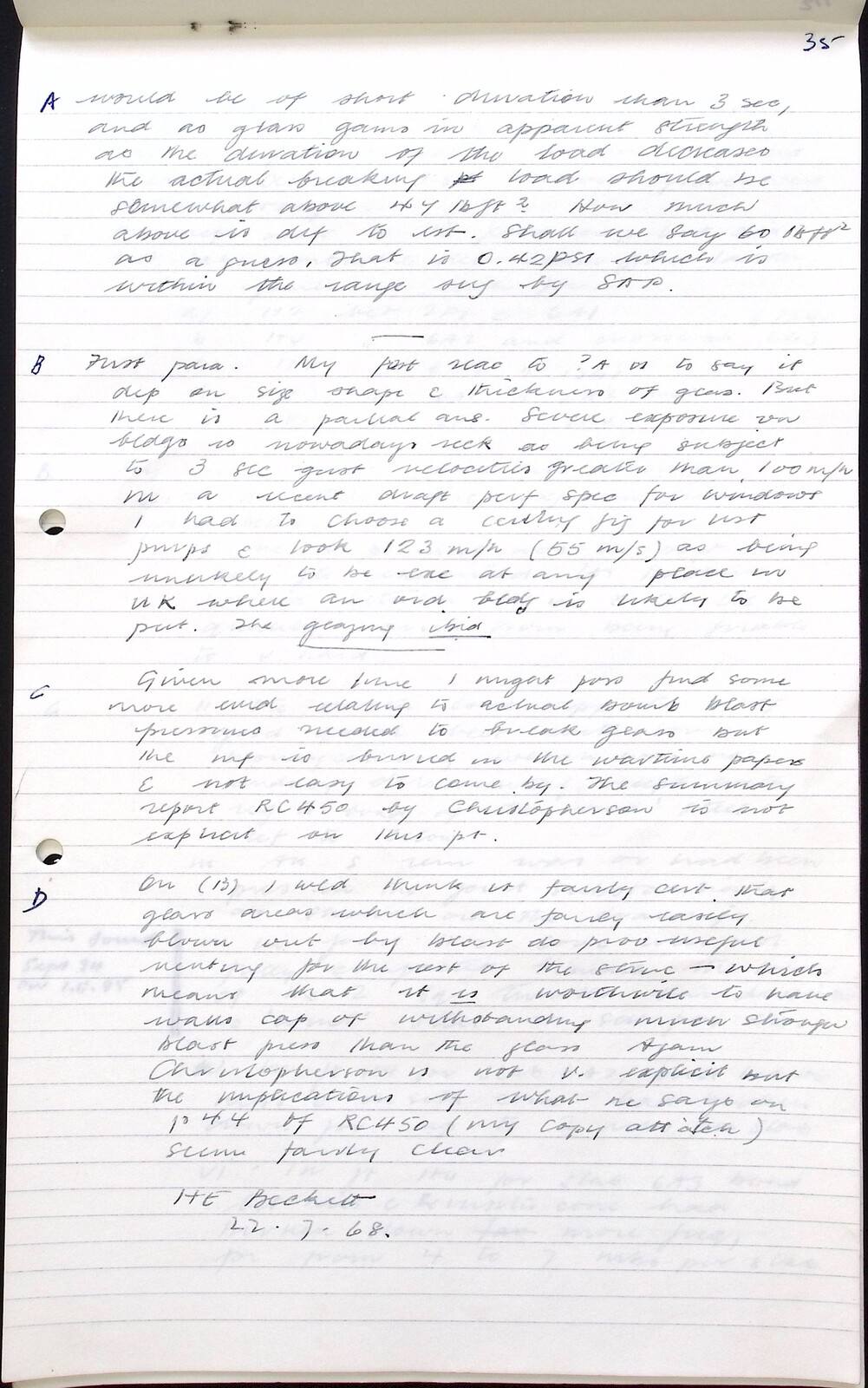
A would be of short duration than 3 sec,
and as glass gains in apparent strength
as the duration of the load decreases
the actual breaking load should be
somewhat above 47 lb/ft^2 How much
above is diff to est. Shall we say 60 lb/ft^2
as a guess, that is 0.42 psi which is
within the range say by SAP.
B First para. My post was to ?A as to say it
dep on size shape & thickness of glass. But
there is a partial ans. Severe exposure on
bldgs is nowadays reck as being subject
to 3 sec gust velocities greater than 100mph
in a recent draft perf spec for windows
I had to choose a century fig for wst
purps & took 123 mph (55 m/s) as being
unlikely to be exc at any place in
UK where an ord bldg is likely to be
put. see grazing ibid
C Given more time I might poss find some
more info relating to actual bomb blast
pressures needed to break glass but
the inf is buried in the wartime papers
& not easy to come by. The summary
report RC450 by Christopherson is not
explicit on this pt.
D On (13) I wld think it fairly cert that
glass areas which are fairly easily
blown out by blast do prov useful
venting for the rest of the struc - which
means that it is worthwhile to have
walls cap of withstanding much stronger
blast press than the glass Again
Christopherson is not v. explicit but
the implications of what he says on
p 44 of RC450 (my copy attdch)
seem fairly clear
HE Beckett
22.7.68.