WESA_12_1_01p34
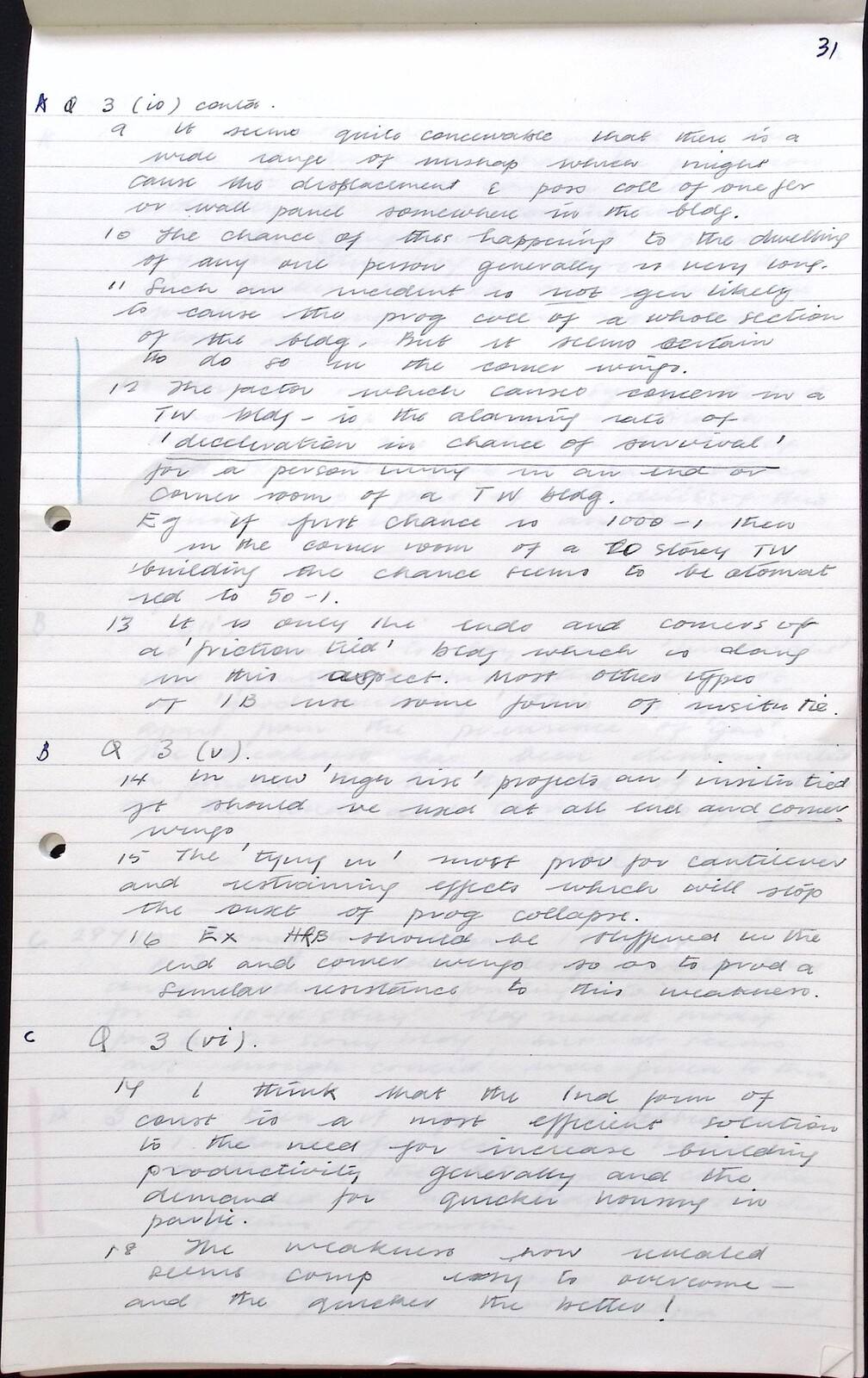
A Q 3 (iv) contd.
9 It seems quite conceivable that there is a
wide range of mishap which might
cause the displacement & poss coll of one fer
or wall panel somewhere in the bldg.
10 The chance of this happening to the dwelling
of any one person generally is very long.
11 Such an incident is not gen likely
to cause the prog coll of a whole section
of the bldg. But it seems certain
to do so in the corner wings.
12 The factor which causes concern in a
TW bldg - is the alarming rate of
'deterioration in chance of survival'
for a person living in an end or
corner room of a TW bldg.
Eg if first chance is 1000 - 1 then
in the corner room of a 20 storey TW
building one chance seems to be atomat
ed to 50 - 1.
13 It is only the ends and corners of
a 'friction tied' bldg which is dang
in this aspect. Most other types
of IB use some form of insitutie.
B Q 3 (v).
14 In new 'high rise' projects an 'insit tied'
jt should be used at all end and corner
wings.
15 The 'tying in' must prov for cantilever
and restraining effects which will stop
the risk of prog collapse.
16 Ex HRB should be stiffened in the
end and corner wings so as to prod a
similar instance to this weakness.
C Q 3 (vi).
17 I think that the ind form of
const is a most efficient solution
to the need for increase building
productivity, generally and the
demand for quicker housing in
partic.
18 The weakness now uncaled
seems comp easy to overcome -
and the quicker the better!