National Tower Blocks Directory 1992
continued from previous page
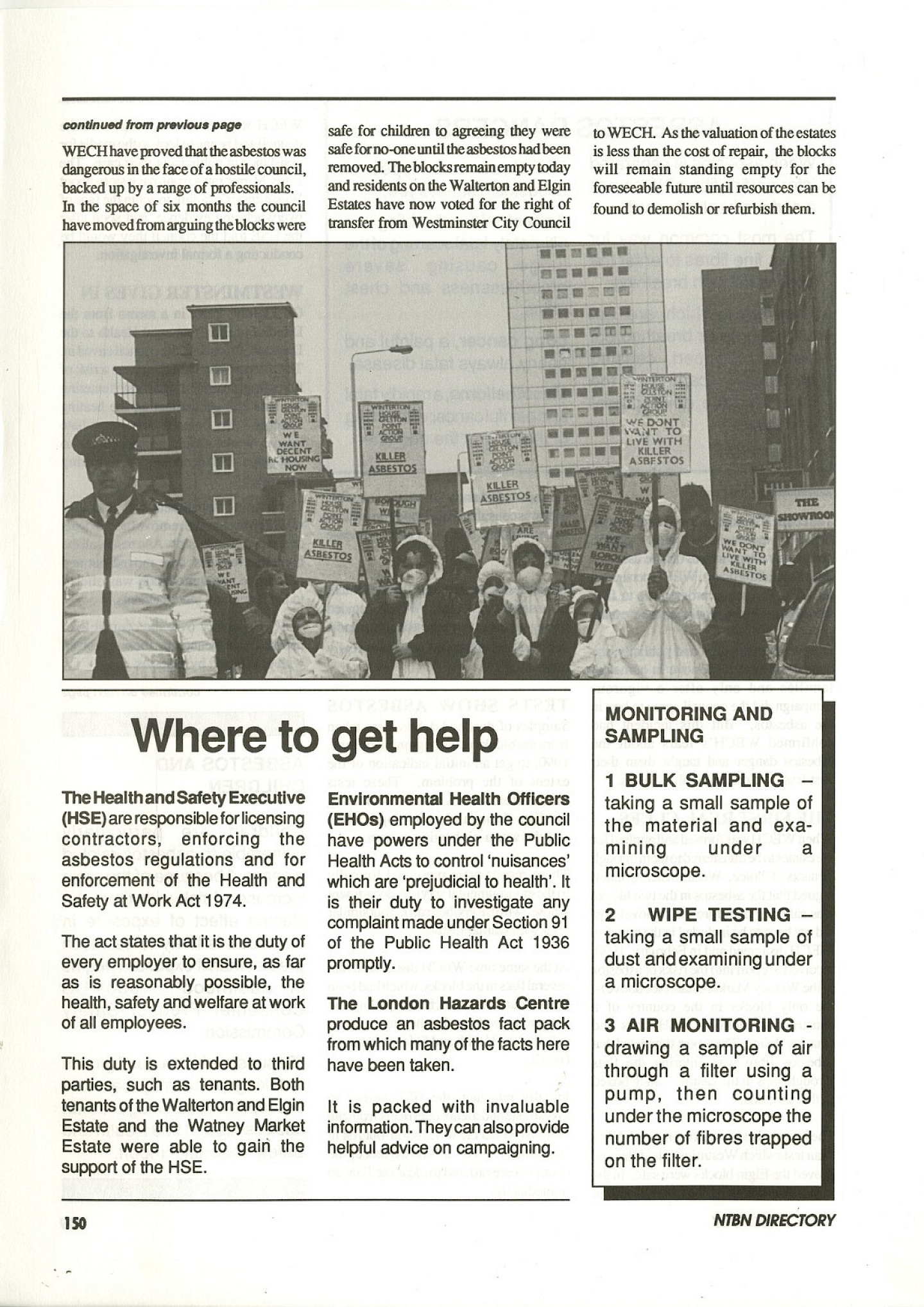
WECH have proved that the asbestos was dangerous in the face of a hostile council, backed up by a range of professionals. In the space of six months the council have moved from arguing the blocks were safe for children to agreeing they were safe for no-one until the asbestos had been removed. The blocks remain empty today and residents on the Walterton and Elgin Estates have now voted for the right of transfer from Westminster City Council to WECH. As the valuation of the estates is less than the cost of repair, the blocks will remain standing empty for the foreseeable future until resources can be found to demolish or refurbish them.
[caption: A demonstration by Walterton and Elgin Estate residents against the presence of asbestos in their homes.]
Where to get help
The Health and Safety Executive (HSE) are responsible for licensing contractors, enforcing the asbestos regulations and for enforcement of the Health and Safety at Work Act 1974.
The act states that it is the duty of every employer to ensure, as far as is reasonably possible, the health, safety and welfare at work of all employees.
This duty is extended to third parties, such as tenants. Both tenants of the Walterton and Elgin Estate and the Watney Market Estate were able to gain the support of the HSE.
Environmental Health Officers (EHOs) employed by the council have powers under the Public Health Acts to control ‘nuisances’ which are ‘prejudicial to health’. It is their duty to investigate any complaint made under Section 91 of the Public Health Act 1936 promptly.
The London Hazards Centre produce an asbestos fact pack from which many of the facts here have been taken.
It is packed with invaluable information. They can also provide helpful advice on campaigning.
MONITORING AND SAMPLING
1 BULK SAMPLING – taking a small sample of the material and examining under a microscope.
2 WIPE TESTING – taking a small sample of dust and examining under a microscope.
3 AIR MONITORING - drawing a sample of air through a filter using a pump, then counting under the microscope the number of fibres trapped on the filter.
150
NTBN DIRECTORY