National Tower Blocks Directory 1992
LESSONS LEARNT FROM
KNOWSLEY HEIGHTS
On April 5th, 1991, at Knowsley
Heights near Liverpool, a fire broke
out in a block of flats which had
recently been refurbished throughout.
The fire was started deliberately in a rear
corner of the building by igniting discarded
foam filled furniture which had been
stacked against the cladding in the bin
store area for some time.
The building had been designed to
minimise energy usage and promote
affordable warmth for the tenants in
addition to the many internal and external
improvements.
As part of that scheme the Capex
overcladding system had been used with
100mm of insulation and the tenants had
seen an improvement in the heating and
condensation problems of their flats.
The fire spread into the cavity
behind the cladding, with tempera-
tures up to 100°C being experi-
enced. The length of time that the
fire blazed before detection is not
known because the fire had started
in the early hours of the morning.
The result of the fire was a vertical section
of the cladding, the width of the original
source of the fire, was damaged. However,
this was in a stairwell area and although
smoke penetrated the corridors damage to
the flats was minimal. There were
fortunately no injuries to tenants, though
some were treated for smoke inhalation.
CHANGING THE DESIGN
The fire had spread up the block but not
along each floor. As a result of the
questions raised about the fire, Capex
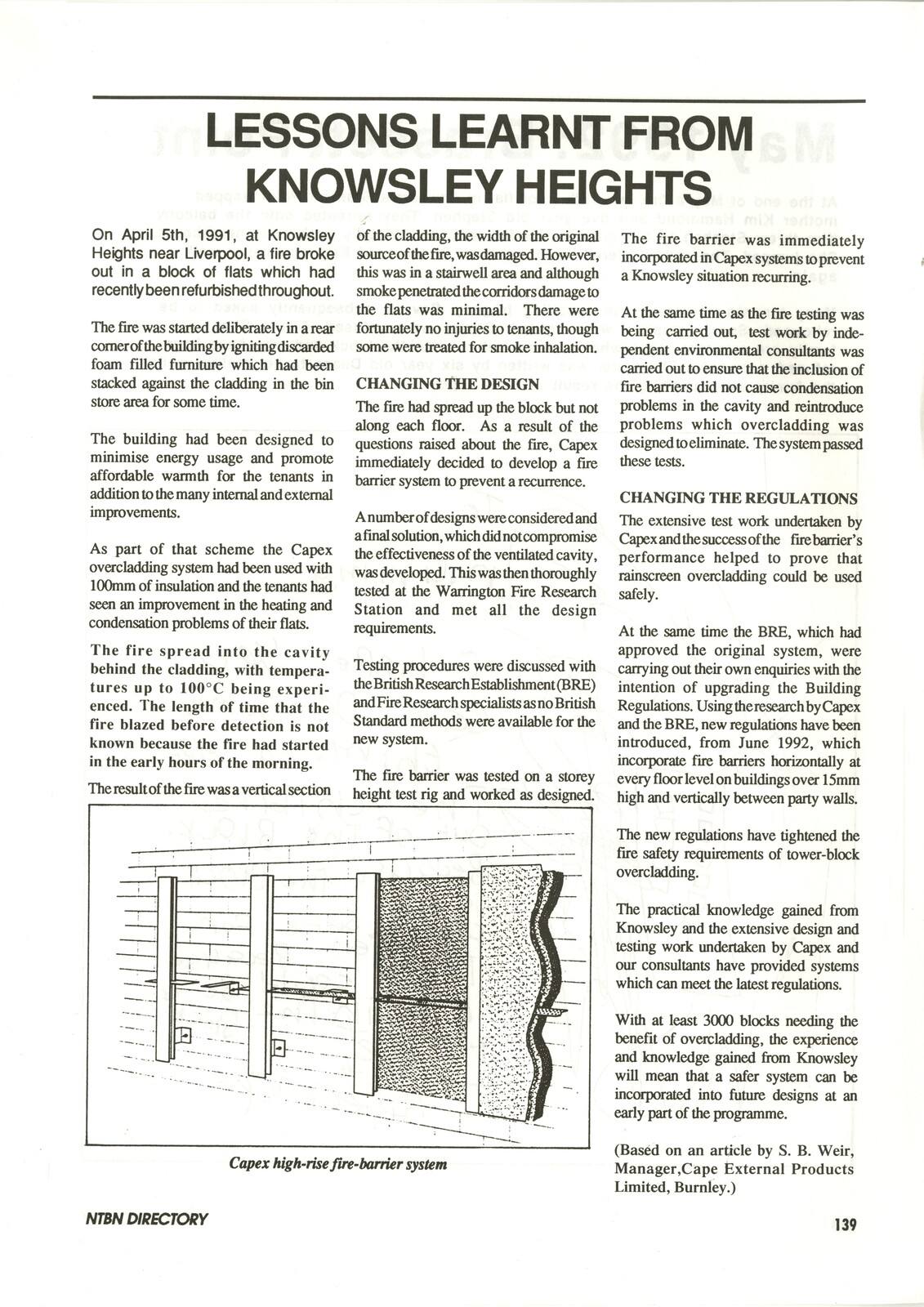
immediately decided to develop a fire
barrier system to prevent a recurrence.
A number of designs were considered and
a final solution, which did not compromise
the effectiveness of the ventilated cavity,
was developed. This was then thoroughly
tested at the Warrington Fire Research
Station and met all the design
requirements.
Testing procedures were discussed with
the British Research Establishment (BRE)
and Fire Research specialists as no British
Standard methods were available for the
new system.
The fire barrier was tested on a storey
height test rig and worked as designed.
[caption: Capex high-rise fire-barrier system]
The fire barrier was immediately
incorporated in Capex systems to prevent
a Knowsley situation recurring.
At the same time as the fire testing was
being carried out, test work by inde-
pendent environmental consultants was
carried out to ensure that the inclusion of
fire barriers did not cause condensation
problems in the cavity and reintroduce
problems which overcladding was
designed to eliminate. The system passed
these tests.
CHANGING THE REGULATIONS
The extensive test work undertaken by
Capex and the success of the fire barrier’s
performance helped to prove that
rainscreen overcladding could be used
safely.
At the same time the BRE, which had
approved the original system, were
carrying out their own enquiries with the
intention of upgrading the Building
Regulations. Using the research by Capex
and the BRE, new regulations have been
introduced, from June 1992, which
incorporate fire barriers horizontally at
every floor level on buildings over 15mm
high and vertically between party walls.
The new regulations have tightened the
fire safety requirements of tower-block
overcladding.
The practical knowledge gained from
Knowsley and the extensive design and
testing work undertaken by Capex and
our consultants have provided systems
which can meet the latest regulations.
With at least 3000 blocks needing the
benefit of overcladding, the experience
and knowledge gained from Knowsley
will mean that a safer system can be
incorporated into future designs at an
early part of the programme.
(Based on an article by S. B. Weir,
Manager, Cape External Products
Limited, Burnley.)
NTBN DIRECTORY 139