Notes for Deputation
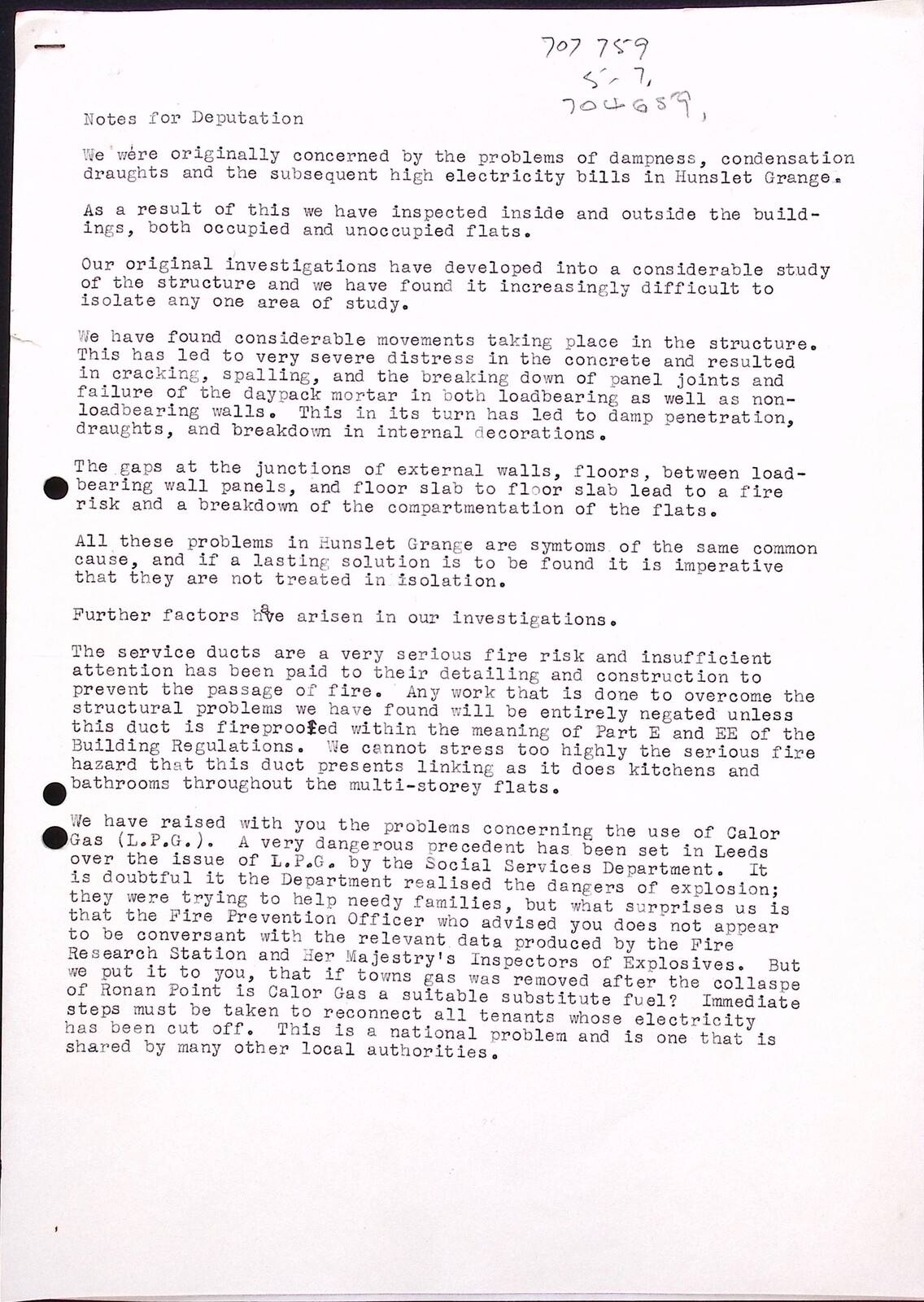
Notes for Deputation
We were originally concerned by the problems of dampness, condensation draughts and the subsequent high electricity bills in Hunslet Grange.
As a result of this we have inspected inside and outside the buildings, both occupied and unoccupied flats.
Our original investigations have developed into a considerable study of the structure and we have found it increasingly difficult to isolate any one area of study.
We have found considerable movements taking place in the structure. This has led to very severe distress in the concrete and resulted in cracking, spalling, and the breaking down of panel joints and failure of the daypack mortar in both loadbearing as well as non-loadbearing walls. This in its turn has led to damp penetration, draughts, and breakdown in internal decorations.
The gaps at the junctions of external walls, floors, between loadbearing wall panels, and floor slab to floor slab lead to a fire risk and a breakdown of the compartmentation of the flats.
All these problems in Hunslet Grange are symtoms of the same common cause, and if a lasting solution is to be found it is imperative that they are not treated in isolation.
Further factors have arisen in our investigations.
The service ducts are a very serious fire risk and insufficient attention has been paid to their detailing and construction to prevent the passage of fire. Any work that is done to overcome the structural problems we have found will be entirely negated unless this duct is fireproofed within the meaning of Part E and EE of the Building Regulations. We cannot stress too highly the serious fire hazard that this duct presents linking as it does kitchens and bathrooms throughout the multi-storey flats.
We have raised with you the problems concerning the use of Calor Gas (L.P.G.). A very dangerous precedent has been set in Leeds over the issue of L.P.G. by the Social Services Department. It is doubtful it the Department realised the dangers of explosion; they were trying to help needy families, but what surprises us is that the Fire Prevention Officer who advised you does not appear to be conversant with the relevant data produced by the Fire Research Station and Her Majestry's Inspectors of Explosives. But we put it to you, that if towns gas was removed after the collaspe of Ronan Point is Calor Gas a suitable substitute fuel? Immediate steps must be taken to reconnect all tenants whose electricity has been cut off. This is a national problem and is one that is shared by many other local authorities.
We suggest that the Housing Services Committee see the F.R.S. film on L.P.G. Explosions and that they ask the Fire Brigade to lay on a test of L.P.G. cannisters, both 10 lb. and 32 lb. type under domestic fire situations. The Public and press must be invited to this.
The original problems that sparked off these inquiries, condensation, dampness, draughts, high electricity bills must not be allowed to become submerged in the more dramatic problems of explosions and fire. A damp flat is a miserable place to live in.
We thank-you for your interim reports and we look forward to the independent report prepared by a nominee of the President of the Institute of Structural Engineers.
SW/CW/km
19/7/76