Notes on Inquiry
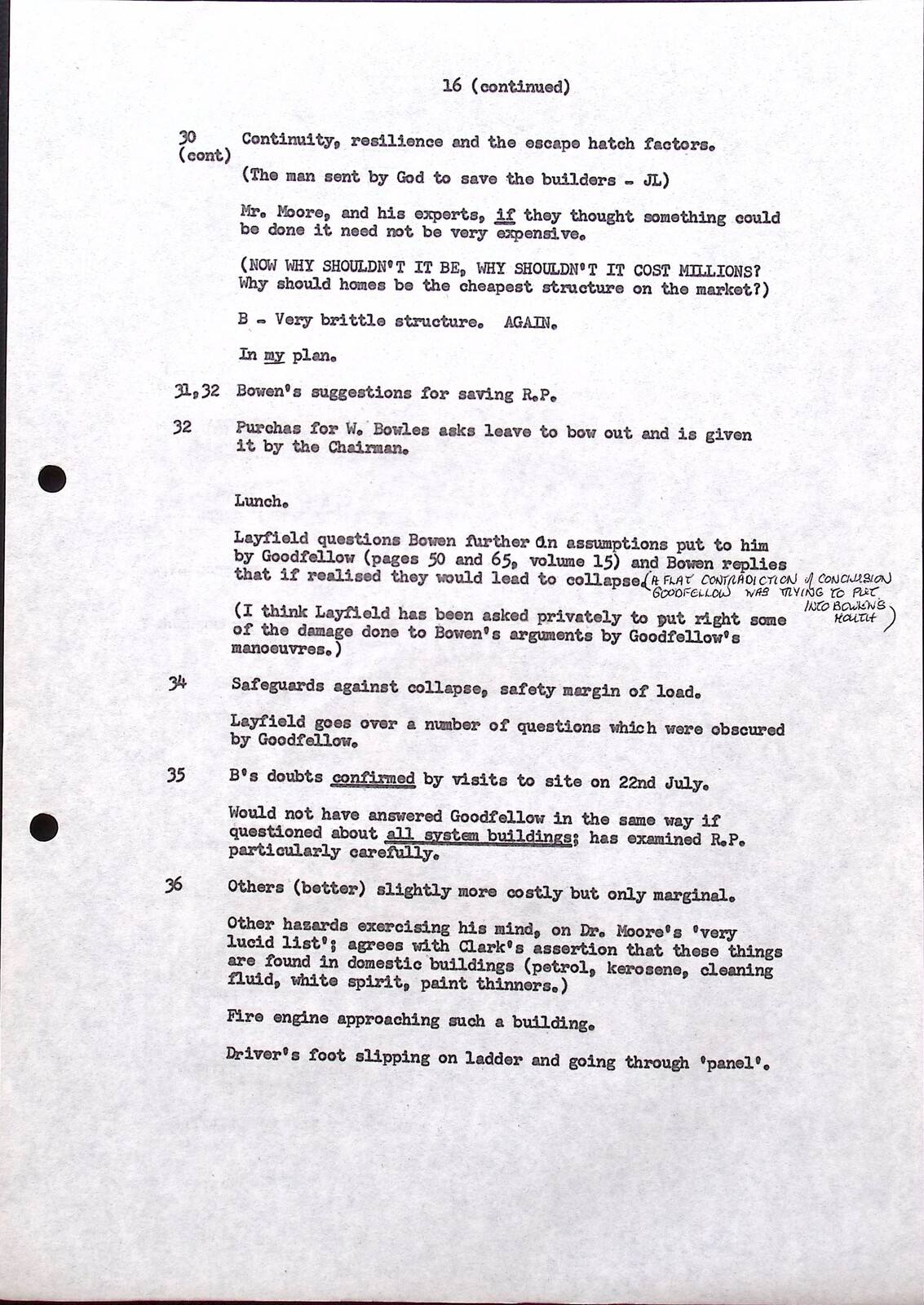
30 Continuity, resilience and the escape hatch factors.
(cont)
(The man sent by God to save the builders - JL)
Mr. Moore, and his experts, if they thought something could
be done it need not be very expensive.
(NOW WHY SHOULDN'T IT BE, WHY SHOULDN'T IT COST MILLIONS?
Why should homes be the cheapest structure on the market?)
B - Very brittle structure. AGAIN.
In my plan.
31,32 Bowen's suggestions for saving R.P.
32 Purchas for W. Bowles asks leave to bow out and is given
it by the Chairman.
Lunch.
Layfield questions Bowen further on assumptions put to him
by Goodfellow (pages 50 and 65, volume 15) and Bowen replies
that if realised they would lead to collapse (A FLAT CONTRADICTION OF CONCLUSION
GOODFELLOW WAS TRYING TO PUT
INTO BOWENS
(I think Layfield has been asked privately to put right some MOUTH)
of the damage done to Bowen's arguments by Goodfellow's
manoeuvres.)
34 Safeguards against collapse, safety margin of load.
Layfield goes over a number of questions which were obscured
by Goodfellow.
35 B's doubts confirmed by visits to site on 22nd July.
Would not have answered Goodfellow in the same way if
questioned about all system buildings; has examined R.P.
particularly carefully.
36 Others (better) slightly more costly but only marginal.
Other hazards exercising his mind, on Dr. Moore's 'very
lucid list'; agrees with Clark's assertion that these things
are found in domestic buildings (petrol, kerosene, cleaning
fluid, white spirit, paint thinners.)
Fire engine approaching such a building.
Driver's foot slipping on ladder and going through 'panel'.