The Best Laid Plans of Mice and Men
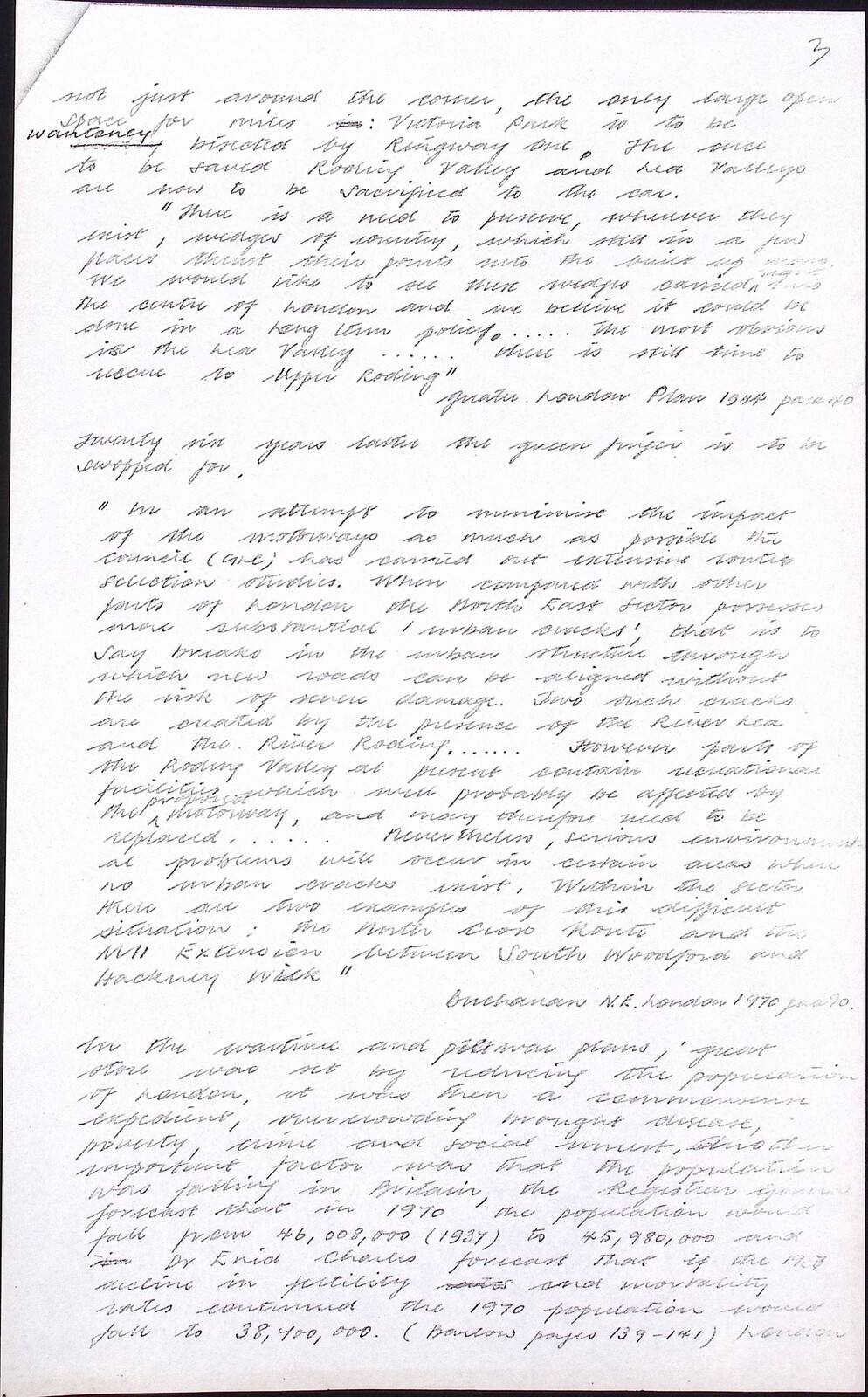
not just around the corner, the only large open
space for miles: Victoria Park is to be
wantonly bisected by Ringway one. The once
to be saved Roding Valley and Lea Valleys
are now to be sacrificed to the car.
"There is a need to preserve, wherever they
exist, wedges of country, which will in a few
places thrust their points into the built up areas.
We would like to see these wedges carried into
the center of London and we believe it could be
done in a long term policy.... The most obvious
is the Lea Valley ..... there is still time to
rescue the Upper Roding"
greater London Plan 1944 para 40
twenty six years later the green prize is to be
swapped for,
"In an attempt to minimise the impact
of the motorways as much as possible the
Council (GLC) has carried out intensive route
selection studies. When compared with other
parts of London the North East sector possesses
more substantial 'urban cracks', that is to
say breaks in the urban structure through
which new roads can be aligned without
the risk of severe damage. Two such cracks
are created by the presence of the River Lea
and the River Roding...... However parts of
the Roding Valley at present contain recreational
facilities which will probably be affected by
the motorway, and may therefore need to be
replaced.... Nevertheless, serious environment-
al problems will occur in certain areas where
no urban cracks exist, Within the sector
there are two examples of this difficult
situation; the North Cross Route and the
M11 Extension between South Woodford and
Hackney Wick"
Buchanan N.E. London 1970 para 70.
In the wartime and postwar plans, 'great
store was set by reducing the population
of London, it was then a common
expedient, overcrowding brought disease,
poverty, crime and social unrest, another
important factor was that the population
was falling in Britain, the Registrar general
forecast that in 1970 the population would
fall from 46,008,000 (1937) to 45,980,000 and
the Dr Enid Charles forecast that if the 1937
decline in fertility rates and mortality
rates continued the 1970 population would
fall to 38,400,000. (Barlow pages 139-141) London