Letter from Sam Webb to Arthur Lewis MP, 'Ronan Point, Newham'
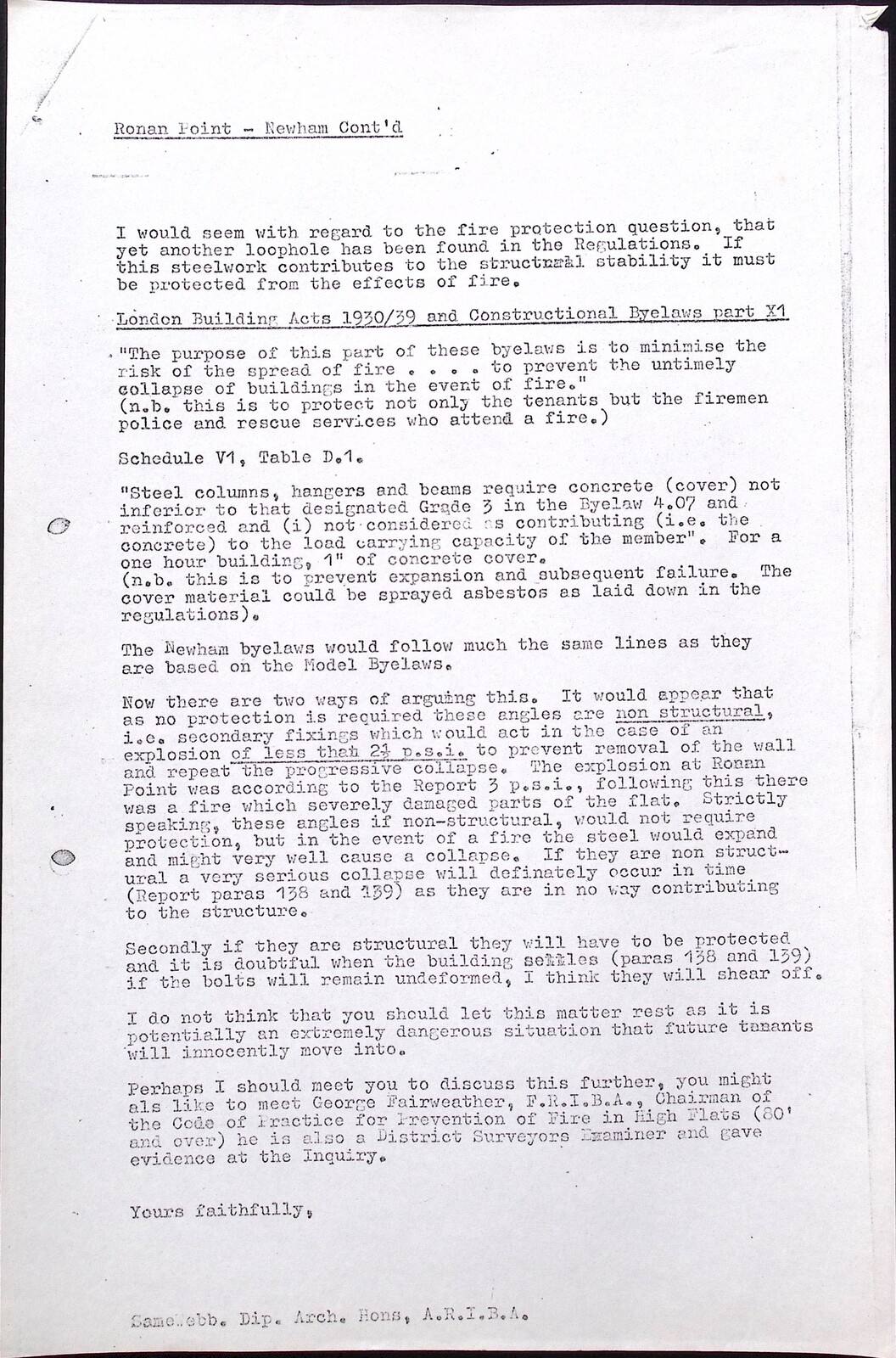
Ronan Point - Newham Cont'd
I would seem with regard to the fire protection question, that
yet another loophole has been found in the Regulations. If
this steelwork contributes to the structural stability it must
be protected from the effects of fire.
London Building Acts 1930/39 and Constructional Byelaws part X1
"The purpose of this part of these byelaws is to minimise the
risk of the spread of fire . . . to prevent the untimely
collapse of buildings in the event of fire."
(n.b. this is to protect not only the tenants but the firemen
police and rescue services who attend a fire.)
Schedule V1, Table D.1.
"Steel columns, hangers and beams require concrete (cover) not
inferior to that designated Grade 3 in the Byelaw 4.07 and
reinforced and (i) not considered as contributing (i.e. the
concrete) to the load carrying capacity of the member". For a
one hour building, 1" of concrete cover.
(n.b. this is to prevent expansion and subsequent failure. The
cover material could be sprayed asbestos as laid down in the
regulations).
The Newham byelaws would follow much the same lines as they
are based on the Model Byelaws.
Now there are two ways of arguing this. It would appear that
as no protection is required these angles are non structural,
i.e. secondary fixings which would act in the case of an
explosion of less than 2 1/4 p.s.i. to prevent removal of the wall
and repeat the progressive collapse. The explosion at Ronan
Point was according to the Report 3 p.s.i., following this there
was a fire which severely damaged parts of the flat. Strictly
speaking, these angles if non-structural, would not require
protection, but in the event of a fire the steel would expand
and might very well cause a collapse. If they are non struct-
ural a very serious collapse will definitely occur in time
(Report paras 138 and 139) as they are in no way contributing
to the structure.
Secondly if they are structural they will have to be protected
and it is doubtful when the building settles (paras 138 and 139)
if the bolts will remain undeformed, I think they will shear off.
I do not think that you should let this matter rest as it is
potentially an extremely dangerous situation that future tanants
will innocently move into.
Perhaps I should meet you to discuss this further, you might
als like to meet George Fairweather, F.R.I.B.A., Chairman of
the Code of Practice for Prevention of Fire in High Flats (80'
and over) he is also a District Surveyors Examiner and gave
evidence at the Inquiry.
Yours faithfully,
Same.ebb. Dip. Arch. Hons, A.R.I.B.A.