Letter from George Fairweather to Sam Webb
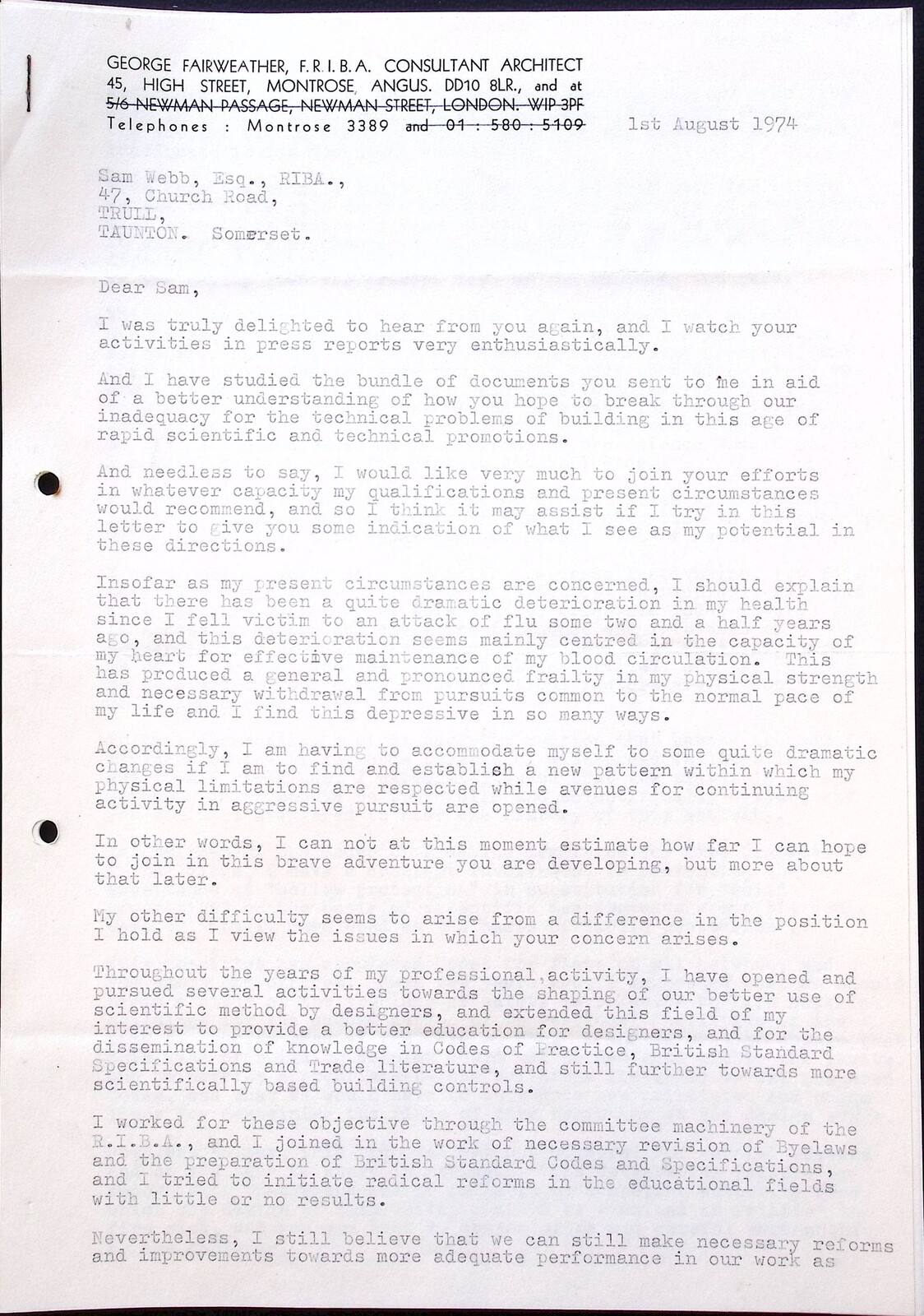
GEORGE FAIRWEATHER, F.R.I.B.A. CONSULTANT ARCHITECT
45, HIGH STREET, MONTROSE, ANGUS. DD10 8LR., and at
[struck through:] 5/6 NEWMAN PASSAGE, NEWMAN STREET, LONDON. W1P 3PF
Telephones : Montrose 3389 and [struck through:] 01 : 580 : 5109
1st August 1974
Sam Webb, Esq., RIBA.,
47, Church Road,
TRULL,
TAUNTON. Somerset.
Dear Sam,
I was truly delighted to hear from you again, and I watch your activities in press reports very enthusiastically.
And I have studied the bundle of documents you sent to me in aid of a better understanding of how you hope to break through our inadequacy for the technical problems of building in this age of rapid scientific and technical promotions.
And needless to say, I would like very much to join your efforts in whatever capacity my qualifications and present circumstances would recommend, and so I think it may assist if I try in this letter to give you some indication of what I see as my potential in these directions.
Insofar as my present circumstances are concerned, I should explain that there has been a quite dramatic deterioration in my health since I fell victim to an attack of flu some two and a half years ago, and this deterioration seems mainly centred in the capacity of my heart for effective maintenance of my blood circulation. This has produced a general and pronounced frailty in my physical strength and necessary withdrawal from pursuits common to the normal pace of my life and I find this depressive in so many ways.
Accordingly, I am having to accommodate myself to some quite dramatic changes if I am to find and establish a new pattern within which my physical limitations are respected while avenues for continuing activity in aggressive pursuit are opened.
In other words, I can not at this moment estimate how far I can hope to join in this brave adventure you are developing, but more about that later.
My other difficulty seems to arise from a difference in the position I hold as I view the issues in which your concern arises.
Throughout the years of my professional activity, I have opened and pursued several activities towards the shaping of our better use of scientific method by designers, and extended this field of my interest to provide a better education for designers, and for the dissemination of knowledge in Codes of Practice, British Standard Specifications and Trade literature, and still further towards more scientifically based building controls.
I worked for these objective through the committee machinery of the R.I.B.A., and I joined in the work of necessary revision of Byelaws and the preparation of British Standard Codes and Specifications, and I tried to initiate radical reforms in the educational fields with little or no results.
Nevertheless, I still believe that we can still make necessary reforms and improvements towards more adequate performance in our work as
Page Two
designers of buildings, and in effect, I eagerly support your first step in setting up a committee within the R.I.B.A., for study of the subject within which building design is now becoming so gravely inadequate in its technical competence.
From this position, I don't think we have to look very far before we see that the role of the architect in his practice of architecture will have to be radically changed and there surely is ample evidence in support of some change in this direction as we look at the present direction of architectural education, and also in the difficulties we are having from the present form of the Building Contract.
While I was Chairman of the R.I.B.A. old Architectural Science Committee, I set up a special committee to study the gap between scientific knowledge and its application in building practice, and this committee produced some very useful guidelines along which we might do something to give more relevance to scientific work, and to give its findings more useful and immediate influence in our work as designers, but nothing was done to implement these findings as Bill Allen succeeded me as Chairman of the Science Committee, and I needn't explain what followed in his influence.
I then lost heart and gave up most of my activities at the RIBA., but this was also influenced by my need for more time in the practice which was at that time enlarging and getting out of hand.
I continued my works at the British Standards Institution, but more towards the preparation of Codes of Practice, particularly as I had from the very beginning of this work to orientate Codes towards the interests of design and check the influence and interests of commercialism. And I might usefully say here that this influence is still one that must be very closely supervised, and may in fact be relevant in your concern that critical factors are commonly swept under the carpet.
In this connection, I might usefully mention that having pressed for revision of the tiling code because of widespread failures in tiling and mosaic claddings, I especially asked that the principle of the movement joint should be truthfully and scientifically tested, and you would be staggered to hear the history of this activity.
As chairman of the Codes of Practice Committee for fire precautions in buildings, I have a constant involvement in preventing the acceptance of "hollow protection" in substitution for "solid protection" on the basis of scientific measurements where the codes were originally developed on the basis of "solid protection".
This Committee has completed Codes for flats of all heights, and for shops and offices. Some few years ago, I suggested that we should begin a study of the problems of safety in relation to fire risk in buildings for the accommodation of recreational facilities in the kind of complex used at the Isle of Man. I had in mind of course that this kind of building complex could not be designed within the limits and principles appropriate to the buildings for which we had prepared Codes, and that we would have to introduce new principles and guide lines for containing the risks of fire beginning at the design stage.
Needless to say, this proposal was not accepted for several reasons and so you have to start in reviewing this devastating failure by recognising that there was no reliable or competent authority from which the design of this building might be examined in relation to fire risk, and you are back to common sense and careful workmanship by the designer.
Page Three
In viewing the evidence as available to me, I see in the architects attitude a characteristic "hope to get away with it", attitude in approaching the design problem of limiting fire risk, and not one to be anticipated when a designer is approaching a problem that is new and can not be satisfactorily resolved within the generally accepted principles as applied in common building types.
I can not see how much further the problems of this design would have been reduced by responsible information about the behaviour of the materials concerned in this case. As I see the position, the real weakness lies in the total indifference and ineptitude of the designers as they viewed the issue of fire risk.
You then refer to the continuing risk in the Ronan Point type of building. I share your opinion that the steel reinforcement inserted to hold the structure against undue displacement of its parts should be protected against exposure to fire, but again, I have to consider a difference of opinion as to the degree of risk this omission is calculated to leave.
You may recall that I gave the opinion in my evidence that we must define safety in relation to the public interest, and suggested that it should exclude unpredictable hazards, or should be calculated within predictable limits. This does not necessarily mean that some degree of unpredictable risk can not be accepted, but that some measure must be taken of that remaining risk so that it can be viewed in some wider context as may be appropriate in different circumstances.
I see something of this element in the official attitude and decision that fire hazard as it remains in the unprotected steel reinforcement of the Ronan Point structures is acceptable having regard to the public interest.
In other words, I am not in my present knowledge and study of this issue ready to pursue the matter dogmatically even as I think at best that it is an ill considered and wrong decision leaving what I personally regard as an unacceptable and unnecessary continuing risk.
Against this detail of the Ronan Point situation, I am not entirely persuaded that the remedial works go very far towards recovery of these structures from the perils of what I had in mind as the "blind" areas of workmanship in the course of construction.
I support your suggestion that we should form an interprofessional committee in aid of examining and providing some understanding and knowledge of building failures throughout the world, but I think this should wait until its terms of reference can be sensibly set out, and in this direction, I think your suggestion for a special examination of the whole issue from the architects position may provide a good beginning as it seeks and discovers the nature and meaning of the circumstances within which this chronic inadequacy of our design process arises and continues so alarmingly.
The most important lesson I have learned as a student of building failures lies in the danger of a wrong or inadequate diagnosis, and this danger arises in the more obvious behaviour of a structure in the nature of the failure ultimately manifest. The initial cause of a building failure is commonly several links back in a chain of events and may not even be present in the structure by the time it has become manifest in collapse or severe nuisance.
Even as the collapse at Ronan Point and the fire at the Isle of Man have very serious and dramatic significance and effect, I see with
Page Four
equal professional concern the continuing failure of buildings to keep out the weather, and the constant menace of collapse in the secondary structures arising from inadequate fixings in relation to inevitable differentials of movement in the overall structure, and in the damage caused to materials, particularly in flat roofs and other thin enclosing structures by condensation.
Additionally, I am acutely concerned about the significance of site workmanship as a prominent factor in structural design, and as far as I can identify there is at present no general awareness of the need for control of this factor at the stage of design where I feel sure we must accept the responsibility for control.
I am sure also that we already have available to us the mechanism within which to make a serious effort towards better building, but I also feel sure that we must reorientate our roles in the total complex of building design and construction if we are to provide the necessary knowledge and expertese for effective performance in all necessary regions of the subject.
Again, I think the architect should take the lead in studying and setting out guide lines for the necessary changes, and so I am content to go along with your first recommendation, and leave the others to do their necessary work when some tangible direction is available in the recommendations of initial conclusions.
I have written all this so that you may have some idea of the kind and degree of help that I may be able to offer to your ambitious programme.
I would of course like very much to join you in a visit to the Isle of Man, but I really am not in sufficient health at present to adventure more than necessary, and even as I would also like so much to have a game of golf with you, I am not certain that I could complete a full round, even as I would be ready to try.
If you are to be near to Montrose while on holiday, I hope that you will be able to come through.
Yours,
George