Inquiry into the Collapse of the Ronan Point Tower Block Canning Town: Statement of Case for the Tribunal by George Fairweather
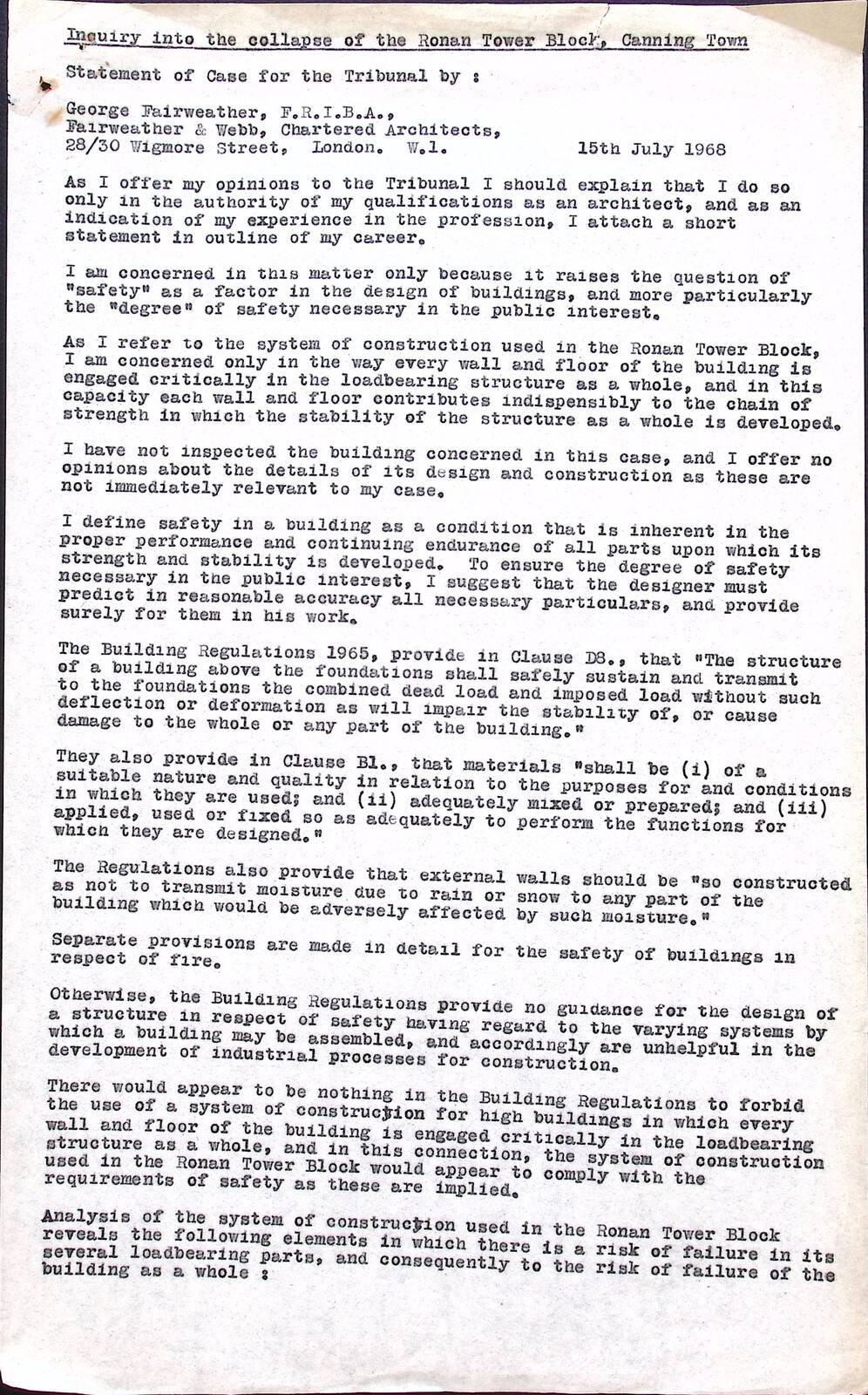
Inquiry into the collapse of the Ronan Tower Block, Canning Town
Statement of Case for the Tribunal by :
George Fairweather, F.R.I.B.A.,
Fairweather & Webb, Chartered Architects,
28/30 Wigmore Street, London. W.1. 15th July 1968
As I offer my opinions to the Tribunal I should explain that I do so
only in the authority of my qualifications as an architect, and as an
indication of my experience in the profession, I attach a short
statement in outline of my career.
I am concerned in this matter only because it raises the question of
"safety" as a factor in the design of buildings, and more particularly
the "degree" of safety necessary in the public interest.
As I refer to the system of construction used in the Ronan Tower Block,
I am concerned only in the way every wall and floor of the building is
engaged critically in the loadbearing structure as a whole, and in this
capacity each wall and floor contributes indispensibly to the chain of
strength in which the stability of the structure as a whole is developed.
I have not inspected the building concerned in this case, and I offer no
opinions about the details of its design and construction as these are
not immediately relevant to my case.
I define safety in a building as a condition that is inherent in the
proper performance and continuing endurance of all parts upon which its
strength and stability is developed. To ensure the degree of safety
necessary in the public interest, I suggest that the designer must
predict in reasonable accuracy all necessary particulars, and provide
surely for them in his work.
The Building Regulations 1965, provide in Clause D8., that "The structure
of a building above the foundations shall safely sustain and transmit
to the foundations the combined dead load and imposed load without such
deflection or deformation as will impair the stability of, or cause
damage to the whole or any part of the building."
They also provide in Clause B1., that materials "shall be (i) of a
suitable nature and quality in relation to the purposes for and conditions
in which they are used; and (ii) adequately mixed or prepared; and (iii)
applied, used or fixed so as adequately to perform the functions for
which they are designed."
The Regulations also provide that external walls should be "so constructed
as not to transmit moisture due to rain or snow to any part of the
building which would be adversely affected by such moisture."
Separate provisions are made in detail for the safety of buildings in
respect of fire.
Otherwise, the Building Regulations provide no guidance for the design of
a structure in respect of safety having regard to the varying systems by
which a building may be assembled, and accordingly are unhelpful in the
development of industrial processes for construction.
There would appear to be nothing in the Building Regulations to forbid
the use of a system of construction for high buildings in which every
wall and floor of the building is engaged critically in the loadbearing
structure as a whole, and in this connection, the system of construction
used in the Ronan Tower Block would appear to comply with the
requirements of safety as these are implied.
Analysis of the system of construction used in the Ronan Tower Block
reveals the following elements in which there is a risk of failure in its
several loadbearing parts, and consequently to the risk of failure of the
building as a whole :
a. An explosion by gas or from any other cause arising from the
normal course of occupancy may displace or damage a wall or floor
in the immediate vicinity.
b. Damage may occur by misdemeanour to a wall or floor, or may other-
wise be caused to expose the structure in danger from other elements.
c. Temperature changes in the weather may cause movements in the
external walls and their connections with related parts, and may
affect the loadbearing structure adversely.
d. Exposure to the rain and the snow is a source of danger in all
external connections, particularly as these connections are
vulnerable in relation to temperature changes.
e. The manufacture of precision standard units for walls and floors
may carry elements of risk in the negligence of workmen and by
carelessness in the preparation of materials and processes for
manufacture.
f. The transport of large and heavy component parts from the workshop
to the building site may cause damage from which incipient
elements of failure may be introduced.
g. Erection in the varying and exacting circumstances of placing and
fixing of wall and floor units in the building introduce hazards
and limitations in control of the work.
These elements of risk are present in each and every wall and floor
unit of construction, and in each and every connection between related
units, and failure of the building as a whole may arise in any one
occurrence.
Even as all these risks can be relieved by diligence and care in every
stage of the building process, the risk of failure is inherent in the
system and remains a danger to the safety of the building as a whole.
In the light of this analysis, it would appear that the system of
construction used in the Ronan Tower Block is incapable of prediction
in reasonable accuracy of all particulars necessary to ensure
structural safety in the degree required by the public interest.
As an additional factor in assessing the suitability of this system of
construction for high buildings, it is necessary to take account of the
cascading result of failure in any part as this introduces an element
of "spread" in the area of danger. This danger is aggravated also in
the hazard it offers in a long unaided journey to the ground.
Accordingly I give my opinion that the system of construction used for
the Ronan Tower Block is unsuitable for high buildings, and does not
provide in its design for the degree of safety necessary in the public
interest.
As I ask the Tribunal to support my opinion in this connection, I also
ask the Tribunal to insclue in its findings the following recommendations:
1. That buildings already constructed and in the course of construction
by the same method as that used in the Ronan Tower Block should be
subjected to supervision under licence as temporary buildings, and
that renewal of licence should be dependent upon the result of
penetrating survey at intervals not exceeding three years.
2. That the British Standards Institution and the Minister of Public
Buildings and Works, and the Department of Health for Scotland should
be asked to prepare Regulations appropriate to and sufficient for the
control of systems for the construction of buildings having regard
to safety in the public interest.
3. That no further construction of high buildings (above two storeys)
should be undertaken by the system used in the Ronan Tower Block until
new Building Regulations in respect of structural safety are prepared.