Sam Webb, 'Background to Ronan Point and Connections with the Poulson Affair'
In November 1968 AFTER the Ronan Point Report was published the Ministry of
Housing issued Circular 62/68. This said all blocks had to be assessed to see if they
could resist a 5psi explosion (today 5psi = 34kPa) kPa (Type B in BRE Report of
1985: “ The Structure of Ronan Point and other Taylor Woodrow Anglian Dwellings"
page 38 figure 2)
The non-loading bearing 6 “ (150mm) concrete wall separating the Kitchen of Flat 90
in Ronan Point from the flat next door had a horizontal crack midway between the
floor and ceiling. It was calculated that the force required to crack the wall was 5 psi
or in today’s terms 34kPa. That was then adopted as a “safe” limit for the building
both in Circular 62/68 and in the Disproportionate Collapse requirement of the 5th
Amendment to the Building Regulations for England & Wales 1970.
Every single block assessed in the UK over 6 storeys failed to meet 5psi which was
the requirement of Circular 62/ 68.
The government were then faced with the unenviable position of either paying local
authorities for all these buildings, because the successive governments had forced
local authorities to use LPS and other Industrialised Building Systems (IB), or of
rewriting the rules.
In time honoured fashion, they rewrote the rules.
They issued Circular 71/68 which said provided the piped mains gas was removed
and bottled gas (LPG) was banned then they only needed to meet 2.5psi
(17kPa)(Type A in the 1985 BRE Report above figure 1)
Moving out gas cookers and moving in new electric cookers made for good TV
and newspaper coverage.
In 1969 the GLC together with the Institute of Structural Engineers decided on a
strategy to overcome this lack of end bearing of the floor plans. They bolted steel
angles on the walls to support the floors and bolted the floors to these to prevent
uplift in case of an explosion.
One of the requirements of the Code of Practice for Concrete floor slabs was they
had a minimum end bearing of 3” (75mm). This was impossible in LPS where the
load bearing leaf of the wall was 6” thick (150mm) and there was only a 3” shelf
(75mm) for the end of the slab to sit in. The angles had no fire proofing because they
carried no load, although in 1984, unsuccessful attempts were made to unbolt the
nuts because they had seized tight as the building had settled.
Following Arup’s investigations, after we told them Ledbury was not safe for gas,
they said that the block not only failed to meet 62/68 it failed 71/68 making it a
Dangerous Structure and until for occupation.
I believe this applies to all the blocks built prior to 1969.
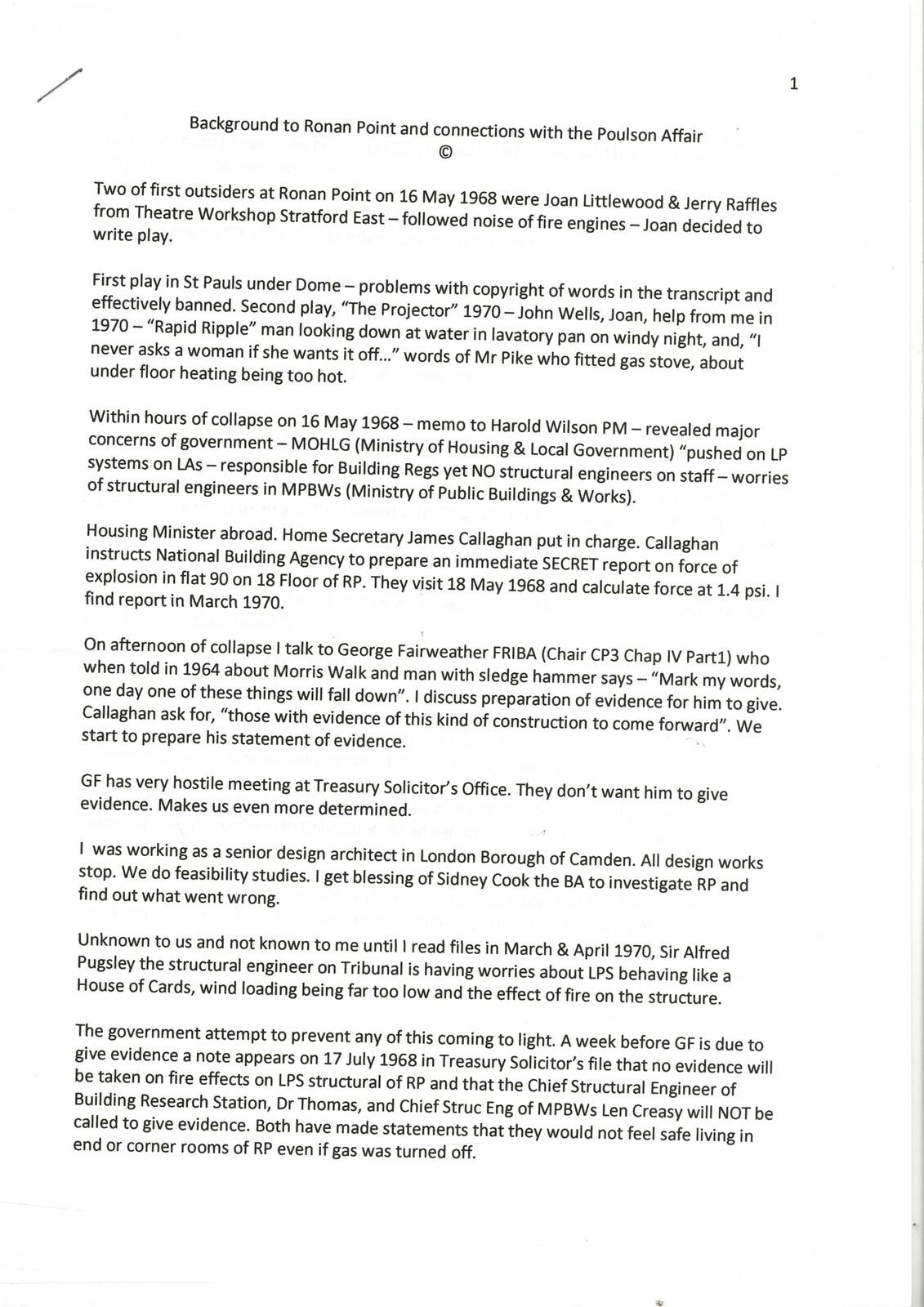
Background to Ronan Point and connections with the Poulson Affair
©
Two of first outsiders at Ronan Point on 16 May 1968 were Joan Littlewood & Jerry Raffles
from Theatre Workshop Stratford East – followed noise of fire engines – Joan decided to
write play.
First play in St Pauls under Dome – problems with copyright of words in the transcript and
effectively banned. Second play, “The Projector” 1970 – John Wells, Joan, help from me in
1970 – “Rapid Ripple” man looking down at water in lavatory pan on windy night, and, “I
never asks a woman if she wants it off…” words of Mr Pike who fitted gas stove, about
under floor heating being too hot.
Within hours of collapse on 16 May 1968 – memo to Harold Wilson PM – revealed major
concerns of government – MOHLG (Ministry of Housing & Local Government) “pushed on LP
systems on LAs – responsible for Building Regs yet NO structural engineers on staff – worries
of structural engineers in MPBWs (Ministry of Public Buildings & Works).
Housing Minister abroad. Home Secretary James Callaghan put in charge. Callaghan
instructs National Building Agency to prepare an immediate SECRET report on force of
explosion in flat 90 on 18 Floor of RP. They visit 18 May 1968 and calculate force at 1.4 psi. I
find report in March 1970.
On afternoon of collapse I talk to George Fairweather FRIBA (Chair CP3 Chap IV Part1) who
when told in 1964 about Morris Walk and man with sledge hammer says – “Mark my words,
one day one of these things will fall down”. I discuss preparation of evidence for him to give.
Callaghan ask for, “those with evidence of this kind of construction to come forward”. We
start to prepare his statement of evidence.
GF has very hostile meeting at Treasury Solicitor’s Office. They don’t want him to give
evidence. Makes us even more determined.
I was working as a senior design architect in London Borough of Camden. All design works
stop. We do feasibility studies. I get blessing of Sidney Cook the BA to investigate RP and
find out what went wrong.
Unknown to us and not known to me until I read files in March & April 1970, Sir Alfred
Pugsley the structural engineer on Tribunal is having worries about LPS behaving like a
House of Cards, wind loading being far too low and the effect of fire on the structure.
The government attempt to prevent any of this coming to light. A week before GF is due to
give evidence a note appears on 17 July 1968 in Treasury Solicitor’s file that no evidence will
be taken on fire effects on LPS structural of RP and that the Chief Structural Engineer of
Building Research Station, Dr Thomas, and Chief Struc Eng of MPBWs Len Creasy will NOT be
called to give evidence. Both have made statements that they would not feel safe living in
end or corner rooms of RP even if gas was turned off.
GF gave evidence on 23 July 1968 and no cross examination took place. He made long
statement from the witness box. Later GF phoned by a QC who said they had been
instructed NOT to question him.
Pugsley instructs Dr Flint of Flint & Neil to carry out investigations into wind loading and
effects of fire on RP. Finds either effect can cause collapse.
Pugsley appears at meeting at City University in early 1969 and draws attention to para 17
of the report which says those who have prepared evidence can read the technical reports.
In March 1970 and with Cook's blessing I do this.
After reading files am contacted by Joan about play.
Also contacted by Paul Foot of Private Eye – I'd been working with him since 1968 – and
asked to look into OSB – Open System Building. We had both had suspicions about two
prominent people, me about T Dan Smith and Paul about Reginald Maudling the Home
Secretary in Heath's government. A journalist from Bradford Ray Fitzwalter has written an
article linking them to an architect called John Poulson. I tell Paul to go to Companies House
and look OSB up. Ray Fitzwalter goes and finds all three and Alderman Andrew Cunningham
are all directors of OSB. We have uncovered the Poulson Affair.
Sydney Cook tells me one day, “I admire what you are doing but remember, these men have
your future in their hands”.
In the summer of 1971 Joan Littlewood and I go to Westminster to discuss with Lord Elwyn
Jones MP and Shadow Attorney General, my findings in the files that I read in 1970. Jones
refuses to meet us. He tells Tom Driberg MP, who took my notes to him, “Tell that young Mr
Webb that if any of this appears in the press, on the radio and TV or in Private Eye, I will
have no hesitation in personally prosecuting him for criminal libel”.
Shortly afterwards T Dan Smith was found not guilty at the Old Bailey of taking bribes from
Sidney Sporle a Wandsworth Councillor. At an earlier trial, that year, Sporle was sentenced
to 6 years for bribing Smith. This was then reduced to 3 years.
In September 1984 Charles Knevitt, architectural correspondent of The Times and I phone
up Sir Alfred Pugsley to tell him we are publishing his crossed-out statement in the draft
report in which he wrote, “It’s only common sense to make the walls of Ronan Point as
strong as the glass in a good window”. He makes no objection. Charles Knevitt and I meet
the editor who agrees to run it on the front page the next day.
Thatcher agrees to release all the files from the 30 year rule to me. When I see them again
in February 1985 over half are missing. When I ask for the copy of the signed report which
went to the Minister in 1968 I’m told they had lost it. This was also not in the file in 1970.
Why was it missing and where is it?
Sam Webb 17 March 2019 ©