National Tower Blocks Directory 1992
three sites would be split between homes
for low cost homes ownership and rented
housing.
THE THEORY
Following an appraisal of Wimpey's
submission for demolition, Scottish
Homes approved £400,000 from its ‘New
Powers’ budget to cover demolition costs.
At a later stage, demolition costs for the
multis and the Orlits will be deducted
from the gross valuation of the site, with
the net value being paid to the district
council.
Wimpey accepted a tender from
Controlled Demolition, a Leeds-based
demolition company specialising in this
type of work. Demolition by the controlled
use of explosives was opted for because it
is both cheaper and quicker than
demolition by hand and machine, thereby
minimising disturbance to local residents.
The demolition contractors gave
assurances that tried and tested techniques
assisted by ‘State of the Art’ engineering
and explosive technology would ensure
safe demolition of the buildings.
Intensive preparatory work was
undertaken between July and September
on five floors within each block, including
selective pre-weakening of primary
structural elements and drilling of charge
holes. In the days prior to demolition each
building was set with 50 lbs of high
explosives, divided into 1,250 separate
charge placements. Detonation was to
take place in three stages, each time
delayed by 1.5 seconds.
DEMOLITION DAY
In view of the proximity of the blocks to
existing housing, a major consultation
and information exercise had to be carried
out by the council and Hunter's Hall Co-
op to ensure that all tenants within the
exclusion zone were informed of the
arrangements for Demolition Day.
Newsletters were circulated to tenants
and public meetings were held to outline
the process and what was to happen on the
day.
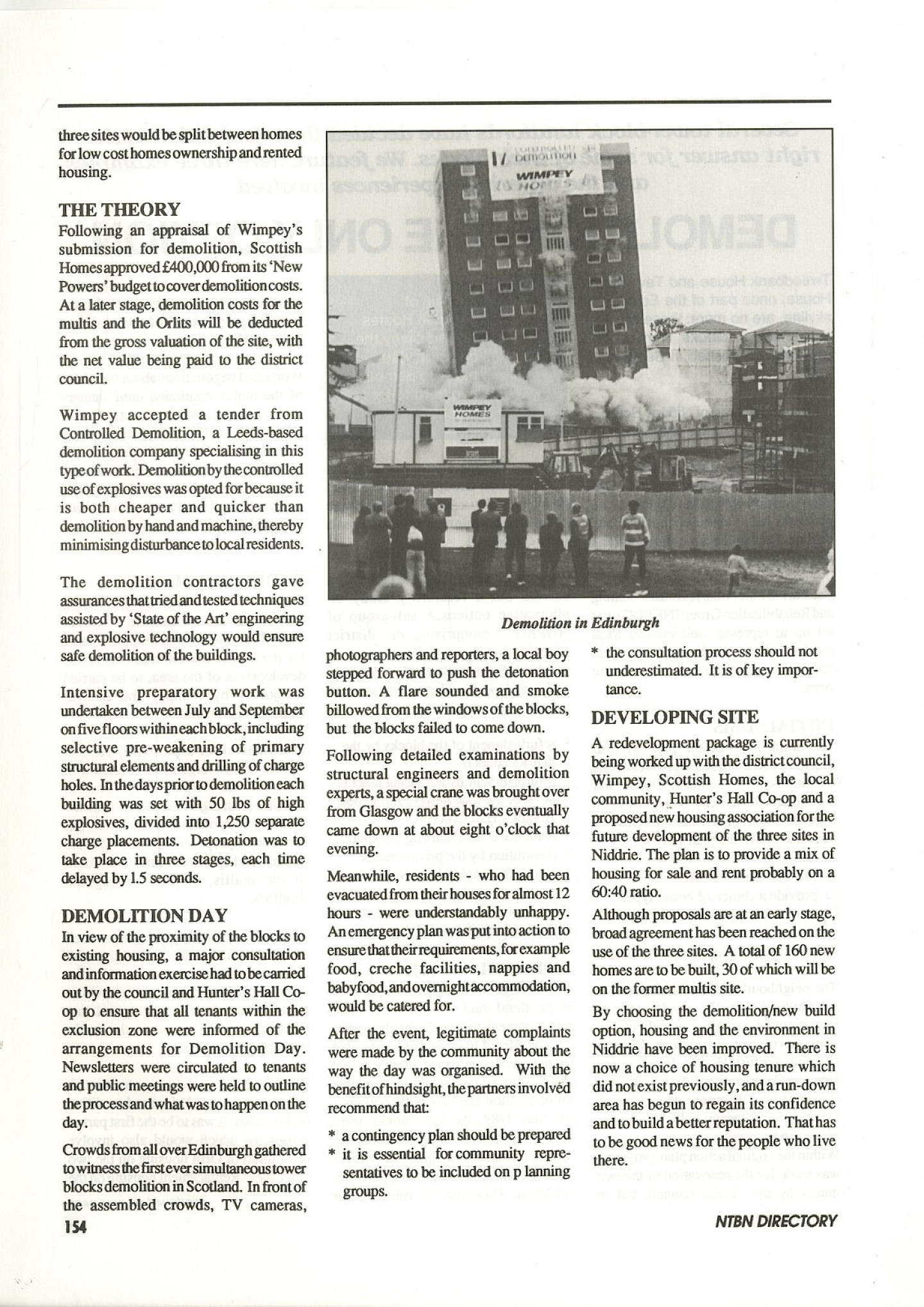
Crowds from all over Edinburgh gathered
to witness the first ever simultaneous tower
blocks demolition in Scotland. In front of
the assembled crowds, TV cameras,
[caption: Demolition in Edinburgh]
photographers and reporters, a local boy
stepped forward to push the detonation
button. A flare sounded and smoke
billowed from the windows of the blocks,
but the blocks failed to come down.
Following detailed examinations by
structural engineers and demolition
experts, a special crane was brought over
from Glasgow and the blocks eventually
came down at about eight o’clock that
evening.
Meanwhile, residents - who had been
evacuated from their houses for almost 12
hours - were understandably unhappy.
An emergency plan was put into action to
ensure that their requirements, for example
food, creche facilities, nappies and
babyfood, and overnight accommodation,
would be catered for.
After the event, legitimate complaints
were made by the community about the
way the day was organised. With the
benefit of hindsight, the partners involved
recommend that:
* a contingency plan should be prepared
* it is essential for community repre-
sentatives to be included on planning
groups.
* the consultation process should not
be underestimated. It is of key impor-
tance.
DEVELOPING SITE
A redevelopment package is currently
being worked up with the district council,
Wimpey, Scottish Homes, the local
community, Hunter's Hall Co-op and a
proposed new housing association for the
future development of the three sites in
Niddrie. The plan is to provide a mix of
housing for sale and rent probably on a
60:40 ratio.
Although proposals are at an early stage,
broad agreement has been reached on the
use of the three sites. A total of 160 new
homes are to be built, 30 of which will be
on the former multis site.
By choosing the demolition/new build
option, housing and the environment in
Niddrie have been improved. There is
now a choice of housing tenure which
did not exist previously, and a run-down
area has begun to regain its confidence
and to build a better reputation. That has
to be good news for the people who live
there.
154
NTBN DIRECTORY