National Tower Blocks Directory 1992
KILLER DUST CAMPAIGN
The use of asbestos is banned in
buildings today but asbestos fibres
take a long time to kill. A woman who
had worked at Cape's asbestos
factory in Barking for less than a year
in 1927 died in 1978.
A witness at the inquest into her death,
pathologist Professor Keith Simpson, told
the coroner: ‘I have known people who
only worked in the factory for an afternoon
to suffer the disease.’ (Guardian 12 May
1978 ‘Asbestos dust took 51 years to
kill’.).
In Winterton House and Gelston Point, in
the London Borough of Tower Hamlets,
virtually every single internal wall surface
in the flats is made of asbestos sheet. The
tenants have fought a long campaign to be
rehoused from the blocks.
Lobbying the council failed to get the
results they wanted and the tenants decided
to intensify the campaign and sought
advice to back up their claims.
Here are just some of the startling points
in a survey of the blocks by an independent
consultant:
“The presence of asbestos in the two
blocks poses a major health hazard, not
only to the people who still live in them
but everyone who lived in them in the
past.
"Those with most to lose are children who
are still living in the blocks. In some cases
very young children will have been
exposed to asbestos dust 24 hours a day,
7 days a week”.
LICENCE TO KILL?
Over 200 tenants from Gelston Point and
Winterton House marched on their town
hall in April, 1991, to press their demands
for the evacuation of the blocks. The
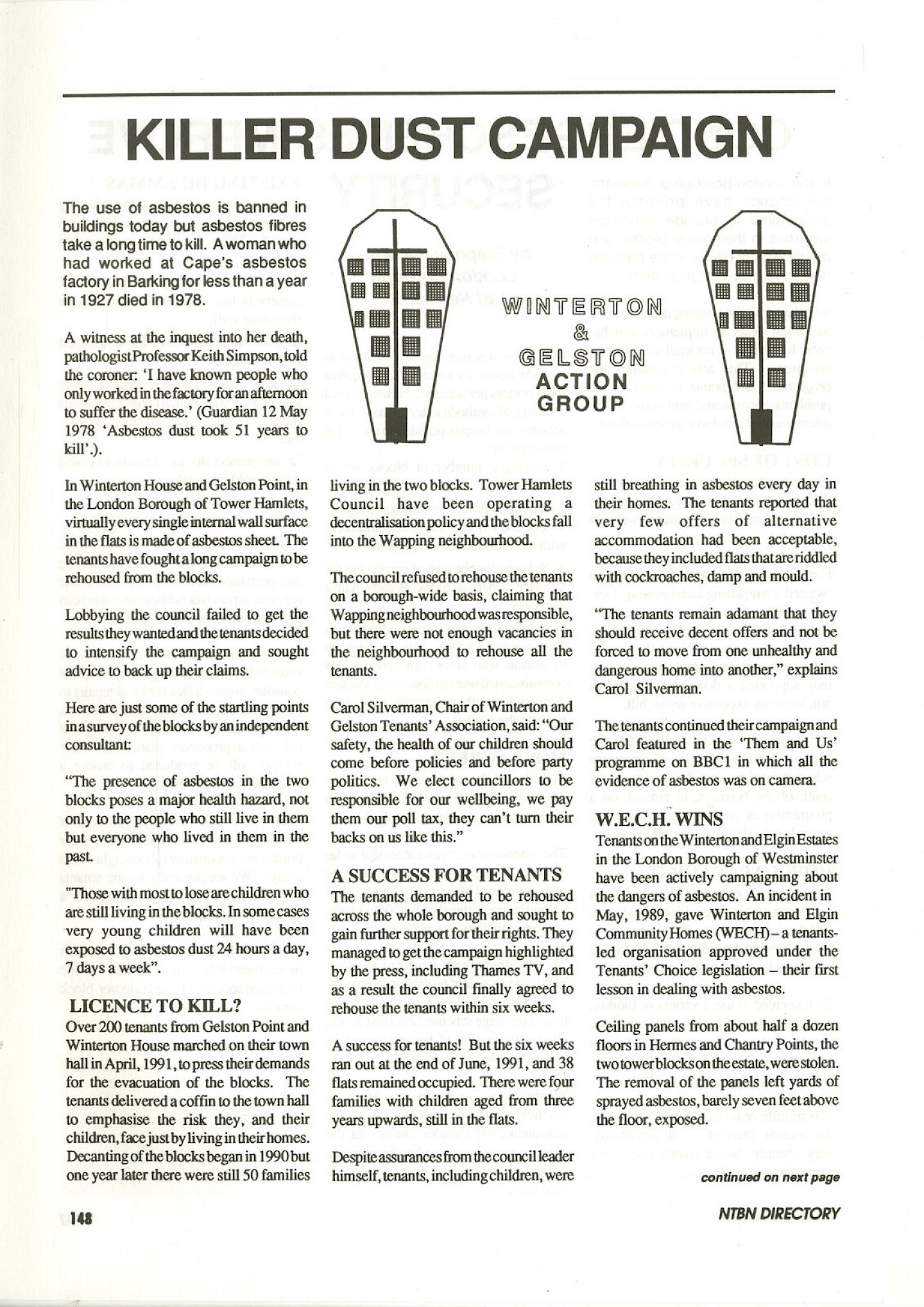
tenants delivered a coffin to the town hall
to emphasise the risk they, and their
children, face just by living in their homes.
Decanting of the blocks began in 1990 but
one year later there were still 50 families
[caption: Two coffins shaped like tower blocks representing Winterton and Gelston]
WINTERTON
&
GELSTON
ACTION
GROUP
living in the two blocks. Tower Hamlets
Council have been operating a
decentralisation policy and the blocks fall
into the Wapping neighbourhood.
The council refused to rehouse the tenants
on a borough-wide basis, claiming that
Wapping neighbourhood was responsible,
but there were not enough vacancies in
the neighbourhood to rehouse all the
tenants.
Carol Silverman, Chair of Winterton and
Gelston Tenants’ Association, said: “Our
safety, the health of our children should
come before policies and before party
politics. We elect councillors to be
responsible for our wellbeing, we pay
them our poll tax, they can’t turn their
backs on us like this.”
A SUCCESS FOR TENANTS
The tenants demanded to be rehoused
across the whole borough and sought to
gain further support for their rights. They
managed to get the campaign highlighted
by the press, including Thames TV, and
as a result the council finally agreed to
rehouse the tenants within six weeks.
A success for tenants! But the six weeks
ran out at the end of June, 1991, and 38
flats remained occupied. There were four
families with children aged from three
years upwards, still in the flats.
Despite assurances from the council leader
himself, tenants, including children, were
still breathing in asbestos every day in
their homes. The tenants reported that
very few offers of alternative
accommodation had been acceptable,
because they included flats that are riddled
with cockroaches, damp and mould.
“The tenants remain adamant that they
should receive decent offers and not be
forced to move from one unhealthy and
dangerous home into another,” explains
Carol Silverman.
The tenants continued their campaign and
Carol featured in the 'Them and Us'
programme on BBC1 in which all the
evidence of asbestos was on camera.
W.E.C.H. WINS
Tenants on the Winterton and Elgin Estates
in the London Borough of Westminster
have been actively campaigning about
the dangers of asbestos. An incident in
May, 1989, gave Winterton and Elgin
Community Homes (WECH) – a tenants-
led organisation approved under the
Tenants' Choice legislation – their first
lesson in dealing with asbestos.
Ceiling panels from about half a dozen
floors in Hermes and Chantry Points, the
two tower blocks on the estate, were stolen.
The removal of the panels left yards of
sprayed asbestos, barely seven feet above
the floor, exposed.
continued on next page
148
NTBN DIRECTORY