National Tower Blocks Directory 1992
SAFETY AND SECURITY IN TOWER
BLOCKS - WHAT IS THE BEST
APPROACH?
JOHN FARR of S.N.U.
outlines the options
One of the jobs of the Safe
Neighbourhood Unit (SNU) is advising
local authorities and residents’ groups
about how best to improve the
management and security of their estates.
There are currently two approaches to
problem; the first approach may be called
the ‘design and layout’ approach.
For example, one way of reducing the
problems in blocks with long internal
corridors might be to divide the corridors
into separate sections each with their
own means of access.
The assumption is that the small so called
‘neighbourhood groups’ created are
more neighbourly, more cohesive and
more able to control anti-social behaviour
from within the groups or from intruders.
TELEVISION MONITORS
The second approach is where these
kind of changes are not possible and
where it is necessary to introduce staff
into the block. Often the expense of
staffing blocks with security guards, or
receptionists or concierges, and the
associated hi-tech security, is justified
by its proponents on the presumed
savings brought about by increased
security.
A relatively recent development of this
second approach is what have been
termed ‘dispersed concierge schemes’.
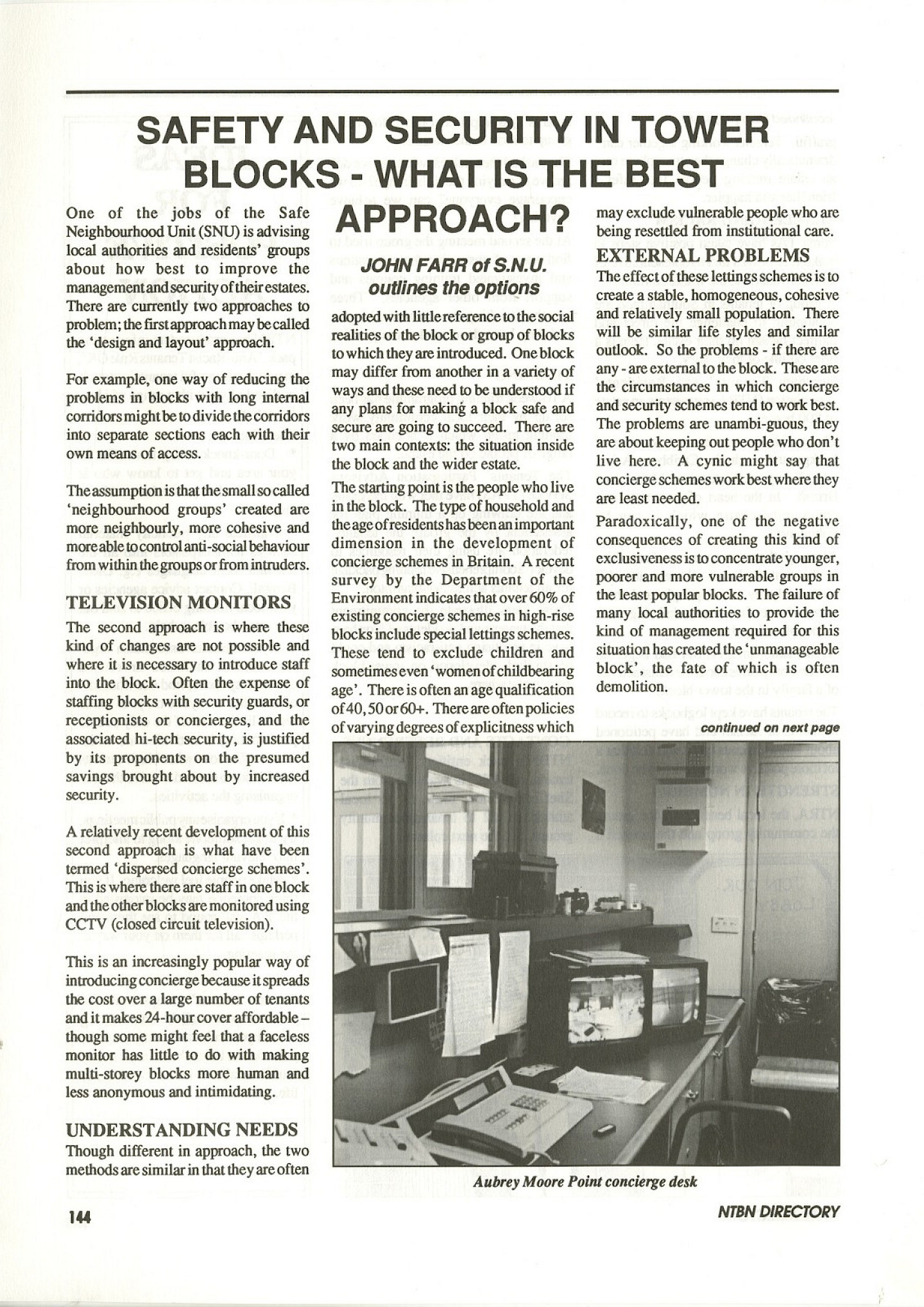
This is where there are staff in one block
and the other blocks are monitored using
CCTV (closed circuit television).
This is an increasingly popular way of
introducing concierge because it spreads
the cost over a large number of tenants
and it makes 24-hour cover affordable –
though some might feel that a faceless
monitor has little to do with making
multi-storey blocks more human and
less anonymous and intimidating.
UNDERSTANDING NEEDS
Though different in approach, the two
methods are similar in that they are often
adopted with little reference to the social
realities of the block or group of blocks
to which they are introduced. One block
may differ from another in a variety of
ways and these need to be understood if
any plans for making a block safe and
secure are going to succeed. There are
two main contexts: the situation inside
the block and the wider estate.
The starting point is the people who live
in the block. The type of household and
the age of residents has been an important
dimension in the development of
concierge schemes in Britain. A recent
survey by the Department of the
Environment indicates that over 60% of
existing concierge schemes in high-rise
blocks include special lettings schemes.
These tend to exclude children and
sometimes even ‘women of childbearing
age’. There is often an age qualification
of 40, 50 or 60+. There are often policies
of varying degrees of explicitness which
may exclude vulnerable people who are
being resettled from institutional care.
EXTERNAL PROBLEMS
The effect of these lettings schemes is to
create a stable, homogeneous, cohesive
and relatively small population. There
will be similar life styles and similar
outlook. So the problems - if there are
any - are external to the block. These are
the circumstances in which concierge
and security schemes tend to work best.
The problems are unambi-guous, they
are about keeping people who don't
live here. A cynic might say that
concierge schemes work best where they
are least needed.
Paradoxically, one of the negative
consequences of creating this kind of
exclusiveness is to concentrate younger,
poorer and more vulnerable groups in
the least popular blocks. The failure of
many local authorities to provide the
kind of management required for this
situation has created the ‘unmanageable
block’, the fate of which is often
demolition.
continued on next page
[caption: Aubrey Moore Point concierge desk]
144
NTBN DIRECTORY