National Tower Blocks Directory 1992
BLOCKED
People with disabilities are
frequently discriminated against
without able-bodied people
even realising it.
How many tower-block entrances
have steps? How many lift-control
and entry-phone panels can be
reached from a wheelchair?
How many community centres or
local housing offices or town halls
are fully accessible?
TENANTS WONDER WHY
Tenants all over the country have
wondered aloud what the architects
who designed their tower-block
homes had in mind. In so many
aspects they are inappropriate to
the needs of their tenants.
People with disabilities do live in
tower blocks, people with
disabilities do visit people who live
in tower blocks.
People with disabilities do want to
play an active part in their local
communities, they want to attend
TA meetings, they want to go to the
housing office and the council
meetings.
But the barriers are everywhere.
Tenants have waged long and
ardous individual campaigns for
improve-ments, such as ramps up
to the front entrance of their blocks.
Local groups, made up of such
individuals, have been formed to
campaign on the wider issue of
access for all within our community.
One such group is Action and
Rights of Disabled People in
Newham. The group was formed
11 years ago and has been
enormously successful in bringing
the access issue to everyone's
attention.
Newham's Town Hall wasn't
accessible to disabled people, who
could not attend council meetings in
the council chamber. For many long,
cold months members of Action and
Rights sat at the bottom of the stairs
while a range of council meetings
took place.
They were there when councillors
went in to the committee meetings
and they were there when they came
out. It was not possible for councillors
to ignore their message.
Success for their campaign came
with the council's decision to make
East Ham Town Hall and the
surrounding area accessible. A range
of alterations was made, including
installing and building ramps.
The group now underake regular
monitoring of all planning applications
for access and they submit their
comments to Newham Council's
Environment and Planning
Committee.
AVOIDING COSTLY ERRORS
It is their belief that it is at the planning
and design stage that access and the
needs of people with disabilities
should be addressed, if costly errors
and costly alterations are to be
avoided.
Once again improvements that benefit
people with disabilities are of benefit
to the whole community.
Ramps up steps are of benefit to
people with children in pushchairs
and prams, to people moving heavy
objects, such as furniture in and out of
the blocks and to elderly people whose
agility is reduced.
Lift and entry-phone control panels
that can be reached from a
wheelchair may also be able to be
reached by children living in the
block, who otherwise might have
to ask people, often strangers, to
help them.
The issue of access is clearly one
which affects most of our
institutions and buildings. People
with disabilities cannot even attend
tenants' or residents' association
meetings to get the issues
considered if they can't get in.
FIRST STEP
They may also feel it inappropriate
to join a group which appears to be
oblivious or unconcerned about
such barriers.
A positive and essential first step is
therefore to ensure that your
buildings and meeting rooms are
accessible.
Then disabled people will be able
to identify the aspects of the tower
blocks and of the estates in general
which need to be addressed if they
are to participate effectively in the
life of the community.
Then these issues too can start to
be progressed by the tenants' asso-
ciation, a truly representative
group.
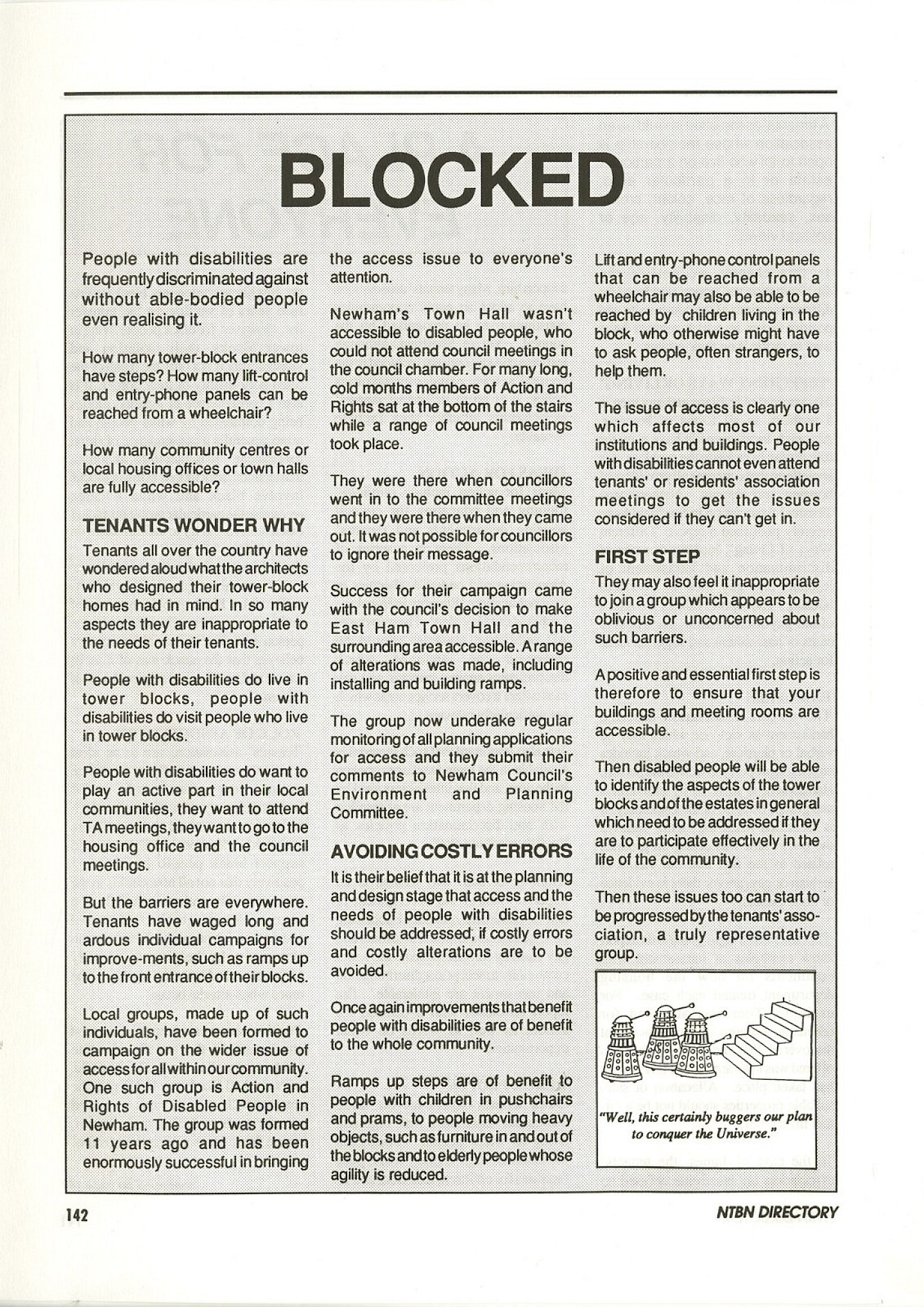
[caption: "Well, this certainly buggers our plan
to conquer the Universe."]
142
NTBN DIRECTORY