National Tower Blocks Directory 1992
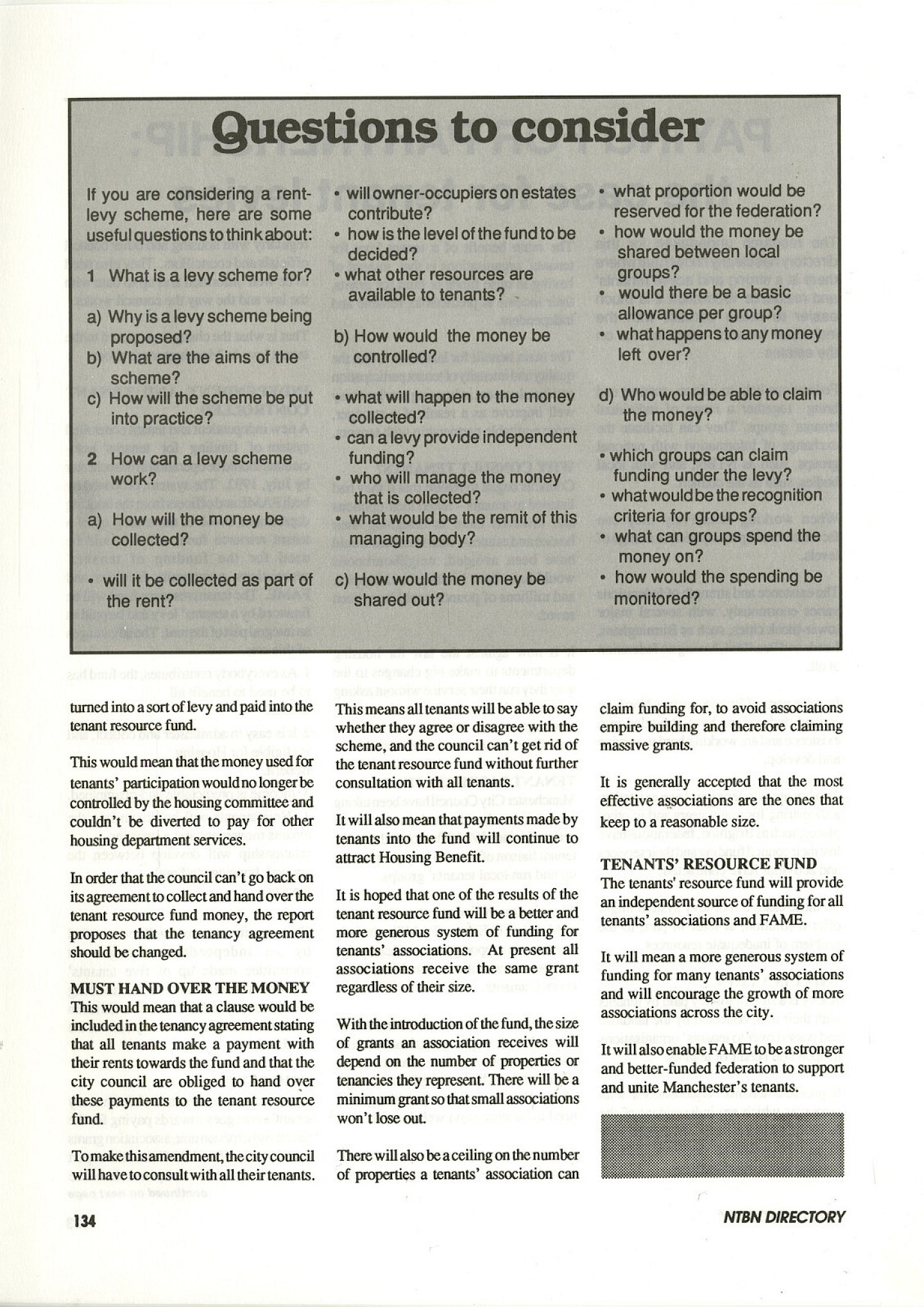
Questions to consider
If you are considering a rent-levy scheme, here are some useful questions to think about:
1 What is a levy scheme for?
a) Why is a levy scheme being proposed?
b) What are the aims of the scheme?
c) How will the scheme be put into practice?
2 How can a levy scheme work?
a) How will the money be collected?
• will it be collected as part of the rent?
• will owner-occupiers on estates contribute?
• how is the level of the fund to be decided?
• what other resources are available to tenants?
b) How would the money be controlled?
• what will happen to the money collected?
• can a levy provide independent funding?
• who will manage the money that is collected?
• what would be the remit of this managing body?
c) How would the money be shared out?
• what proportion would be reserved for the federation?
• how would the money be shared between local groups?
• would there be a basic allowance per group?
• what happens to any money left over?
d) Who would be able to claim the money?
• which groups can claim funding under the levy?
• what would be the recognition criteria for groups?
• what can groups spend the money on?
• how would the spending be monitored?
turned into a sort of levy and paid into the tenant resource fund.
This would mean that the money used for tenants' participation would no longer be controlled by the housing committee and couldn't be diverted to pay for other housing department services.
In order that the council can't go back on its agreement to collect and hand over the tenant resource fund money, the report proposes that the tenancy agreement should be changed.
MUST HAND OVER THE MONEY
This would mean that a clause would be included in the tenancy agreement stating that all tenants make a payment with their rents towards the fund and that the city council are obliged to hand over these payments to the tenant resource fund.
To make this amendment, the city council will have to consult with all their tenants.
This means all tenants will be able to say whether they agree or disagree with the scheme, and the council can't get rid of the tenant resource fund without further consultation with all tenants.
It will also mean that payments made by tenants into the fund will continue to attract Housing Benefit.
It is hoped that one of the results of the tenant resource fund will be a better and more generous system of funding for tenants' associations. At present all associations receive the same grant regardless of their size.
With the introduction of the fund, the size of grants an association receives will depend on the number of properties or tenancies they represent. There will be a minimum grant so that small associations won't lose out.
There will also be a ceiling on the number of properties a tenants' association can claim funding for, to avoid associations empire building and therefore claiming massive grants.
It is generally accepted that the most effective associations are the ones that keep to a reasonable size.
TENANTS' RESOURCE FUND
The tenants' resource fund will provide an independent source of funding for all tenants' associations and FAME.
It will mean a more generous system of funding for many tenants' associations and will encourage the growth of more associations across the city.
It will also enable FAME to be a stronger and better-funded federation to support and unite Manchester's tenants.
134
NTBN DIRECTORY