National Tower Blocks Directory 1992
continued from previous page
agreements than the council are able to offer. The problems which will be highlighted, by tower-block tenants especially, often require major refurbishment and repair because of the nature and structure of blocks.
Other issues concerning the maagement of the blocks are more easily remedied and could improve the day-to-day living of tenants.
Estate Agreements could be wholly successful if the resources, especially the funding, were adequate to solve the problems highlighted by tenants in blocks.
Nonetheless the agreements are a clear contract between the council and tenants as to what each can expect or provide.
Drawing up an estate agreement can help strengthen a flagging or weak tenants' association. The agreements are an important development in both tenant consultation and housing management.
However, all involved felt that the real test will be whether the council can deliver the level and quality of services agreed for each estate.
Housing associations: meeting the challenge
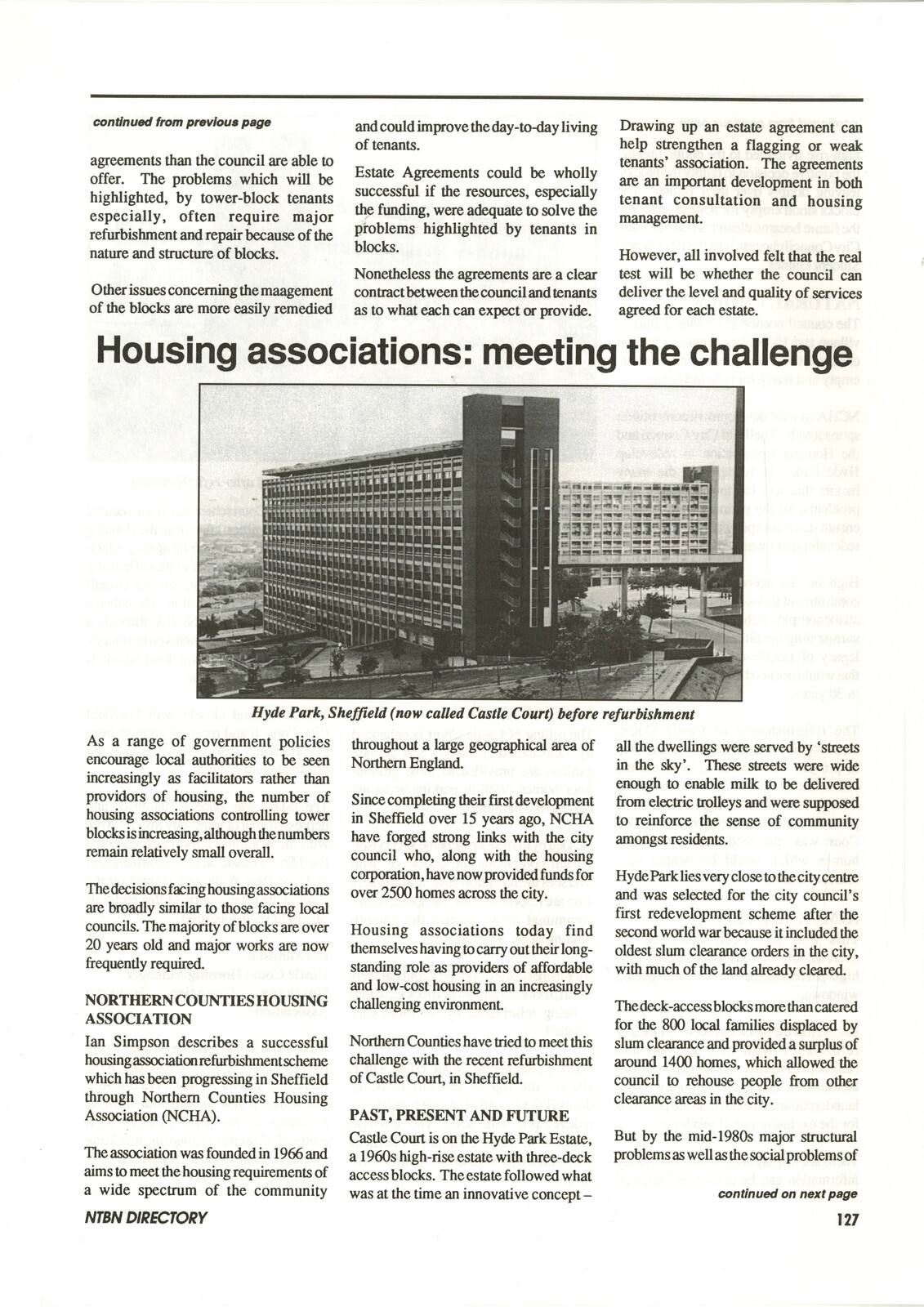
[caption: Hyde Park, Sheffield (now called Castle Court) before refurbishment]
As a range of government policies encourage local authorities to be seen increasingly as facilitators rather than providors of housing, the number of housing associations controlling tower blocks is increasing, although the numbers remain relatively small overall.
The decisions facing housing associations are broadly similar to those facing local councils. The majority of blocks are over 20 years old and major works are now frequently required.
NORTHERN COUNTIES HOUSING ASSOCIATION
Ian Simpson describes a successful housing association refurbishment scheme which has been progressing in Sheffield through Northern Counties Housing Association (NCHA).
The association was founded in 1966 and aims to meet the housing requirements of a wide spectrum of the community throughout a large geographical area of Northern England.
Since completing their first development in Sheffield over 15 years ago, NCHA have forged strong links with the city council who, along with the housing corporation, have now provided funds for over 2500 homes across the city.
Housing associations today find themselves having to carry out their long-standing role as providers of affordable and low-cost housing in an increasingly challenging environment.
Northern Counties have tried to meet this challenge with the recent refurbishment of Castle Court, in Sheffield.
PAST, PRESENT AND FUTURE
Castle Court is on the Hyde Park Estate, a 1960s high-rise estate with three-deck access blocks. The estate followed what was at the time an innovative concept – all the dwellings were served by ‘streets in the sky’. These streets were wide enough to enable milk to be delivered from electric trolleys and were supposed to reinforce the sense of community amongst residents.
Hyde Park lies very close to the city centre and was selected for the city council’s first redevelopment scheme after the second world war because it included the oldest slum clearance orders in the city, with much of the land already cleared.
The deck-access blocks more than catered for the 800 local families displaced by slum clearance and provided a surplus of around 1400 homes, which allowed the council to rehouse people from other clearance areas in the city.
But by the mid-1980s major structural problems as well as the social problems of
continued on next page
NTBN DIRECTORY 127