National Tower Blocks Directory 1992
its blocks. However, research has
recently been completed into the
needs of single parents which may
lead to some services or facilities
being introduced. The authority report
that their relationship with their tenants
is a fair one and they take part in
regular consultation with tenants'
organisations.
The number of tenants' and residents'
associations in Wolverhampton has
more than doubled in the past few
years to 51. More than half of these
are affiliated to the Woverhampton
Federation of Tenants' Associations
(WFTA). WFTA has representatives
on the housing services committee
and the housing management sub-
committee.
HAFLBE
WORCESTER
Worcester City Council, Farrier
House, Farrier Street, Worcester,
WR1 3ES. Tel: 0905 723471.
Contact: Peter John.
Worcester City Council own three
tower blocks, all of 6 to 12 storeys.
The blocks contain 149 flats and
represent 2.5% of the total council
stock. No blocks have been de-
molished and none has been trans-
ferred to other owners. All three blocks
provide sheltered accommodation for
the elderly and have a resident
warden.
The aspect of their tower-block stock
which gives the authority most cause
for concern is a difficulty in letting flats
on the higher floors. They also fear
that the obsolescence of lifts will be a
problem in the next three to five years.
The authority report that the flats are
in good condition structurally,
although there has been some water
penetration through the rooves.
Capital works are underway to deal
with this problem. When the flats were
designated as sheltered schemes,
security was upgraded and com-
munity facilities provided. Households
with small children are not offered
tower-block homes. This policy has
changed in the last ten years - when
the blocks became sheltered. There-
fore, there are not substantial numbers
of children living in the blocks.
The authority consider their rela-
tionship with their tenants to be a
good one and they take part in regular
consultation with tenants' organi-
sations. There is regular contact
through established residents' groups
in the sheltered-housing blocks.
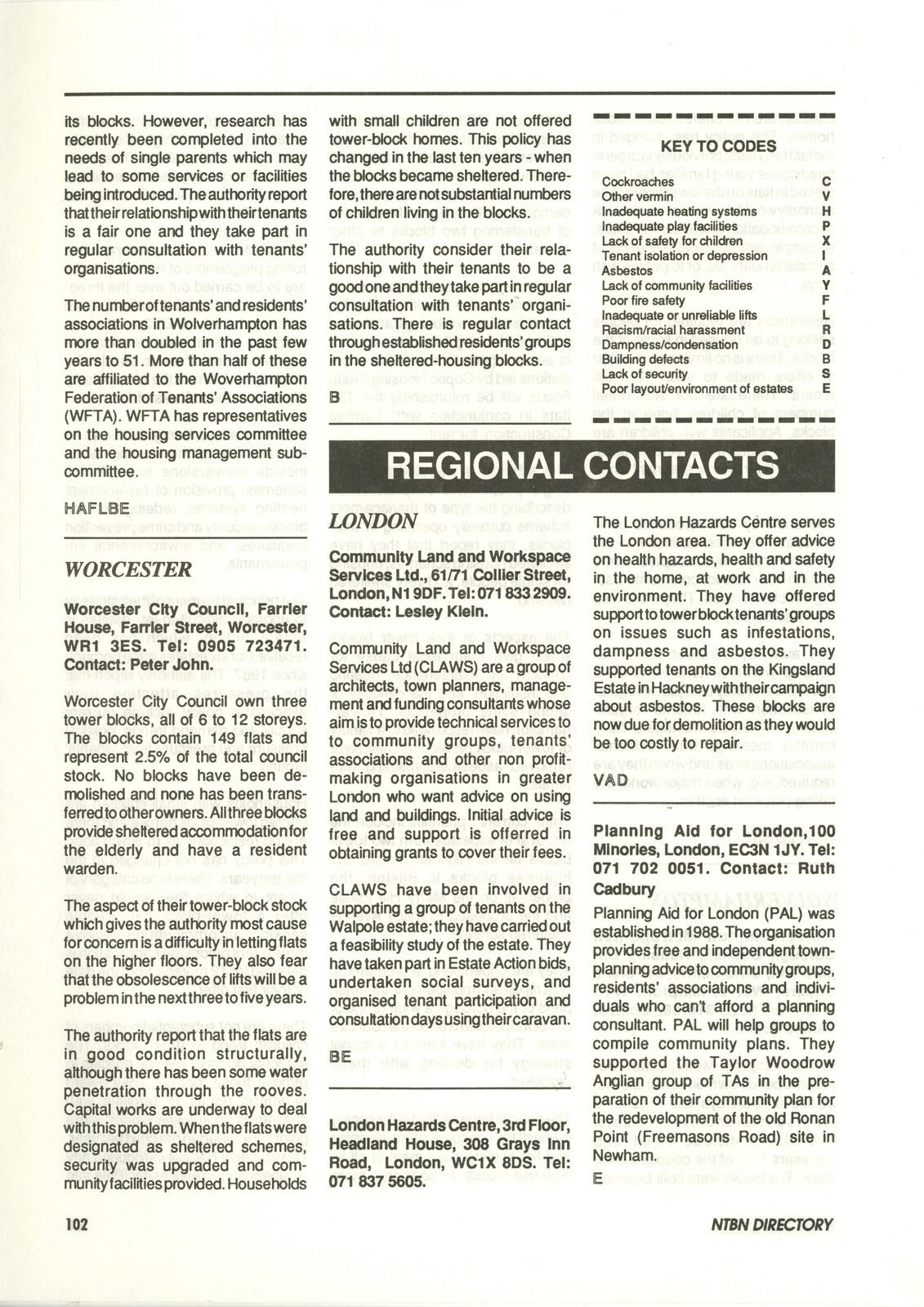
KEY TO CODES
Cockroaches C
Other vermin V
Inadequate heating systems H
Inadequate play facilities P
Lack of safety for children X
Tenant isolation or depression I
Asbestos A
Lack of community facilities Y
Poor fire safety F
Inadequate or unreliable lifts L
Racism/racial harassment R
Dampness/condensation D
Building defects B
Lack of security S
Poor layout/environment of estates E
REGIONAL CONTACTS
LONDON
Community Land and Workspace
Services Ltd, 61/71 Collier Street,
London, N1 9DF. Tel: 071 833 2909.
Contact: Lesley Klein.
Community Land and Workspace
Services Ltd (CLAWS) are a group of
architects, town planners, manage-
ment and funding consultants whose
aim is to provide technical services to
community groups, tenants'
associations and other non profit-
making organisations in greater
London who want advice on using
land and buildings. Initial advice is
free and support is offered in
obtaining grants to cover their fees.
CLAWS have been involved in
supporting a group of tenants on the
Walpole estate; they have carried out
a feasibility study of the estate. They
have taken part in Estate Action bids,
undertaken social surveys, and
organised tenant participation and
consultation days using their caravan.
London Hazards Centre, 3rd Floor,
Headland House, 308 Grays Inn
Road, London, WC1X 8DS. Tel:
071 837 5605.
The London Hazards Centre serves
the London area. They offer advice
on health hazards, health and safety
in the home, at work and in the
environment. They have offered
support to tower block tenants' groups
on issues such as infestations,
dampness and asbestos. They
supported tenants on the Kingsland
Estate in Hackney with their campaign
about asbestos. These blocks are
now due for demolition as they would
be too costly to repair.
Planning Aid for London, 100
Minories, London, EC3N 1JY. Tel:
071 702 0051. Contact: Ruth
Cadbury
Planning Aid for London (PAL) was
established in 1988. The organisation
provides free and independent town-
planning advice to community groups,
residents' associations and indivi-
duals who can't afford a planning
consultant. PAL will help groups to
compile community plans. They
supported the Taylor Woodrow
Anglian group of TAs in the pre-
paration of their community plan for
the redevelopment of the old Ronan
Point (Freemasons Road) site in
Newham.
102
NTBN DIRECTORY