National Tower Blocks Directory 1987
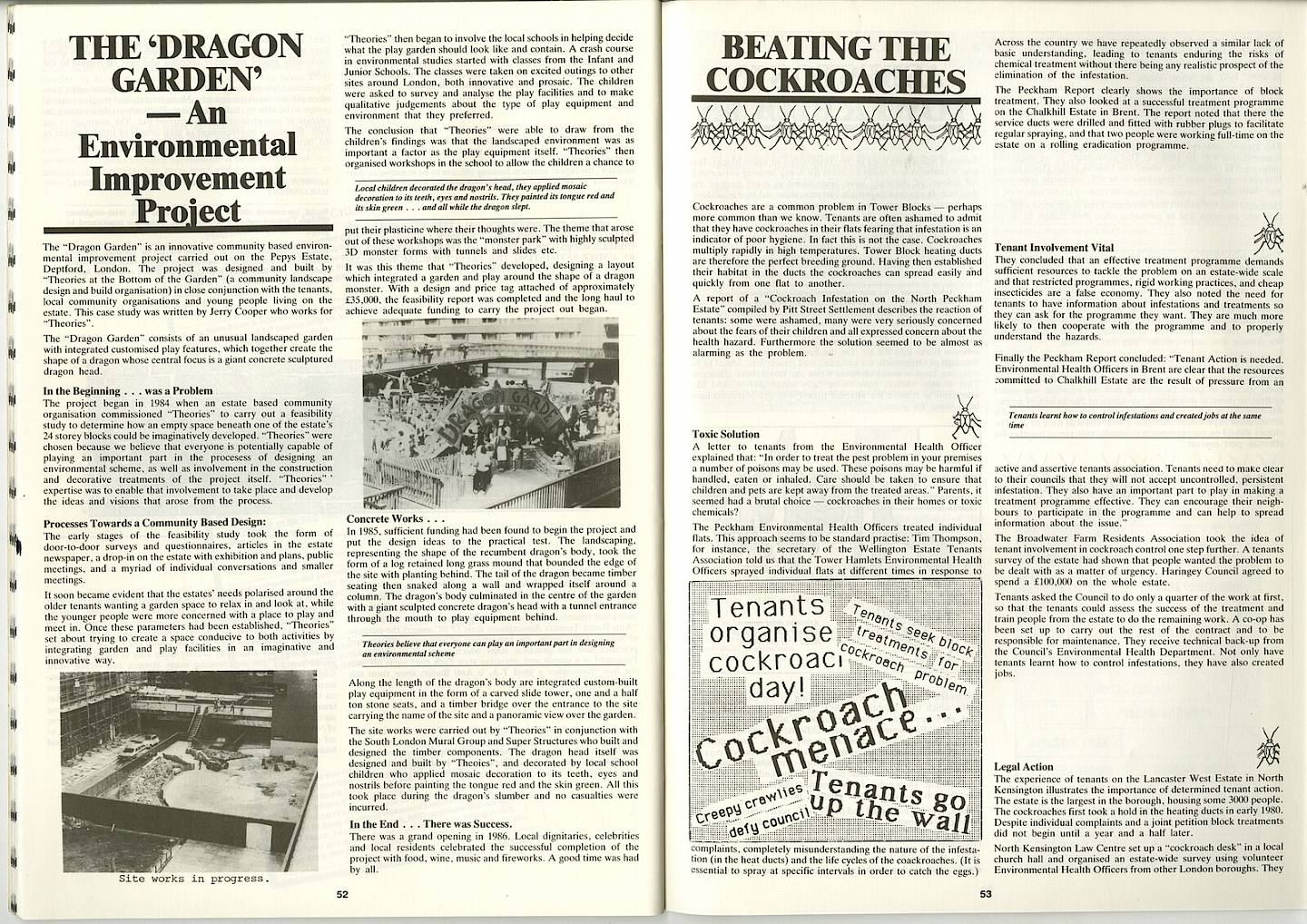
THE ‘DRAGON GARDEN’
— An
Environmental
Improvement
Project
The “Dragon Garden” is an innovative community based environmental improvement project carried out on the Pepys Estate, Deptford, London. The project was designed and built by “Theories at the Bottom of the Garden” (a community landscape design and build organisation) in close conjunction with the tenants, local community organisations and young people living on the estate. This case study was written by Jerry Cooper who works for “Theories”.
The “Dragon Garden” consists of an unusual landscaped garden with integrated customised play features, which together create the shape of a dragon whose central focus is a giant concrete sculptured dragon head.
In the Beginning . . . was a Problem
The project began in 1984 when an estate based community organisation commissioned “Theories” to carry out a feasibility study to determine how an empty space beneath one of the estate’s 24 storey blocks could be imaginatively developed. “Theories” were chosen because we believe that everyone is potentially capable of playing an important part in the process of designing an environmental scheme, as well as involvement in the construction and decorative treatments of the project itself. “Theories” expertise was to enable that involvement to take place and develop the ideas and visions that arose from the process.
Processes Towards a Community Based Design:
The early stages of the feasibility study took the form of door-to-door surveys and questionnaires, articles in the estate newspaper, a drop-in on the estate with exhibition and plans, public meetings, and a myriad of individual conversations and smaller meetings.
It soon became evident that the estates’ needs polarised around the older tenants wanting a garden space to relax in and look at, while the younger people were more concerned with a place to play and meet in. Once these parameters had been established, “Theories” set about trying to create a space conducive to both activities by integrating garden and play facilities in an imaginative and innovative way.
“Theories” then began to involve the local schools in helping decide what the play garden should look like and contain. A crash course in environmental studies started with classes from the Infant and Junior Schools. The classes were taken on excited outings to other sites around London, both innovative and prosaic. The children were asked to survey and analyse the play facilities and to make qualitative judgements about the type of play equipment and environment that they preferred.
The conclusion that “Theories” were able to draw from the children’s findings was that the landscaped environment was as important a factor as the play equipment itself. “Theories” then organised workshops in the school to allow the children a chance to
[caption: Local children decorated the dragon’s head, they applied mosaic decoration to its teeth, eyes and nostrils. They painted its tongue red and its skin green . . . and all while the dragon slept.]
put their plastine where their thoughts were. The theme that arose of these workshops was the “monster park” with highly sculpted 3D monster forms with tunnels and slides etc.
It was this theme that “Theories” developed, designing a layout which integrated a garden and play around the shape of a dragon monster. With a design and price tag attached of approximately £35,000, the feasibility report was completed and the long haul to achieve adequate funding to carry the project out began.
[caption: Site works in progress.]
Concrete Works . . .
In 1985, sufficient funding had been found to begin the project and put the design ideas to the practical test. The landscaping, representing the shape of the recumbent dragon’s body, took the form of a log retained long grass mound that bounded the edge of the site with planting behind. The tail of the dragon became timber seating then snaked along a wall and wrapped itself around a column. The dragon’s body culminated in the centre of the garden with a giant sculpted concrete dragon’s head with a tunnel entrance through the mouth to play equipment behind.
[caption: Theories believe that everyone can play an important part in designing an environmental scheme]
Along the length of the dragon’s body are integrated custom-built play equipment in the form of a carved slide tower, one and a half ton stone seats, and a timber bridge over the entrance to the site carrying the name of the site and a panoramic view over the garden.
The site works were carried out by “Theories” in conjunction with the South London Mural Group and Super Structures who built and designed the timber components. The dragon head itself was designed and built by “Theories”, and decorated by local school children who applied mosaic decoration to its teeth, eyes and nostrils before painting the tongue red and the skin green. All this took place during the dragon’s slumber and no casualties were incurred.
In the End . . . There was Success.
There was a grand opening in 1986. Local dignitaries, celebrities and local residents celebrated the successful completion of the project with food, wine, music and fireworks. A good time was had by all.
BEATING THE COCKROACHES
Across the country we have repeatedly observed a similar lack of basic understanding, leading to tenants enduring the risks of chemical treatment without there being any realistic prospect of the elimination of the infestation.
The Peckham Report clearly shows the importance of block treatment. They also looked at a successful treatment programme on the Chalkhill Estate in Brent. The report noted that there the service ducts were drilled and fitted with rubber plugs to facilitate regular spraying, and that two people were working full-time on the estate on a rolling eradication programme.
Cockroaches are a common problem in Tower Blocks — perhaps more common than we know. Tenants are often ashamed to admit that they have cockroaches in their flats fearing that infestation is an indicator of poor hygiene. In fact this is not the case. Cockroaches multiply rapidly in high temperatures. Tower Block heating ducts are therefore the perfect breeding ground. Having then established their habitat in the ducts the cockroaches can spread easily and quickly from one flat to another.
A report of a “Cockroach Infestation on the North Peckham Estate” compiled by Pitt Street Settlement describes the reaction of tenants: some were ashamed, many were very seriously concerned about the fears of their children and all expressed concern about the health hazard. Furthermore the solution seemed to be almost as alarming as the problem.
[caption: Tenants learnt how to control infestations and created jobs at the same time]
Toxic Solution
A letter to tenants from the Environmental Health Officer explained that: “In order to treat the pest problem in your premises a number of poisons may be used. These poisons may be harmful if handled, eaten or inhaled. Care should be taken to ensure that children and pets are kept away from the treated areas.” Parents, it seemed had a brutal choice — cockroaches in their homes or toxic chemicals?
The Peckham Environmental Health Officers treated individual flats. This approach seems to be standard practise: Tim Thompson, for instance, the secretary of the Wellington Estate Tenants Association told us that the Tower Hamlets Environmental Health Officers sprayed individual flats at different times in response to
[image: A graphic titled: "Tenants organise cockroach day! Cockroach menace... Tenants seek block treatments for cockroach problem. Tenants go up the wall, Creepy crewlies defy council!"]
complaints, completely misunderstanding the nature of the infestation (in the heat ducts) and the life cycles of the cockroaches. (It is essential to spray at specific intervals in order to catch the eggs.)
Tenant Involvement Vital
They concluded that an effective treatment programme demands sufficient resources to tackle the problem on an estate-wide scale and that restricted programmes, rigid working practices, and cheap insecticides are a false economy. They also noted the need for tenants to have information about infestations and treatments so they can ask for the programme they want. They are much more likely to then cooperate with the programme and to properly understand the hazards.
Finally the Peckham Report concluded: “Tenant Action is needed. Environmental Health Officers in Brent are clear that the resources committed to Chalkhill Estate are the result of pressure from an active and assertive tenants association. Tenants need to make clear to their councils that they will not accept uncontrolled, persistent infestation. They also have an important part to play in making a treatment programme effective. They can encourage their neighbours to participate in the programme and can help to spread information about the issue.”
The Broadwater Farm Residents Association took the idea of tenant involvement in cockroach control one step further. A tenants survey of the estate had shown that people wanted the problem to be dealt with as a matter of urgency. Haringey Council agreed to spend a £100,000 on the whole estate.
Tenants asked the Council to do only a quarter of the work at first, so that the tenants could assess the success of the treatment and train people from the estate to do the remaining work. A co-op has been set up to carry out the rest of the contract and to be responsible for maintenance. They receive technical back-up from the Council’s Environmental Health Department. Not only have tenants learnt how to control infestations, they have also created jobs.
Legal Action
The experience of tenants on the Lancaster West Estate in North Kensington illustrates the importance of determined tenant action. The estate is the largest in the borough, housing some 3000 people. The cockroaches first took a hold in the heating ducts in early 1980. Despite individual complaints and a joint petition block treatments did not begin until a year and a half later.
North Kensington Law Centre set up a “cockroach desk” in a local church hall and organised an estate-wide survey using volunteer Environmental Health Officers from other London boroughs. They